You don’t grow - you die! Not growing and setting yourself up for growth is actually more risky than investing for growth!
Have a USP - unique sales proposition
What is the magic formula why a client will come to you and stay with you? What is your purpose ? Be chrystal clear about why someone will do business with you rather than anyone else If you don’t have this Your business will be taken away by someone who has this nailed
Make it scalable
You haven’t got a business if it revolves around you 16 hours a day - what you have done - is built yourself a job! the relationships needs to be woth the business - not the owner - So that the value does not end when they founder leaves the business.
Have an exit plan
Even if you don’t plan to Exit!
This means that you will plan to grow your business into a sellable asset that will have a significantly higher value - than if you don’t plan for an exit!
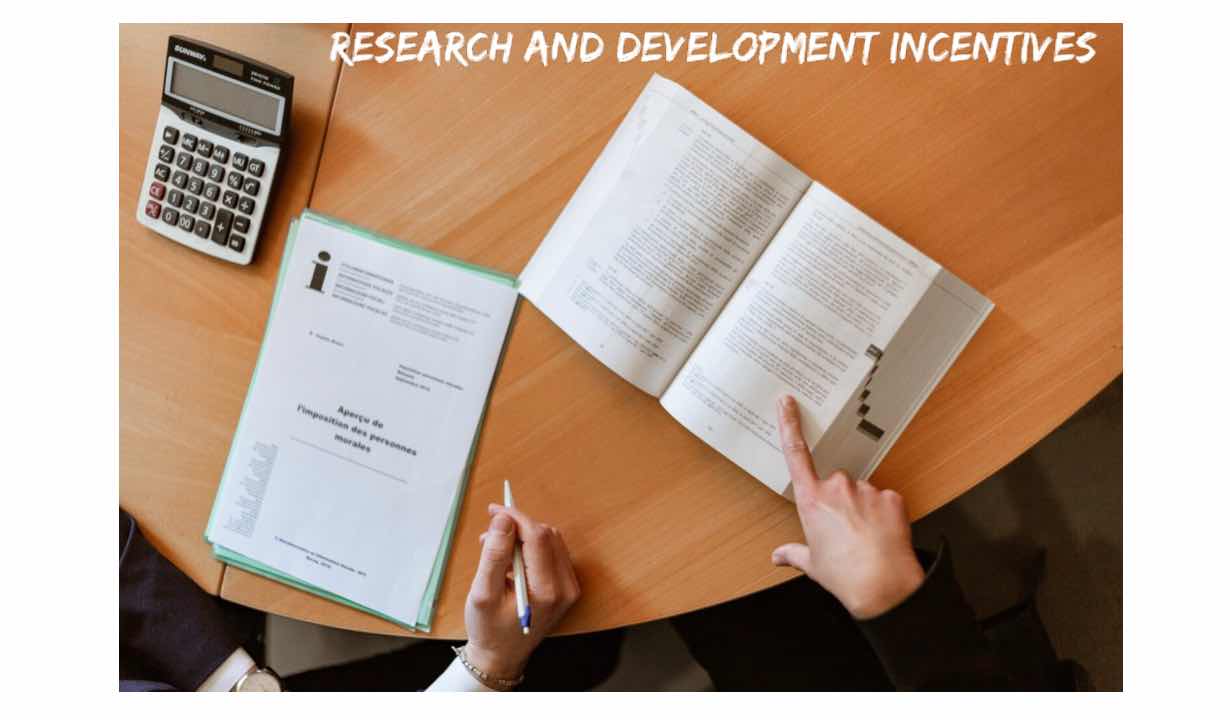
If you are looking to innovate and explore ways of doing new things - through Research and Development - the Government is there to support you through the RDTI (research and Development Tax Inventive)
There are however hoops to go through and paperwork and records to keep.
Mick Lynch - R&D Tax Specialist at BSI Innovation has said that the Research and Development Tax Incentive issues and audits - specifically as it relates to the aggressive and adversarial approach that it had to technology and software - seem to be stabilising
The turbulence that was
The Coalition was planning to make a $1.8 billion cut to the programme (which they have subsequently scrapped.)
In early 2017, software claims started to be reviewed following concerns advisory firms were encouraging companies to make claims that weren’t actually eligible. This led to a number of high-profile audits and clawbacks, with startup giant Airtasker ordered to pay back millions of dollars relating to RDTI claims in 2015 and 2016.
The programme is stabilising
While this dispute is ongoing, Airtasker is now accessing the RDTI again, with its last years financials showing $1m benefit over last few years!
Audits of companies are happenning - but seem to be fair and reasonable
Compliance with the programme is key - said Lynch , with organisations claiming needing to hold contemporaneous records of R&D projects and activity.
The view with Ausindustry is more of an educational approach than a crackdown approach.
Be sure to explore whether there is an advantage for a grant in your business!
Mick Lynch suggests to innovative companies that are doing or keen to do R&D projects to come forward and explore the opportunity.
Justin Wastnage founder of Vloggi is solving the problem of how to generate quality video content at scale and for minimal cost.
Video is poised to explode as the dominant vehicle for creating content to support brand messaging, and Vloggi is the best-placed platform in this space to capitalise on this save of video creation.
He raised $700k at a preseed valuation of $3.3m and is now looking at raising the next round!
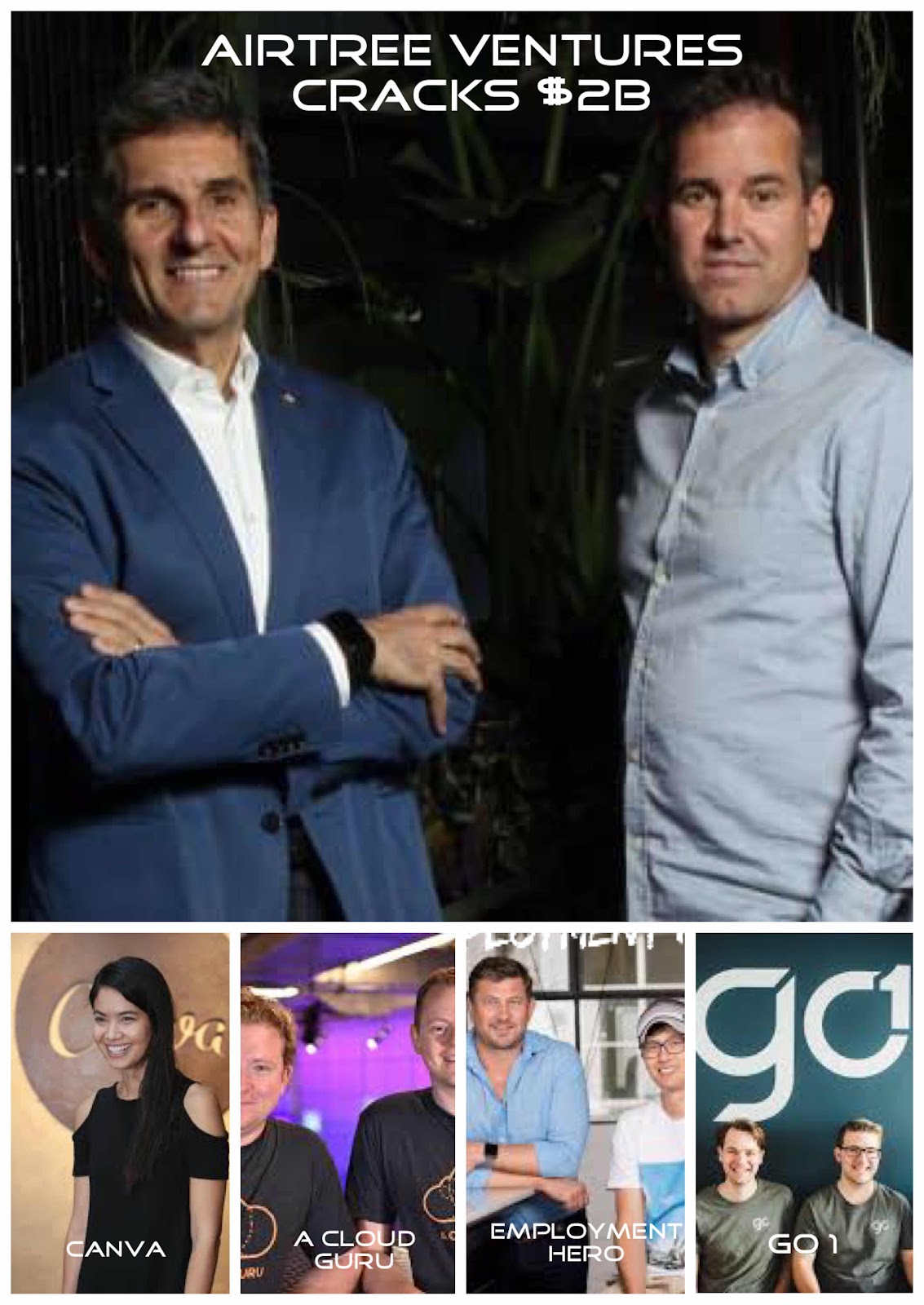
Craig Blair and Daniel Petre’s AirTree’s portfolio has grown from $60m to a whopping $2 billion!
AirTree has invested in a host of companies, including Canva, GO1, A Cloud Guru and Employment Hero, which have grown to the extent its holdings are now valued above $2 billion.
Classic comment from Craig Blair!
“Breakout successes including the sales of Afterpay for $39 billion and A Cloud Guru for $2 billion has enabled the VC sector to go from a small outback village, to now being like a large country town,” Mr Blair said.
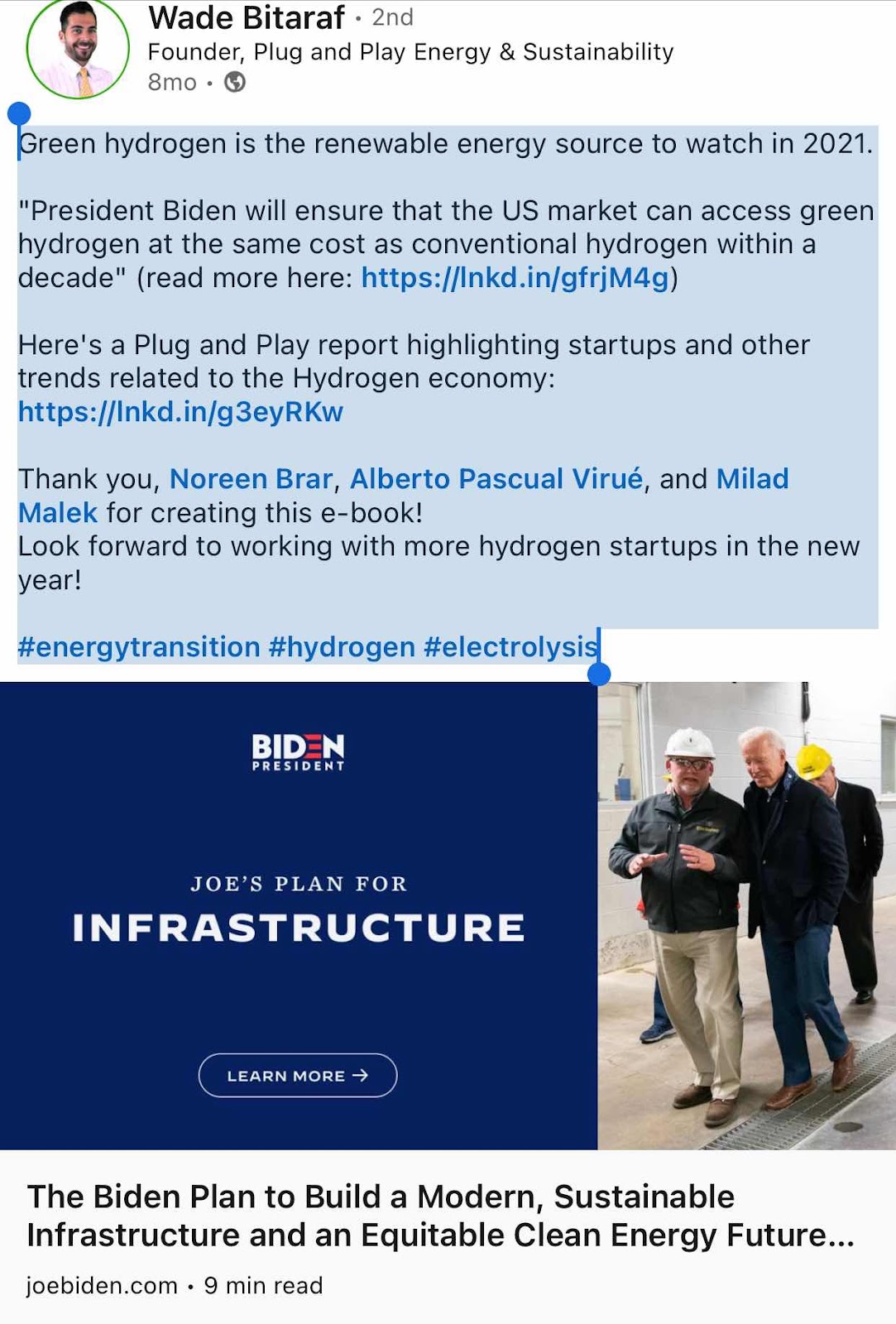
Green hydrogen is the renewable energy source to watch in 2021.
"President Biden will ensure that the US market can access green hydrogen at the same cost as conventional hydrogen within a decade" (read more here: https://lnkd.in/gfrjM4g)
Here's a Plug and Play report highlighting startups and other trends related to the Hydrogen economy:
https://lnkd.in/g3eyRKw
Thank you, Noreen Brar, Alberto Pascual Virué, and Milad Malek for creating this e-book!
Look forward to working with more hydrogen startups in the new year!
(Bloomberg) -- Venture capitalist Chris Sacca is launching four climate tech funds worth about $800 million in total through his new firm Lowercarbon Capital LLC
Sacca says “Let’s fund the unfundable, What’s the stuff where the business case isn’t there yet, but with relatively small dollars there might be a super high leverage opportunity?”
VC money flowing into climate tech startups has grown 40-fold between 2013 and 2019, from $400 million to $16 billion, according to a 2020 PwC report.
So who is Chris Sacca
Sacca made his name and lots of money with early bets on companies such as Twitter, Instagram, Uber, Stripe and Kickstarter. But in a surprise move in 2017, at the age of 42, Sacca walked away from traditional venture investing.
Sacca thinks climate tech is at a tipping point, especially because of the pace at which talented people are entering the space.
“Covid created this reflective moment and so did being drowned in fire smoke,” he says. “A lot of these folks are hearing from their kids: ‘Hey, what are you doing to save our future ?’”
The Saccas funds will be joined by more than 250 other limited partners. The smallest capital commitment is $15,000 and the largest they declined was for $150 million. The Limited Partners ( LPs ) include not just rich individuals, but also foundations, non-profits, universities and pension funds.
The Climate VC Model
“When you’re building a new social network, you spend a couple of years coding it all towards launch day. Then you put it out and no one cares,” he says. With climate tech companies, “we seed the science and we get to prototype. Then we find that first customer willing to pay for it, because what we’ve made is cheaper, better, faster, easier to use, more delicious or requires less maintenance. And we see that first incremental revenue faster.”
The Goal
Like other climate-tech VCs, Sacca wants his startups to reduce or remove emissions ideally at the scale of billions of tons each year. Many of Lowercarbon’s 50 investments to date—not all of which are public yet—have been for startups that remove carbon dioxide from the air using a variety of technologies.
Afterpay co-founder Anthony Eisen wants Australia to become the “head office for global tech companies” and compete with Silicon Valley and Tel Aviv, joining Atlassian boss Scott Farquhar and Tesla chair Robyn Denholm in a push to drive the fast-growing sector above one million jobs by 2025.
The nation’s leading tech companies – including Afterpay, Atlassian, Canva, Google Australia, Airtasker and Microsoft Australia – will launch Tech Council of Australia on Wednesday, bringing together tech moguls and start-up pioneers to position the country as a global hub.
With the industry already pumping $167bn into the economy and employing 861,000 Australians, fuelled by a 65,000 jobs boom during the pandemic, the Tech Council has set a target of increasing economic output to $250bn within a decade.
Exciting news with Square acquiring Afterpay in what will be the largest M&A deal in Australian history!
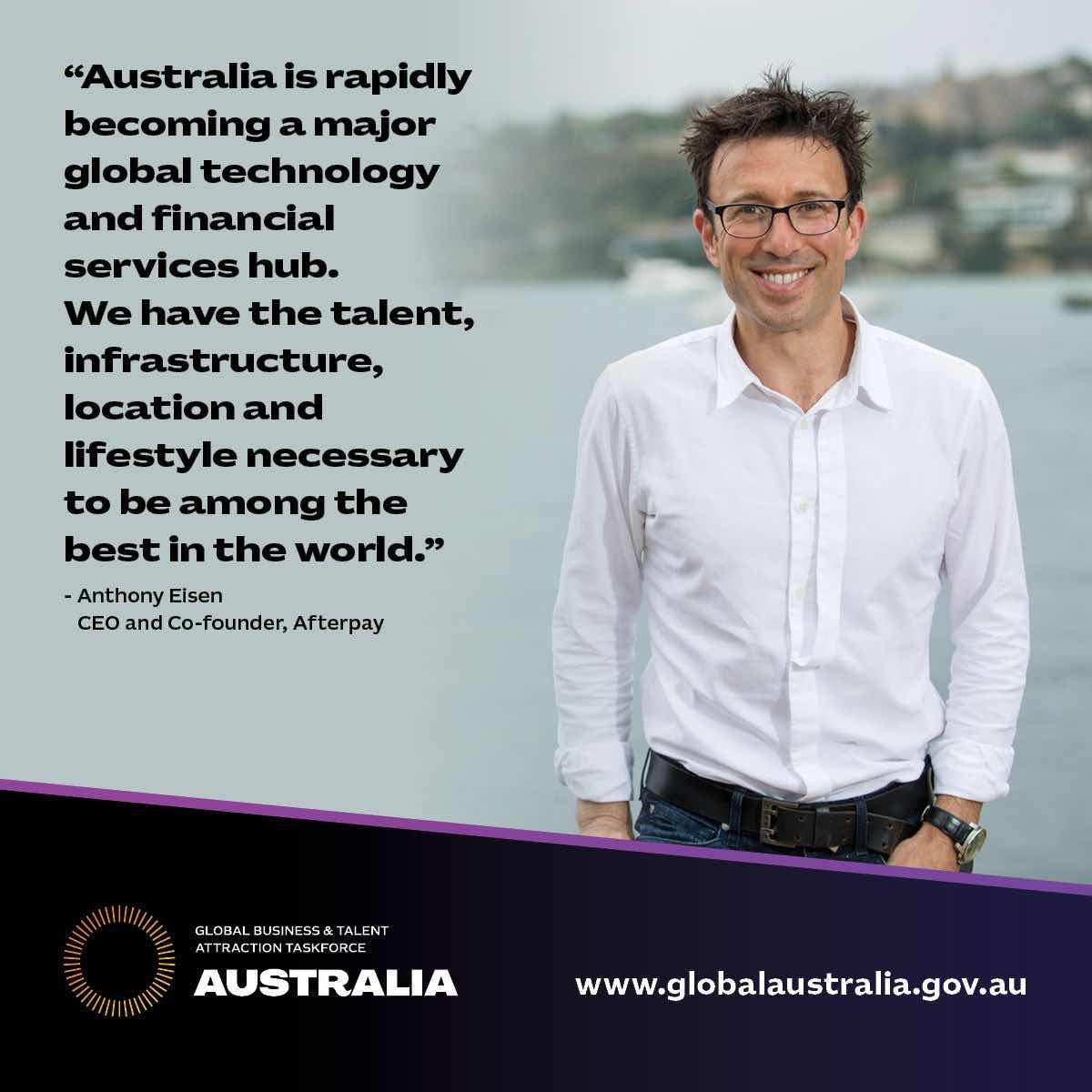
Afterpay CEO Anthony Eisen says Australia is rapidly becoming a major global technology and financial services hub.
“We have the talent, infrastructure, location and lifestyle necessary to be among the best in the world. As an Australian company, Afterpay is proud to play a role in making that happen.
Find out more at: www.globalaustralia.gov.au
Global Business & Talent Attraction Taskforce Australian Trade and Investment Commission (Austrade)
Australian Department of Foreign Affairs and Trade
Peter Verwer AO David Tony Michael Susan Stan Brendan Jodette Sandaldeep Brooke Bel Rob Tom Zenia Sarah Pip Stephanie
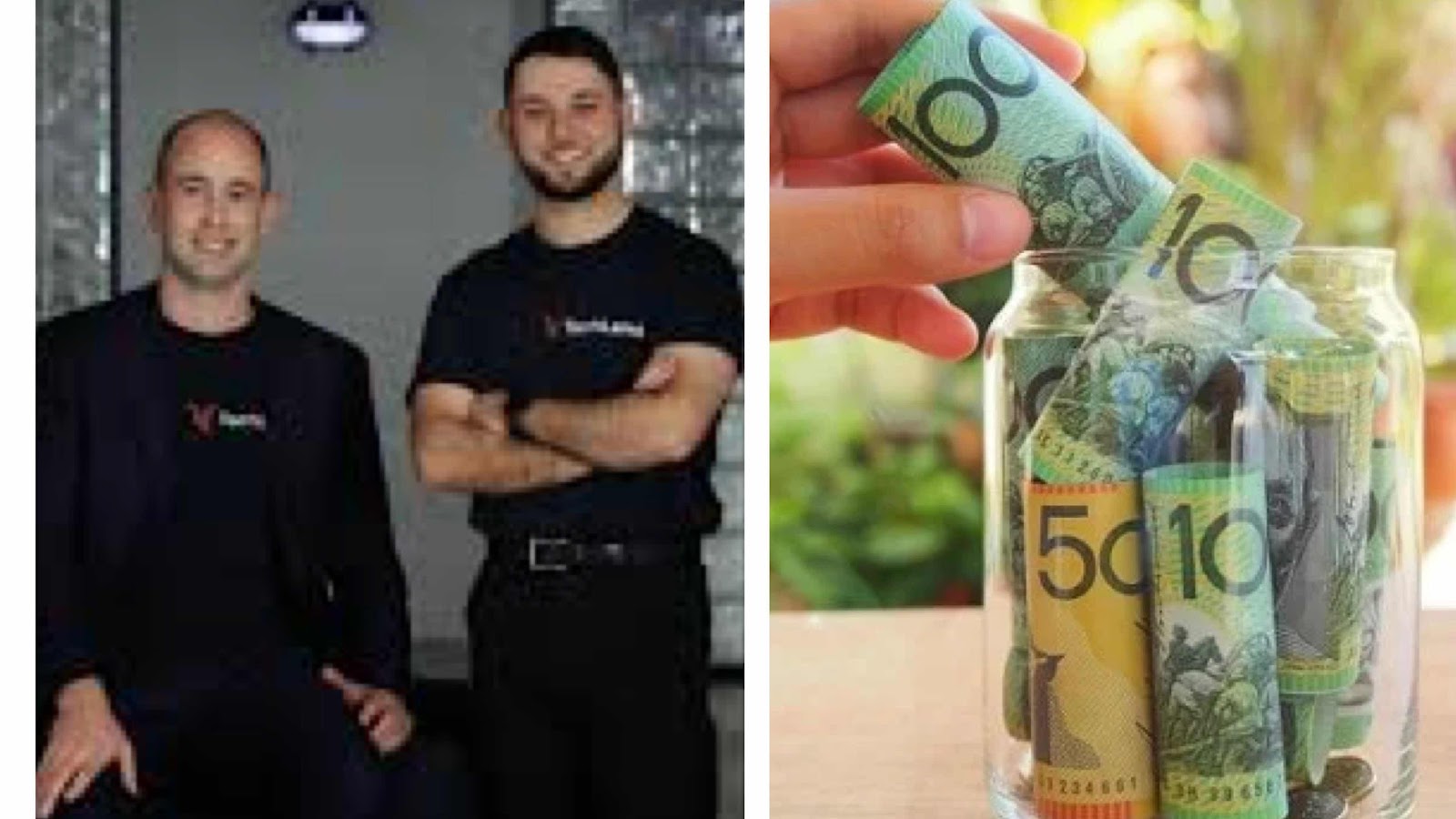
Exciting times ahead for Aaron Bassin’s TechLend as they secure an additional $50M in funding, from Partners For Growth!
What TechLend does
Theymake bridging loans much simpler in the housing market - disrupting the traditional property finance market
Some of the people
Nick Jacobs Amber Johnston Aleisha Smith Adam Borowsky Maximilien Penel Jason Georgatos Richard Osborne Karthi Sepulohniam (Subramaniam)) Matt Leibowitz
So who is Partners for Growth
Partners for Growth (PFG) is a Silicon Valley based VC firm that invests in emerging growth companies across the innovation economy, and has invested more than $450 million in over 60 Australian startups and scale ups to date. PFG has partnered with leading ecommerce furniture and mattress company Koala; small business loan specialist Prospa and rewards platform Cashrewards.
Jason Georgiatos, Managing Director of Partners for Growth, said: .. Techlend’s vision is in line with PFG’s strategy to support global fintech disruptors. “
Nick Mnar and Anthony Eisen cofounders of Afterpay
Afterpay announced Square intends to acquire Afterpay for $39 billion - the largest corporate transaction in Australian history.
Congrats Nick Molnar and team 👏 #startupaus #auspol #entrepreneurship
Square and Afterpay are two of the fastest growing fintech companies with a shared mission of economic empowerment and financial inclusion, and together, plan to deliver an even more attractive platform for consumers and merchants across geographies, categories and segments.
This partnership marks a huge milestone for the Australian technology sector and our growing profile on the world stage.
Congratulations on this wonderful moment to the entire team
Nick Crocker, general partner of Blackbird, says now “is the best time to be a founder in Australian history”.
Here are some of Australia’s “unicorns” valued at $1bn or more, after a spate of raisings as venture capitalists and wealth investors have piled in and spent billions in
Culture Amp hits a $2 billion,
Canva - a $19 billion
Airwallex - $3 billion - founders created their own find
Jodi Geddes and Kate Pollard startup “Circle In”a “fam tech” has secured.seed funding of $2.275m funding from the VC Community including Our Innovation Fund , Leigh Jasper and Carol Schwartz and has a host of big name clients including Medibank Private, Atlassian and Culture Amp, EY, GAP and Estee Lauder.
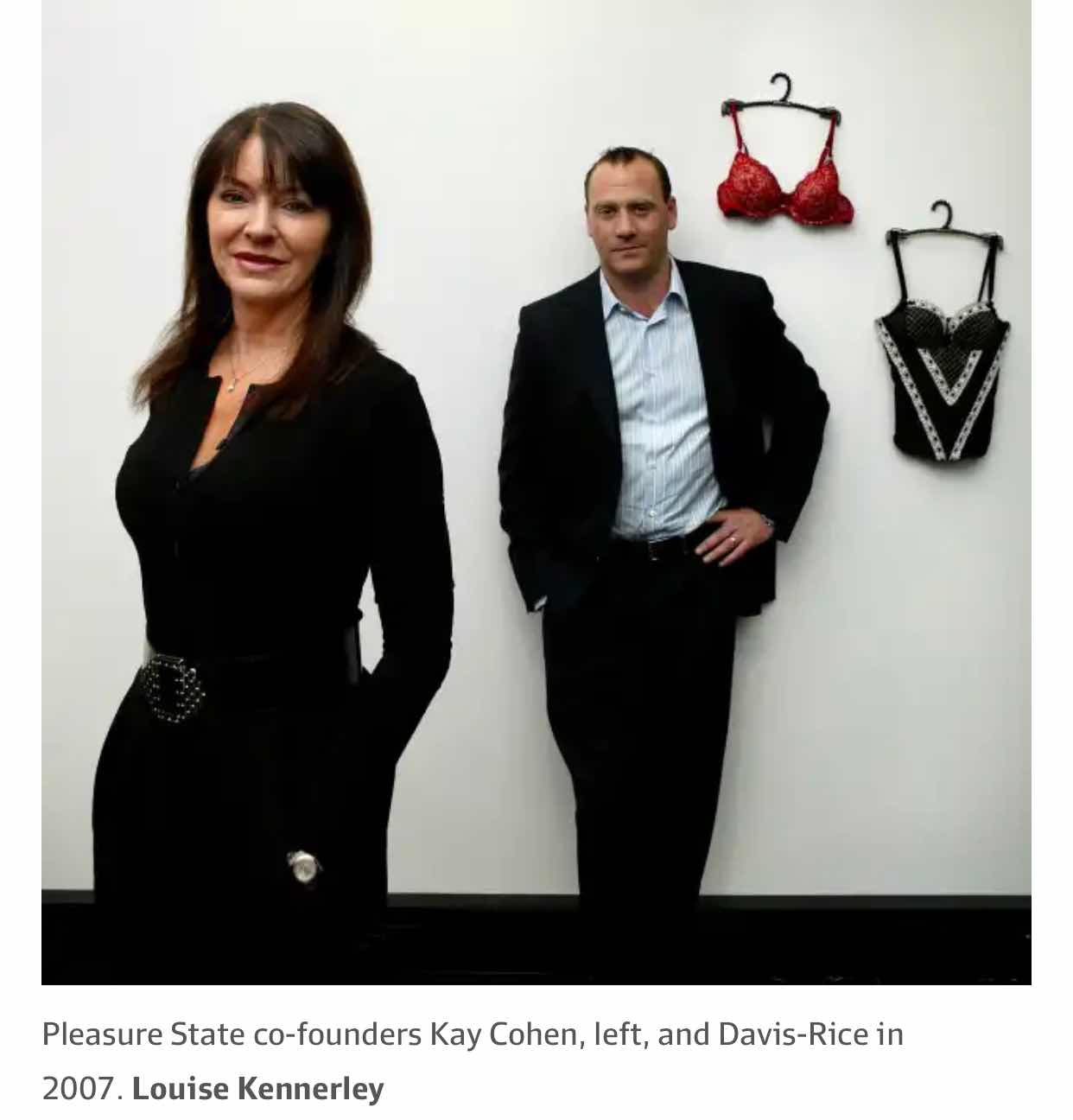
almost fell out of bed - when he saw his struggling lingerie company’s NASDAQ share price going through the roof - “We were trading at a market cap of $US550 million and we had been about $US80 million the day before - on the verge of collapse
— Justin Davis-Rice, Bendon CEO”
A band of Reddit Investors came to the party to support the stock giving the Australian export a chance to shine
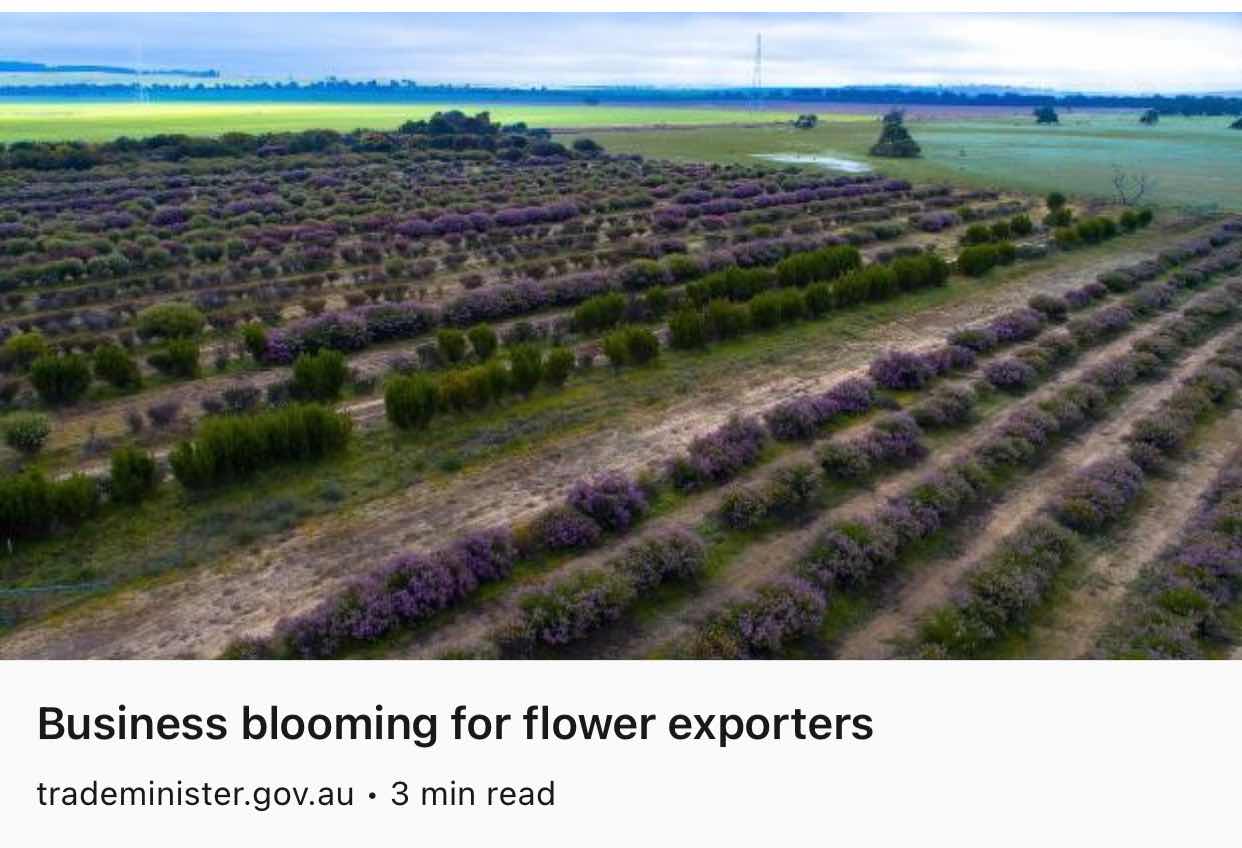
Wafex provides about half of Australia's national flower #exports. It employs 150 staff, owns 4 large grow farms and buys from 50 domestic commercial growers across south-west Western Australia, South Australia, Victoria, the NSW North and South Coast regions and south-east Queensland.
When airfreight availability plummeted at the start of the pandemic, Australia’s largest wildflower exporter was looking at a $5 million dollar hit and the heartbreak of laying off staff.
Enter the International Freight Assistance Mechanism (IFAM). Accessing IFAM-supported flights was a lifeline for Wafex as it enabled their prized blooms to continue moving into markets including the United States, Taiwan, China, Singapore, Hong Kong, Holland, Vietnam and Japan which in turn helped them bounce back from the brink of financial ruin.
As one of Business Insider's"30 Women in Venture Capital to Watch,” Fran Hauser knows what gets her to open up her own wallet to help fund a startup.
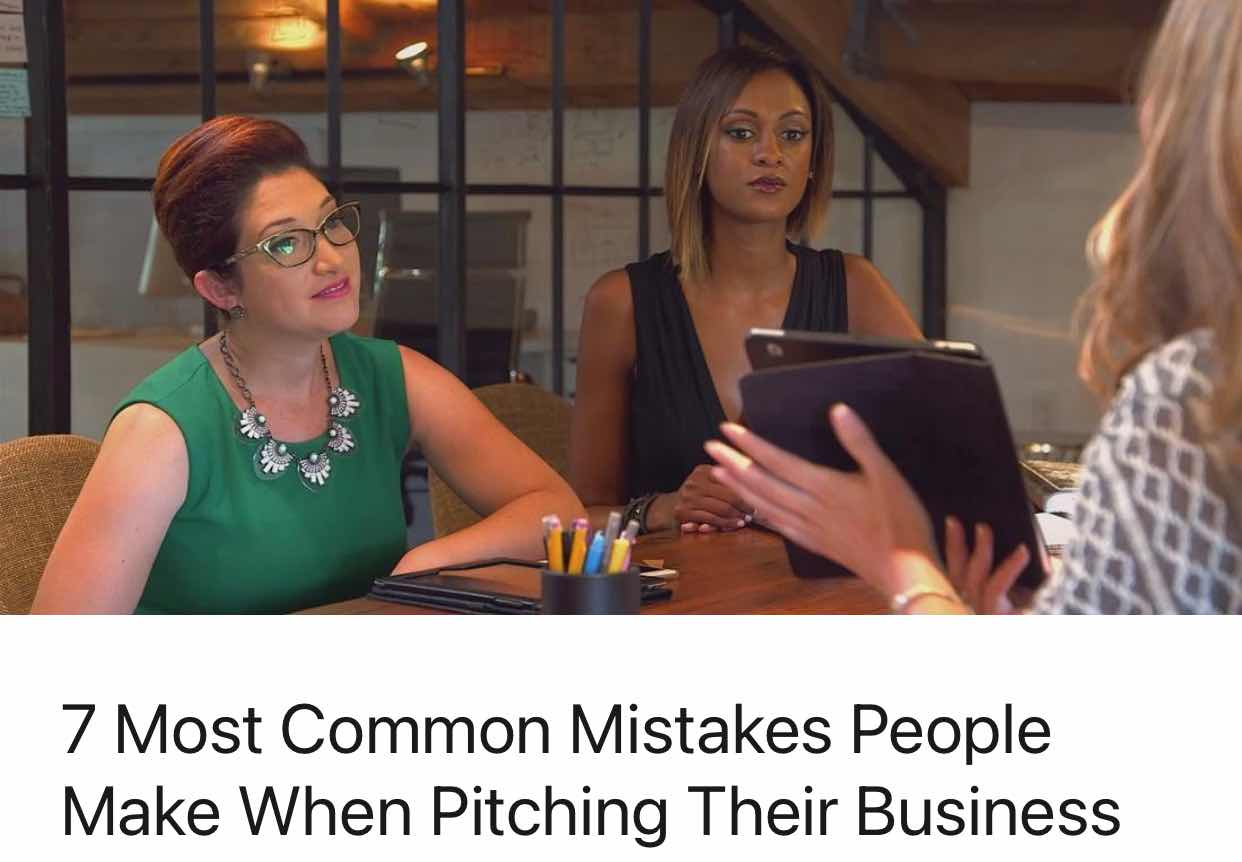
Here are Fran Hauser’s7 most common mistakes people make pitching their business:
1.Forgetting the investor is a human being. Yes, fundraising is about products and money and financial returns and all of that. But there is also the human factor, too. You're asking this person to join you in a potentially risky (and hopefully successful) long-term relationship. Since this is a human relationship—and not one solely with the investor’s bank account—trust needs to be established first. To do this, spend time learning about the investor ahead of your meeting so you can make a personal connection. I know I greatly appreciate it when a founder starts the meeting by referencing something about me personally. Remember, the investor is a human being, not a human ATM.
2. Not qualifying investors. The same way you qualify prospects for a sales position, you have to qualify investors too. Look for investors that, not only like your industry, but also have either previously invested in that space or have a personal affiliation with it. It’s important to know if they are actively investing at the stage you’re seeking funding for, because otherwise you’re wasting their time—and yours. Find out when the last investment they made was, plus how many investments they make annually. And it’s crucial to know their reputation as an investor and how they treat partners. Regardless of how much money they can offer, do you really want to work with a known jerk?
3. Lack of honest Q &A prep. A great salesperson always tries to anticipate what the objections, comments and questions are going to be. Develop answers to the five questions you hope investors won't ask. Where are the company’s vulnerabilities? What holes are still yet to be filled in? Why won’t the company turn profit for a year? Make sure you air all your personal concerns that keep you up at night and have data-backed reasons why those issues won’t be a problem in the future.
4. Too much jargon. You want the investor leaving the meeting thinking yours is an opportunity too big to pass up. That now is the right time and YOU are the founder who can make it happen. But you don’t want the investor thinking you’re full of BS because you load on inspirational quips and a giant vocabulary. Be authentic by providing actual numbers and real-life stories. These are things that investors are going to remember and will be able to easily repeat to their colleagues. Simpler is better.
5. Dismissing feedback. The companies in my portfolio that failed have one common thread and it went back to my initial meetings with the founders: They were quick to dismiss any feedback. You can still be confident, have conviction in your company, and run things they way you want, and also show that you’re coachable too. Being responsive shows the investor you’re open to ideas, just like any good boss worth their salt should be. Relationships are not one sided.
6. Lack of mindset. Mindset is everything. If you go into your fundraising with a growth mindset, it will make the whole process so much more enjoyable. Go in with your eyes wide open. There are going to be a lot of NOs, but if you turn each one of those rejections into a learning moment, you’ll enjoy the process a lot more.
7. Why does the world need another X? Another common mistake I often see is that the founder starts with a product description before they communicate the pain point or opportunity. Convince the investor that there is a need first and then follow up with how you are addressing that need with your next billion-dollar idea.
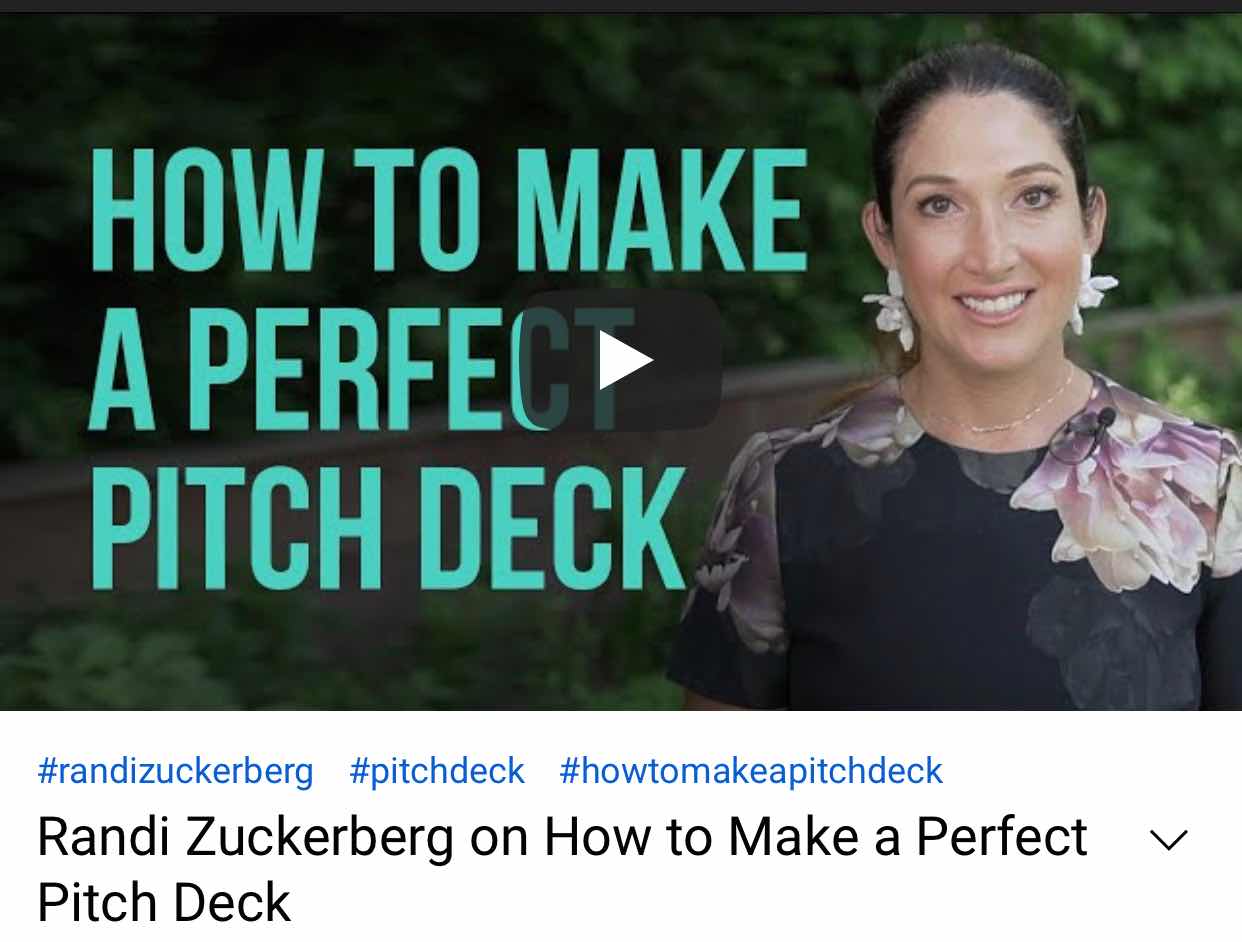
From seeing dozens of pitches from entrepreneurs every week, I've learned what makes a great pitch deck TRULY STAND OUT!
Here are five strategies to make your deck compelling and increase your chances so that investors can't say "NO" to you when you go out to raise money for your business.
✔️ Make it crystal clear what problem you're solving and how your business is doing that. The person on the other side of the table or the other side of the email you're sending the pitch deck to probably knows nothing — so you should make sure you're explaining things so clearly as if you were telling something to a toddler.
✔️ Clearly outline how much of the market opportunity you think you could capture. Whether that's a billion-dollar or two-thousand-dollar opportunity, be realistic and let investors understand your business's full potential. The right investor is going to be a little different depending on what the market opportunity is.
✔️ There are many teams out there that investors can back; why should they back you? What is the unique expertise that you bring to the table? Why are you the person to solve this problem?
✔️ Don't be afraid to be clear about what you don't know. Be open about the gaps in your skill sets or your team's and share how your advisors and other people can fill them in when you don't meet specific criteria. Investors like to see that you're not pretending to know everything in the game.
✔️ Establish a clear ASK in your deck. I've seen so many great pitch decks that got me excited about a company, but then they never specifically said how much money they were raising, in what increments, or how much the valuation was. Make sure you have a specific ask at the end of your deck so people know exactly how they can get involved.
Check out her latest YouTube video on this topic here. #pitchdeck #pitching #investors