Saturday, March 25, 2023

Managing Risk for Tech Companies and Developers in Light of SVB

Great advice from Ross Chaldecotte of Kinde - talking ways to manage risk for startups and tech companies looking to scale…..



Thankfully it looks like Silicon Valley Bank (SVB) customers will retain all of their funds. Kinde was never directly impacted as we bank in Australia with one of the big 4 banks and utilize Airwallex for our international transactions. It did, however, make us painfully aware of the risks of keeping all of our eggs in one basket (not just around banking).

Here are some of the approaches we’re applying to help distribute risk and protect our customers and team (most of these are already in place):

* Always have at least 2 bank accounts and distribute funds between them so that there is never a central point of failure. Make sure that banks used are truly different entities and are federally guaranteed. Ideally cap account limits to insured limits – but this seems an unlikely / impossible scenario with large amounts of funds.

* Make sure we have up to date records of balances and statements to prove balances should we need them.

* Make regular backups of our critical software systems so that if any one point fails we can roll to a secondary as fast as possible with minimal loss. We looked at the scenario where a third party like Xero or Stripe got taken down by SVB failure and realized the knock-on effects could be quite large.

* Build redundancy into everything that we develop. We build with a rule of 2. Which means that every integration we use should be deliberately built with a minimum of 2 vendors in mind. For example, if we use Stripe, we will also build for Adyen or Worldpay. This is better for our customers as they gain choice and can use their preferred vendor, but it’s also better for us, as it doesn’t lock us in and protects us from catastrophic failure.

* A complete AWS failure seems highly unlikely and if it occurs would be a catastrophic event far larger than Kinde. Most of the world would be reeling and the majority of customers we work with would also be hit directly. In the event that service here did not return, standard best practice would apply. Code is stored in both github and locally, and database backups are made regularly. We would be able to have Kinde back up and running fairly quickly on an alternative like Google Cloud. Assuming the zombies hadn’t eaten us all by then.

* To protect our own customers, we continue to have strongly defined business continuity plans and our software in escrow to ensure we are protecting our customers in the event of our own failure.

We’re still working through it and I’m sure there are other things we will encounter along the way.

It would be interesting to know what others are doing that I’ve missed. Feel free to post in the comments.

#svb #siliconvalleybank #riskmanagement #risk #redundancy #software #banks 

Tuesday, March 21, 2023

Mark Gustowski talks about the importance of cash and reducing burn


To say that the current capital markets are challenging would be an understatement. 

The tech ecosystem has come out of what can only be described as enormous orchestrated bubble, fuelled by 
  • endless printing of money during the pandemic, that ultimately led to 
  • high inflation, 
  • interest rate hikes, and 
  • massive job shedding.

Could it have been avoided with foresight and measured fiscal policy? Sure but let’s not let a good fiscal management in the way of government elected terms. 

But what does this mean for our startup sector? Well if you raised during the bubble well done, hopefully you raised enough to give you another 24-30 mths of runway. If you didn’t, and you find yourself going to the well again in the next 12 months, be prepared for down-rounds. Valuations have dropped, from Meta and Stipe through to startups.

Is it all bad? Not necessarily, it’s a normalisation of the market and valuations but I do worry about the 2021 and 2022 investment vintages, returns are going to be a real challenge for them.

Cash is king 


So what now? What do VCs like Mandalay Venture Partners look for in a deal? Well for starters you better be sure to be raising for 18 months or more, preferably 24 to see you through the current period. 

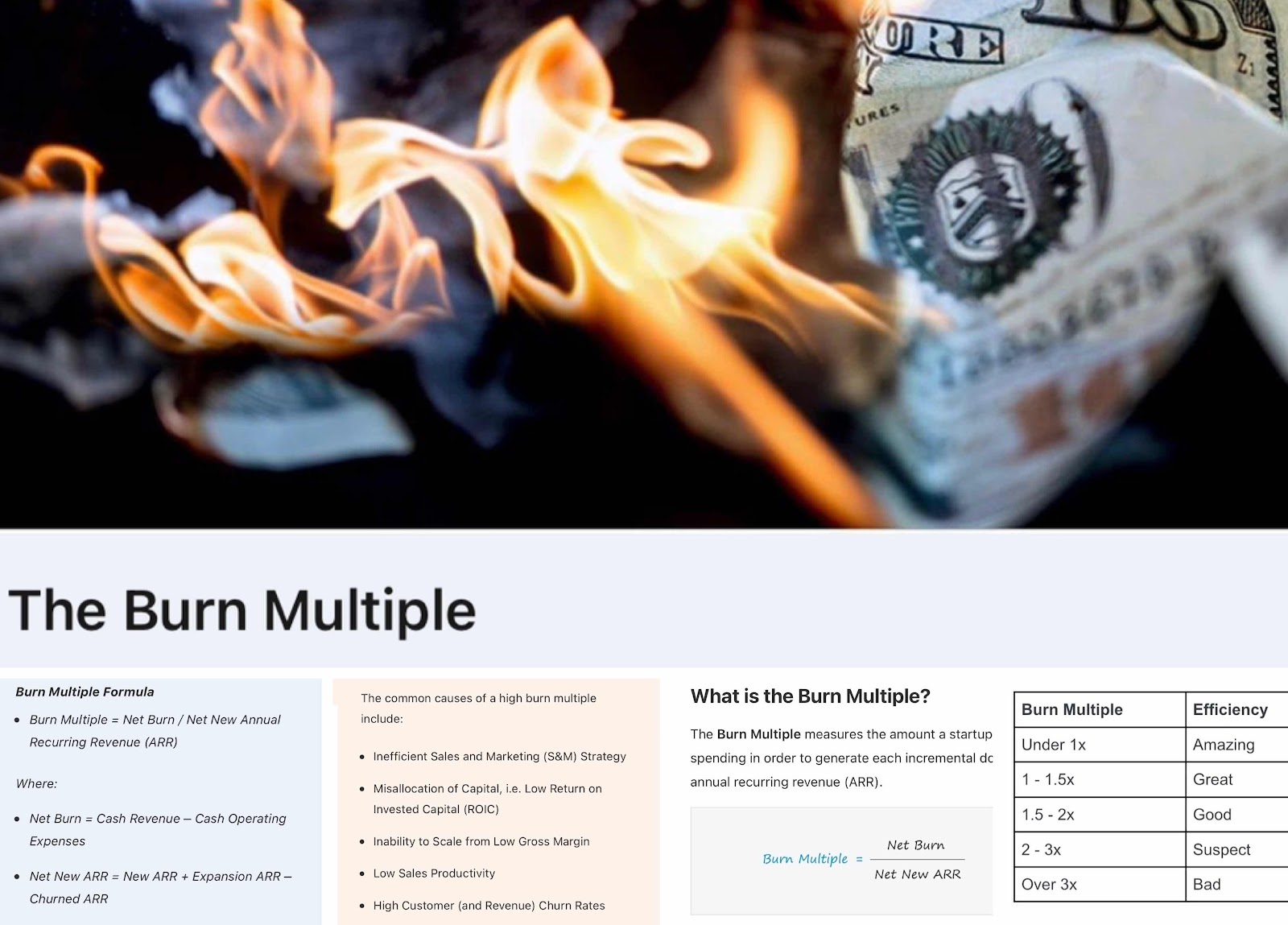
Austerity means slowing growth, managing burn and understanding the all important ‘burn multiple’. 

Growth for growth sake is no longer the metric, it’s now efficiency of growth that will make you stand out. 


If you’re a founder you best get your head around the concept of ‘burn multiple’ really fast. Investors will be looking at your spend (burn) vs your revenue and doing back-of-the-napkin assessments to ascertain how sustainable your business is going to be. 

https://bsivc.blogspot.com/2023/03/david-sacks-burn-multiple.html


the Burn Multiple - the inverted Bessemer ratio shared by David Sacks 


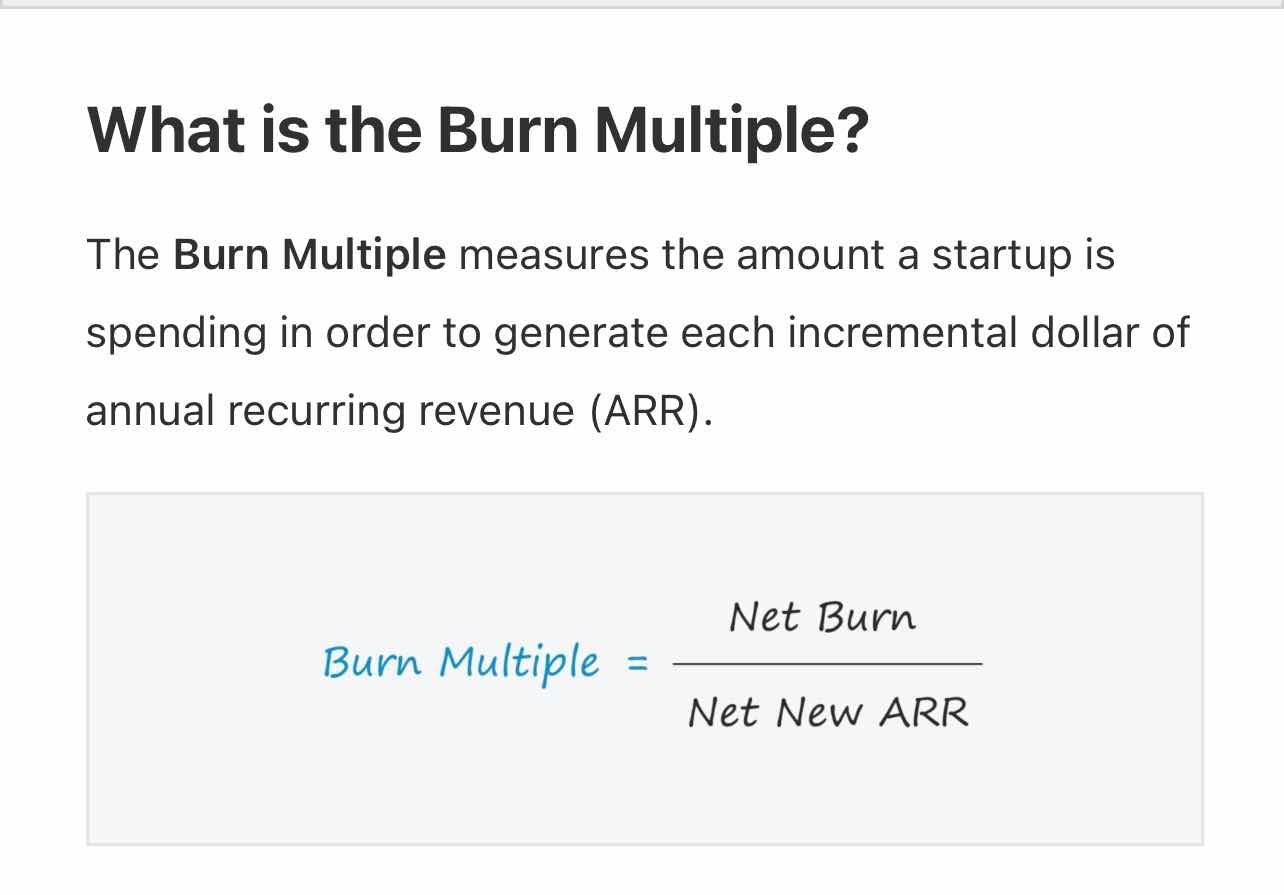
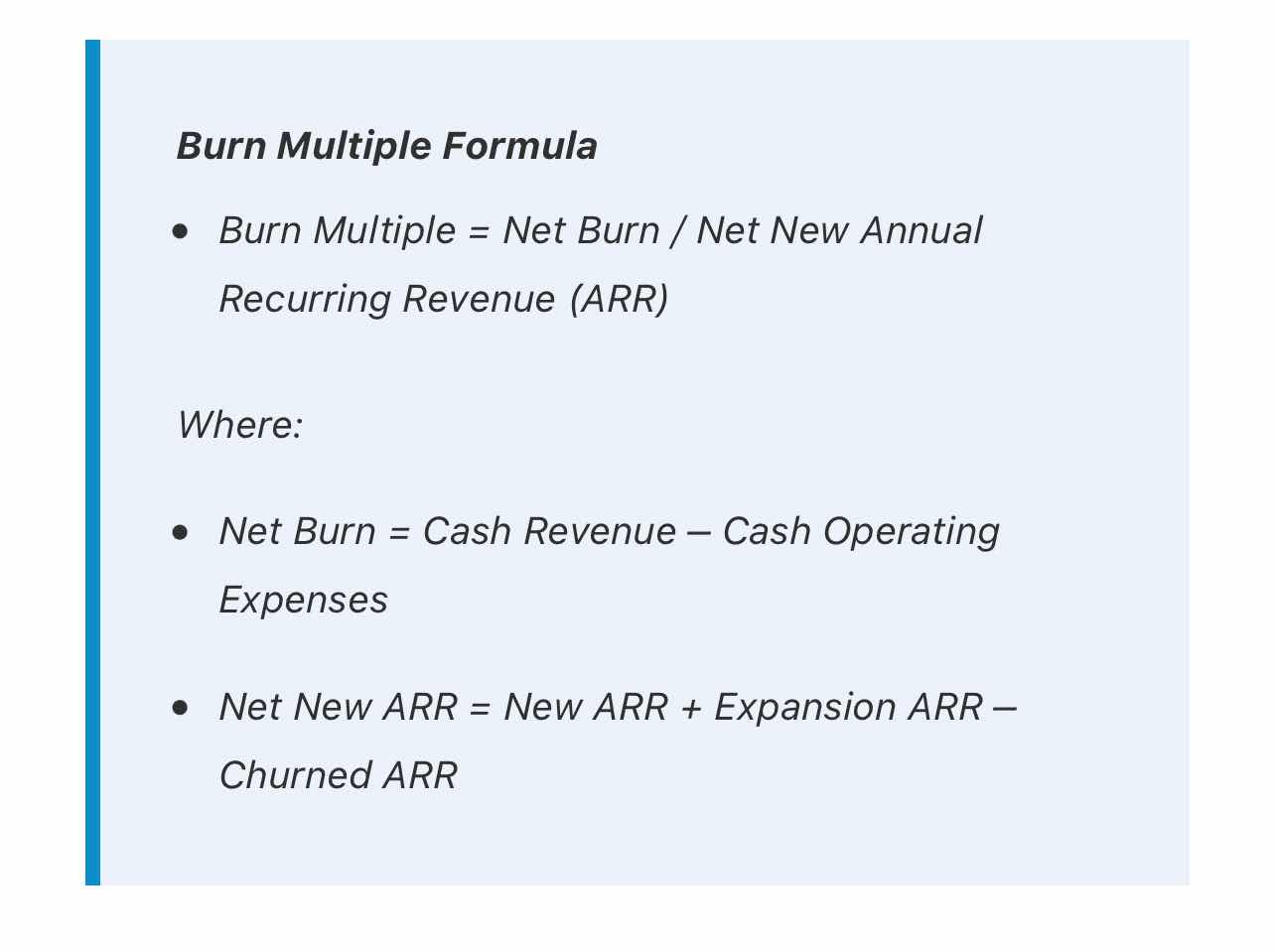
Burn Multiple = Net Burn / Net New ARR

In other words, how much is the startup burning in order to generate each incremental dollar of ARR?

The higher the Burn Multiple, the more the startup is burning to achieve each unit of growth. 

The lower the Burn Multiple, the more efficient the growth is.

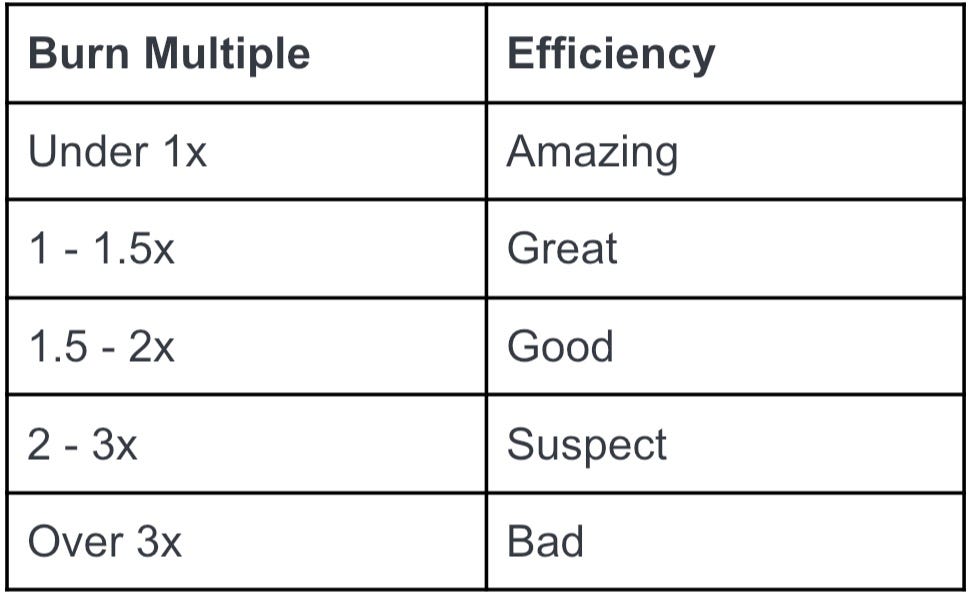
For venture-stage startups, these are reasonably good rules of thumb


So when raising Seed to Series-A and beyond, consider the following:

๐Ÿ‘๐Ÿผ18 months runway is ok, 24 months is better 
๐Ÿ‘๐Ÿผcap salaries and remunerate via ESOPs that can reduce burn 
๐Ÿ‘๐Ÿผif new markets are exceeding a burn multiple of 3-4, reconsider for now
๐Ÿ‘๐Ÿผmanaged growth is ok, cash is king
๐Ÿ‘๐Ÿผmark to market regularly 

This is not the environment you want to be raising in twice in the same 18 months. Money is going to get tighter as interest rates continue to rise to curb inflation. It’s going to be hard to attract dry powder as venture returns become less attractive with other capital allocation assets. 

Learn about the concept of burn multiples in austere times (see attached article). Great opportunities will still be funded but we are no longer in a ‘blitz-scale’ era; your growth and market strategies need to reflect that. 

A good investor will help navigate these waters. We don’t expect founders to understand all the underlying macro economic issues, but it is our role to help you chart a sustainable path forward. 

Don’t be afraid to ask questions, test assumptions or reach out as it’s the best way for us to get through this together. 

#startup #capitalmarkets  #tech #investment #venturecapital #venture


David Sacks - the burn multiple


David Sacks of PayPal, Twitter and All in game talks about a burn multiple

Two simple ways to measure capital efficiency are the Hype Ratio and Bessemer’s Efficiency Score:
  1. Hype Ratio = Capital Raised (or Burned) / ARR
  2. Efficiency Score = Net New ARR / Net Burn

David  think Bessemer has the right idea but prefers to flip the numerator and denominator, so the ratio is an annualized version of the Hype Ratio. 

He  calls this the Burn Multiple:
Burn Multiple = Net Burn / Net New ARR


  • A gross margin problem — If the company spends too much on COGS in order to deliver the product or service, its burn will increase rapidly as it scales. If there’s not operating leverage in the business, the Burn Multiple will not improve with scale.
  • A sales efficiency problem — If CAC is prohibitive or sales productivity is diminishing, burn will increase relative to new ARR, causing the Burn Multiple to worsen even though growth continues.
  • A churn problem — Churn will net against the denominator of the Burn Multiple, causing the multiple to increase. A leaky bucket makes it hard to grow efficiently.
  • A growth challenge — If growth is stalling, the company may seek to compensate by spending more on marketing, give-aways, discounts, or promotions. That will be picked up in a higher Burn Multiple, as burn rises faster than new sales.
  • A founder leadership problem — If the founder lacks the skill or will to control burn, that will show through in the Burn Multiple.

Eventually, for a company to become profitable, burn must reach 0, which implies that the Burn Multiple should also approach 0 over time.

Tuesday, March 14, 2023

How to become a centre of influence and build a business plan

 Billy Connolly talking business planning and what people said about Ivan Kaye's talk on "becoming a centre of influence" about how to become a centre of influence 


Tuesday, March 07, 2023

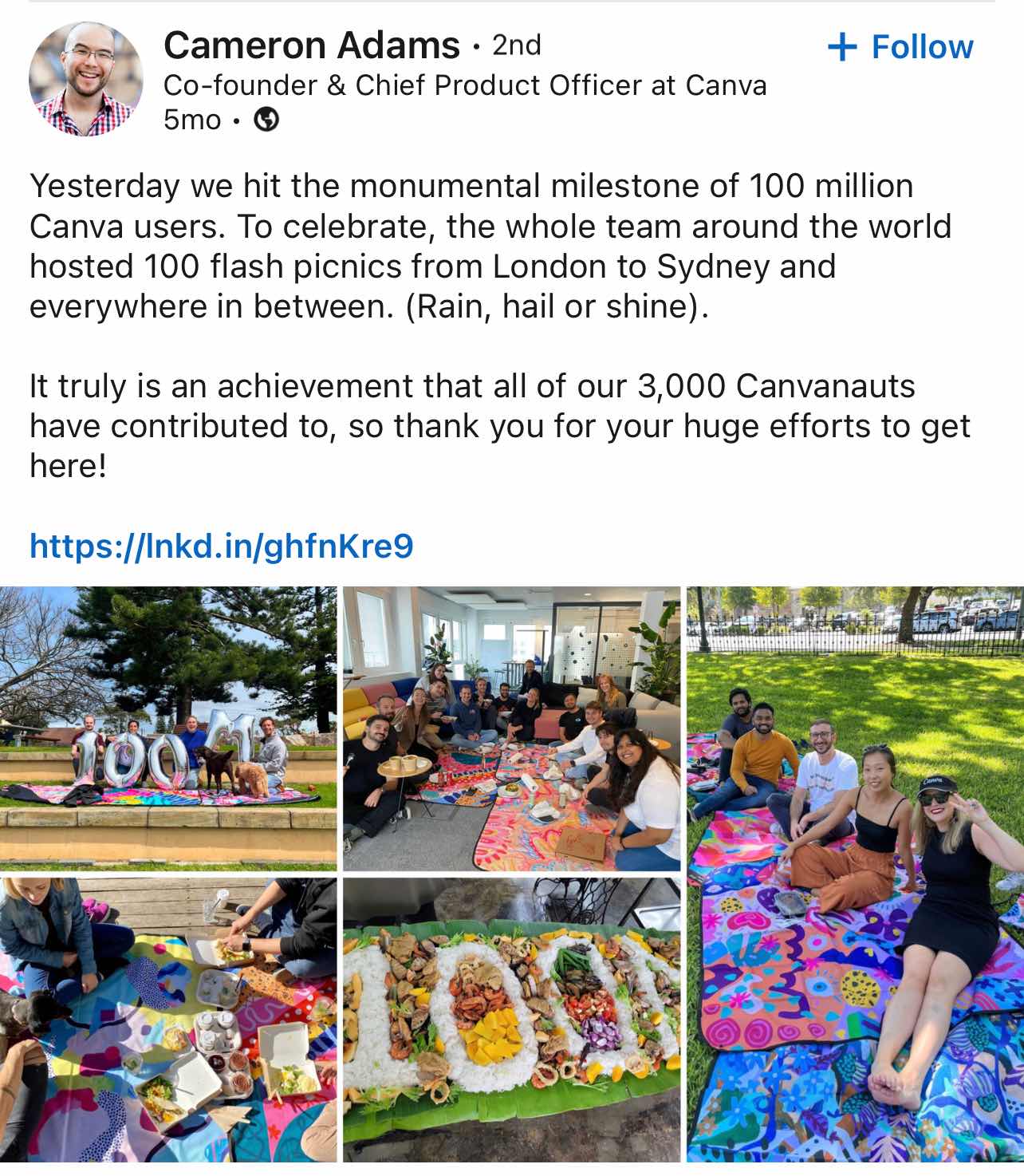
Canva quietly passing 100 million users


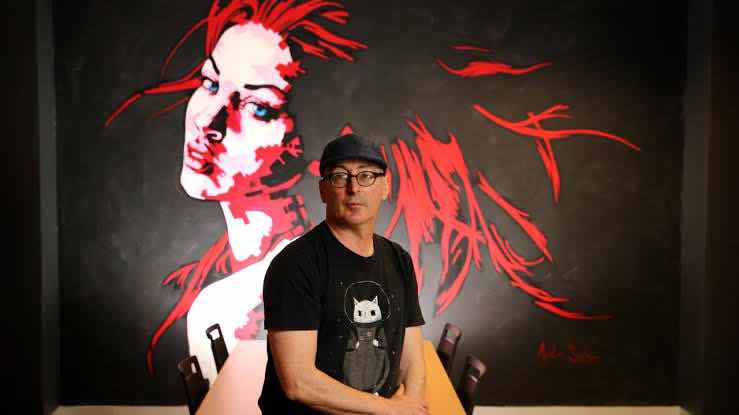
Democratising Art with RedBubble - a dream that Martin Hosking turned to action


20 years ago Martin hosting offered us a chance to invest in an idea to bdemocratize art and photography - connecting artists with a global audience and providing a hassle-free way to monetize that art.

Redbubble is now a global online marketplace that allows independent artists, designers, and creators to sell their artwork on a wide range of products such as t-shirts, phone cases, stickers, and home decor items 

With a turnover of 109s of mikkkions of dollars

The platform has become a powerful tool for creatives to monetize their art and reach a wider audience.

How does it work ?

One of the biggest advantages of Redbubble is the ease of use for both sellers and buyers. For sellers, it's a simple and free process to upload designs and choose which products to feature them on. The platform takes care of production, shipping, and customer service, making it a hassle-free way to sell art. For buyers, Redbubble offers a wide variety of unique and original designs, making it easy to find something that suits their personal style.

Redbubble offers a flexible revenue-sharing model that allows artists to set their own prices and earn a percentage of each sale. This means that artists can earn a steady income from their art without having to worry about the logistics of production and shipping.


Global Reach

Another key advantage of Redbubble is its global reach. With millions of users from all over the world, artists have the potential to reach a much larger audience than they would through traditional methods of selling art. The platform also offers a range of marketing tools, such as email marketing and social media promotion, to help artists increase their exposure and sales.

Martin’s vision of enabling independent creators to compete with established brands and reach new heights of success has democratized the art market

Tuesday, February 28, 2023

$5m investment in Mutinex set to become a homerun


Coming to America (L-R): Equity Venture Partners' Allen Zhu and Justin Lipman; Mutinex co-founders Henry Innis and Matt Faruggia. 


"Fundamentally, we have to win in the US market," 


from an EVP lens 

Lipman of EVP believes they could have bagged another home run with B2B saas company Mutinex - but to do this - founder Henry Innes says that 


“We see around 2,000 companies a year,” said Lipman, “and last year we invested in six.” 

Mutinex “ticks all the boxes of what a great B2B software company in the early stage looks like.”


“Investing $5m at a $37m Val in Mutinex is one of the most obvious decisions you’ll ever be presented with in the world of venture - expecting Mutinex to be a $400m business soon!!!”


Why??


It is a 


  • Great product 
  • Has Great talent 
  • Has Great buyin from customers 
  • Has a Clear focus and large vision 
  • The teams  drive and commitment is simply infectious. 


Special thanks to Charlie Gearside for the tip (via Matt de Boer as usual), Brodie Arnhold and Chris for being so welcoming and the broader leadership team in Dan Gooden, Adam Beaupeurt, Mark Tovbis, Daniel Chu who made the investment decision the no-brainer we’re always chasing.


What Mutinex does

The business focuses on marketing investment analytics and built its GrowthOS software product to provide marketers and cfos with insights to help target their marketing spend.


A new feature allows marketers to measure how brand presence contributes to sales volume and marketing ROI,


  • Mutinex is growing fast because finance teams accept the methodology, which attributes marketing and media activity to business impact above baseline sales.
  • Global comms holding companies and consulting firms will license the platform similar to CX and martech cloud platforms like Adobe and Salesforce

Customers include 

Mutinex lists Intuit Australia, Youi Insurance, ING, Bendigo Bank, ME Bank, Asahi Oceania and Samsung Australia as customers.


Lipman 

“To be honest, if you continue to delight customers, continue to serve them well, liquidity exit opportunities take care of themselves.”


Henry Innes 


“the size of this market of companies that are actively going to need this type of software – there's at least 2,000, 3000 enterprises [globally]. They're all spending millions of dollars currently with consultants ... we will help these companies help make informed decisions on their marketing spend and build up to a $100 million ARR [annual recurring revenue] B2B software business”


There is an Opportunity to leverage consulting firms as alliance partners and resellers and they can license our product then upsell services to support and build out enablement.  


Investors

  • EVP
  • Bloomsbury Information Capital
  •  iSelect and Endota Day spa chair Brodie Arnhold, 
  • former WPP COO Chris Savage 
  • former PwC and current Sayers Partner 
  • 3AW radio host Russel Howcroft 


20 of the 24 original seed backers are investing again, nine of which increased their position. 


https://www.bandt.com.au/martech-startup-mutinex-announces-5-million-seed-extension-round/


The background - from Pirates to corporates 


https://www.mrweb.com/drno/news34109.htm


The company's flagship platform, WarChest, helps to analyse marketers' past decisions and then predict the value of future choicesthe company raised $2.4m in a seed round of funding, and in August it appointed former Mediabrands / Starcom exec John Sintras as President, US and Multinational, to lead expansion into the US. The firm now has some 26 full time staff members, and says it expects to reach 40-50 within the next year. 

The US expansion might partly explain the rename - there is already a web site personalization specialist based in San Francisco with the name Mutiny - but co-founder Henry Innis told www.mumbrella.com.au there is more to it than this: 'Another way to articulate it is, Mutinex signals that know we're evolving beyond just the rebellious spirit and kind of maturing a bit as well. You don't necessarily want a band of pirates managing billions of dollars of money'. Similarly, WarChest will now be known as GrowthOS, 'to better position the product in terms of the value it is delivering to customers'. 

Innis has taken the title of CEO while his co-founder Matt Farrugia becomes Chief Operating Officer, clarifying the quite separate roles the two are now playing. 

Beaupeurt, formerly MD of Digital at independent creative, CX and connections agency HERO, joins as Chief Commercial Officer, with sales, finance, marketing and success functions all reporting in to him. The founder in 2014 of a strategic marketing and communications agency called B.B.E., acquired by HERO in 2020, he worked earlier at ad agencies Ogilvy and AKQA. 

Innis, who has worked with Beaupeurt in two previous roles, says the firm has focused on hiring leaders who in turn can attract, build and scale talented teams, and describes Beaupeurt as 'somebody who deeply understands that perspective that the ability to hire well is probably as important as any other element'. 

Li joins from Rokt as Senior Data Scientist, Kosheliev from Data Robot as Senior Customer Data Scientist and Bertolus from Bupa as Head of Growth Marketing. The company says it will announce further hires in the coming months in customer success, engineering, product and user experience. 

Web site: www.mutiny.group . 

Friday, February 24, 2023

Climate Tech on the March

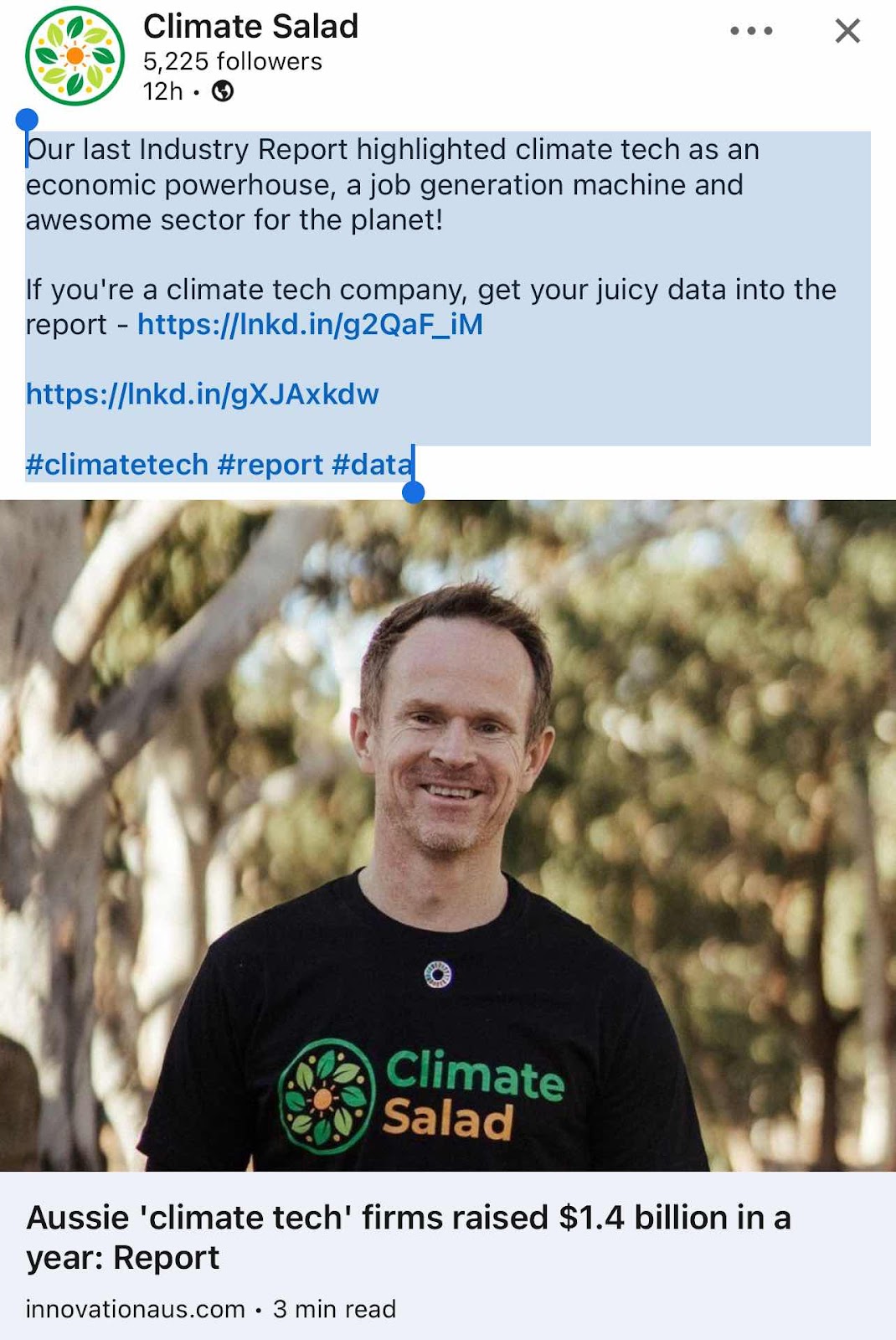
Climate Salad’s Industry Report highlighted climate tech as an economic powerhouse, a job generation machine and awesome sector for the planet! 

If you're a climate tech company, get your juicy data into the report - https://lnkd.in/g2QaF_iM


#climatetech #report #data


Tuesday, February 21, 2023

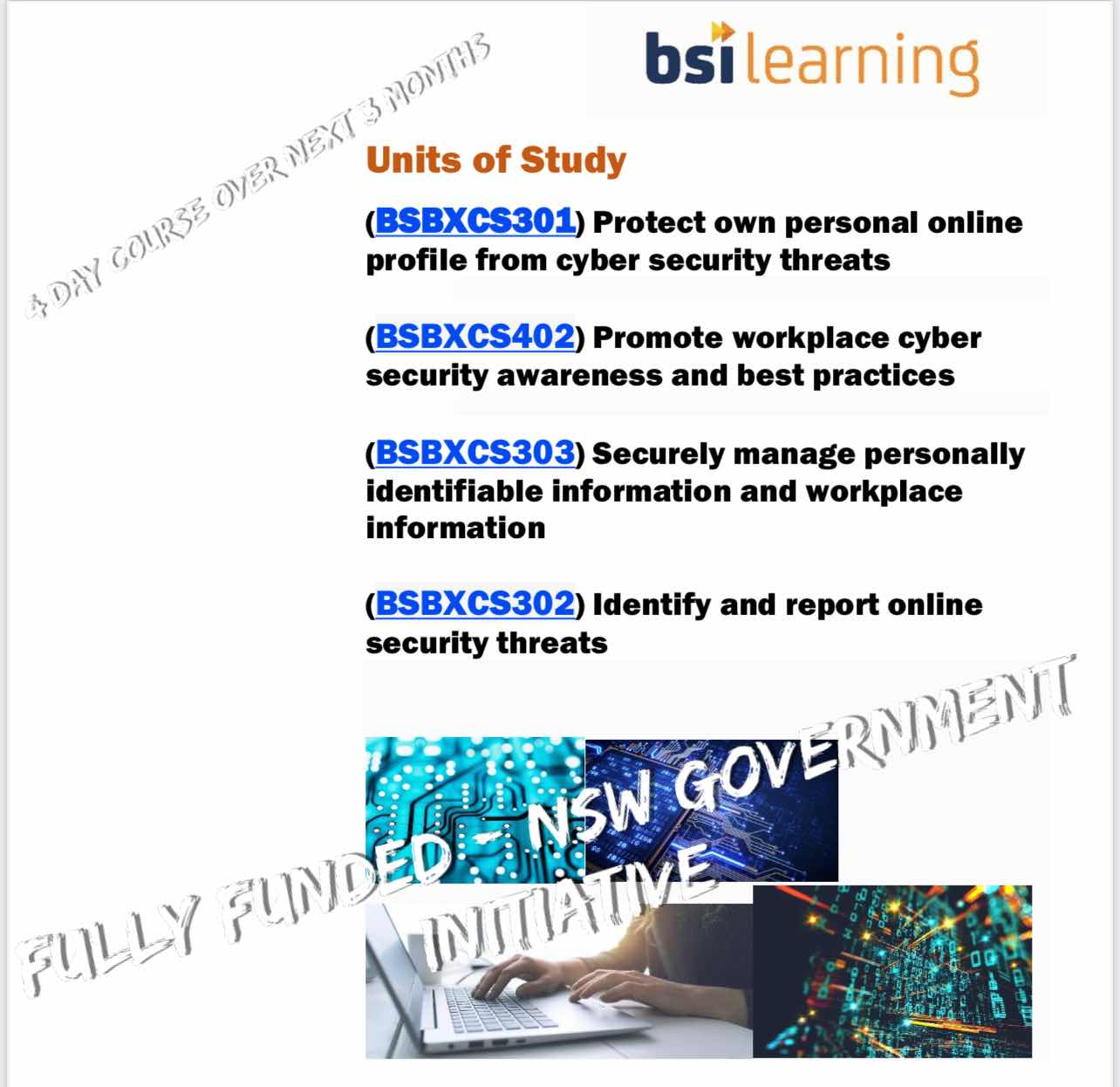
Are you open to be part of a government funded Cybersecurity Course?


Opportunity to do a fully funded Cybersecurity course - NSW initiative


Cybersecurity has seen an increasing demand for skilled workers in every industry that uses computers, networks and the Internet. Cybersecurity experts work on measures to protect the data from theft, damage or ransomware when locked. The data can cover sensitive information, personally identifiable data (PII), health information, banking or other financial details, Intellectual property and government or industry information.

If you are working in a small or large business, personal and professional cyber security is now considered a must-have skill. A proposed SEC rule will require companies to disclose their cybersecurity governance capabilities, including the board’s oversight of cyber risk, a description of management’s role in assessing and managing cyber risks, the relevant expertise of such management, and management’s role in implementing the company’s cybersecurity policies, procedures, and strategies. Meeting the new regulatory requirements can be better achieved by aligning how operational leaders discuss cybersecurity with their boards.

Specifically, where pertinent to board oversight, registrants will be required to disclose:

  • whether the entire board, a specific board member, or a board committee is responsible for the oversight of cyber risks,
  • the processes by which the board is informed about cyber risks, and the frequency of its discussions on this topic,
  • whether and how the board or specified board committee considers cyber risks as part of its business strategy, risk management, and financial oversight.


Statement of Attainment Cyber Security Awareness Skill Set BSBSS00094

This skill set addresses the skills and knowledge to assist an organisation improve cyber threat awareness and protect against cyber risk across a broad range of industries. This skill set applies to those working in a broad range of industries who as part of their job role engage in cyber security threat assessments and protection against cyber security risk. These units of competency from BSB Business Services Training Packages meet industry requirements for those required to assist in raising cyber security awareness with organisations.

BSBXCS301 Protect own personal online profile from cyber security threats

BSBXCS302 Identify and report online security threats.

BSBXCS303 Securely manage personally identifiable information and workplace information

BSBXCS402 Promote workplace cyber security awareness and best practices

Audience

  • Individuals who use social media and email
  • Organisations concerned with cyber security
  • Government organisations concerned with privacy, fraud and cyber attacks

Enrolment

Please enrol on the link provided Cyber Security Awareness Skill Set

Fee

This is part of the NSW Fee Free Initiative by the NSW Department of Education and is fully funded for BSI Learning Institute

Saturday, February 18, 2023

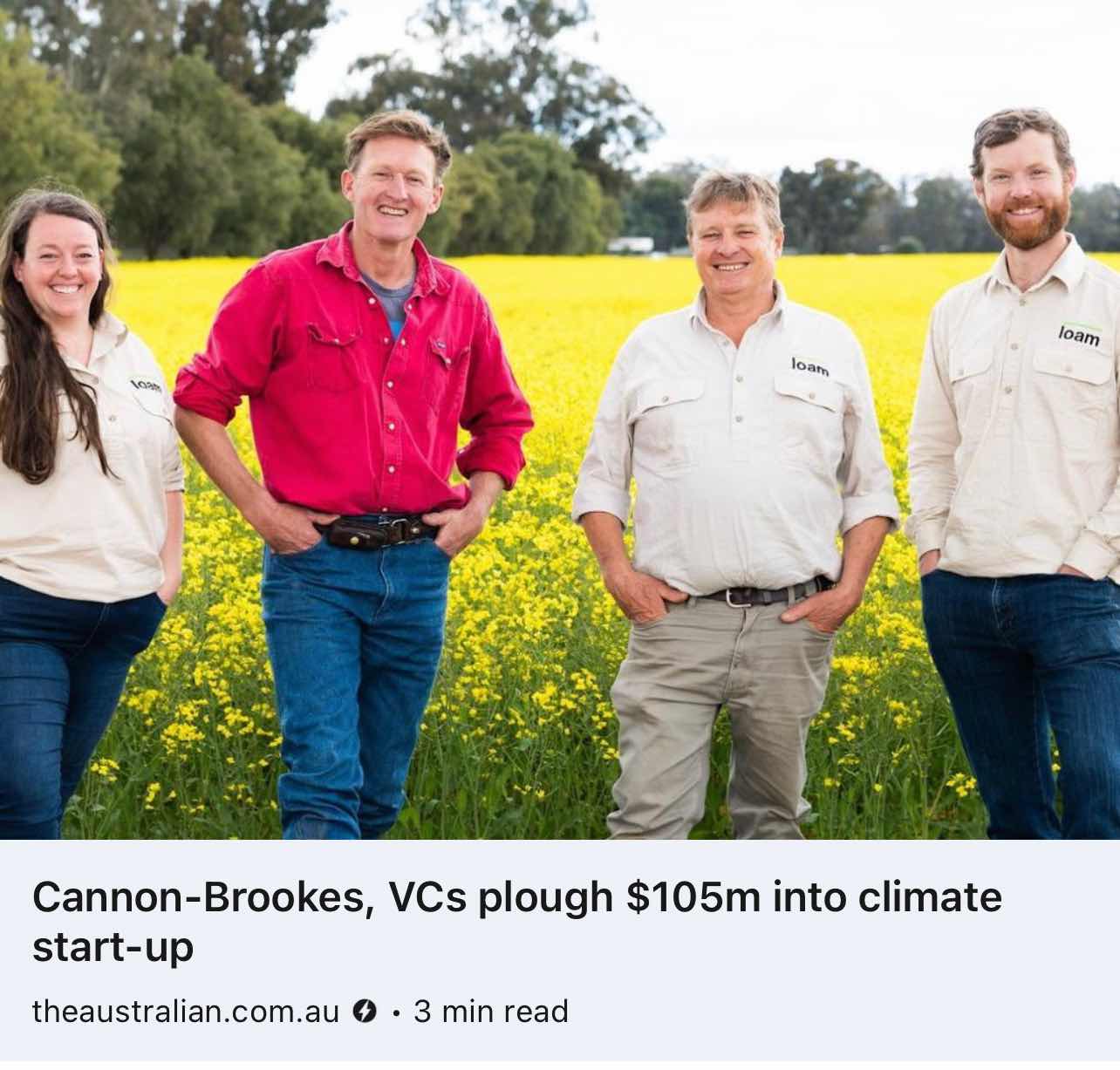
Guy Hudson and Climate Startup Loam bag $105m


Tech billionaire Mike Cannon-Brookes has joined venture capital outfits including the CSIRO-backed Main Sequence, Lowercarbon Capital and Wollemi Capital in ploughing $105m into one of the nation’s fastest-growing start-ups, Loam, which is launching its carbon removal technology in the Australian market.

After years of research and product development, Loam is this week debuting its microbial technology, which chief executive Guy Hudson says will enable farmers to capture carbon from the atmosphere and store it stably in soil, allowing them to both generate revenue and tackle climate change.

The start-up has received backing from Mr Cannon-Brookes’ family office Grok Ventures, in a blockbuster Series B round co-led by Lowercarbon Capital and Wollemi Capital with participation from Horizons Ventures, Acre Venture partners, Main Sequence, the Clean Energy Finance and others, bringing Loam’s total funding to $150m.

The start-up’s previous backers include TIME Ventures, a venture capital firm led by billionaire Salesforce CEO Marc Benioff and Canadian billionaire Tobias Lรผtke, the founder of e-commerce company Shopify.

The company, which was founded in Orange NSW in 2019, did not disclose its valuation, but the raising is one of the largest for an Australian start-up in 2023 to date. It now has dozens of staff working across four laboratories in Australia and the US.

“The role of beneficial fungi in agriculture has been hugely underexplored. We’re only just starting to understand how important these organisms are in the ecosystem,” Mr Hudson said.

“By applying Loam seed treatment, farmers can accelerate a path towards healthier, more productive soils by building soil carbon more quickly, which benefits resiliency and productivity. It also provides the opportunity for farmers to diversify revenues into natural capital markets and carbon markets.

“Microbial science has an enormous role to play in addressing climate change.”

Read more:
https://lnkd.in/dGaQ2Xr8

Friday, February 17, 2023

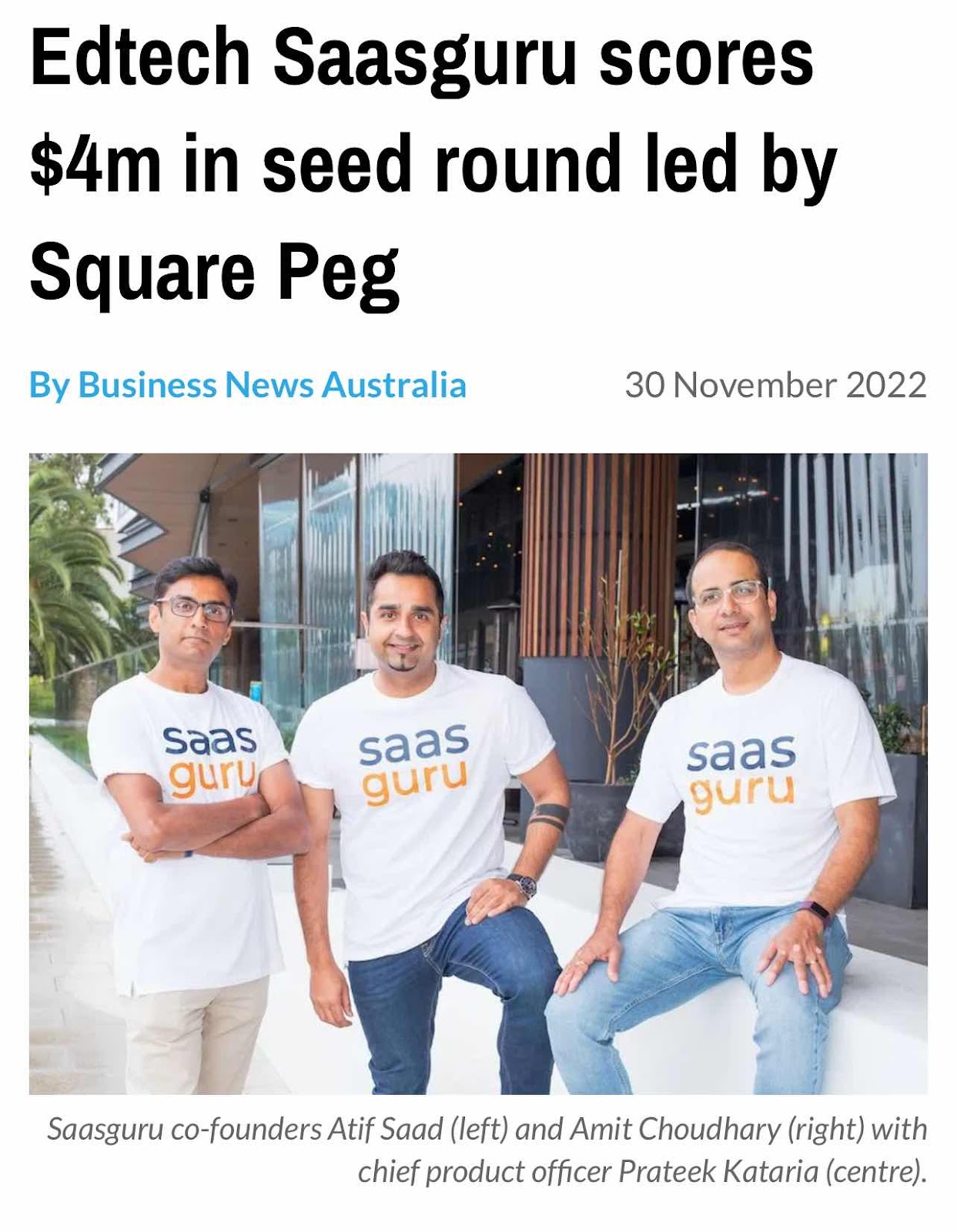
Edtech SAASGURU raises a seed round of $4m in Nov 22after raising $1.3m a year ago


SAASGURU - an edtech providing  cloud skills and certification - Founded a year ago with seed funds of $1.3m ,- have raised  a seed round of $4 million from Square Peg , Blacknova and Antler  -  to further build out the company’s technology stack.


The team have done it before! 


Amit Choudhary (CEO) and Atif Saad (CTO) sold their previous venture Saasfocus to US IT firm Cognizant (NASDAQ: CTSH) in 2018.


What is Saasguru 


Founded in mid-2021, Saasguru is an e-learning platform where more than 40,000 users from 20 different countries are upskilled by  studying cloud systems From  20 different cloud consulting companies and mentors and a personalised TikTok style micro-learning platform.


Through Saasguru, the co-founders are looking to train the next generation of workers that will 

require cloud computing skills in their careers. 


In his previous salesforce consultancy  SaaSFocus, Choudhury would hire new recruits and train them to become skilled and billable consultants. This has become the “secret sauce” of SAASGURU”


What SAASGURU does 

  • provide certifications on AWS and Salesforce 
  • an initial benchmarking exam, 
  • tools that adapt to the individual’s learning style and knowledge gaps, 
  • a gamified platform showing how they stack up against their peers and offering challenges.
  • A network of more than 100 experienced ‘gurus’ share snippets of advice via short TikTok-style videos.
  • Once the learner’s dashboard is green, they’re ready to take their certification exam. 


For those that have used the platform for as little as two weeks, pass rates are currently at about 90%!


The Market 


According to Amazon Web Services (AWS), the need for cloud computing skills in the Asia Pacific (APAC) region alone will triple by 2025, requiring about 109 million individuals with those skills from a base of 37 million as of 2020. 


Since 2021, the company has added a variety of learning programs to its platform covering Salesforce, ServiceNow, AWS, GCP and Azure. 


Saasguru says it plans to use the investment to expand into more high-demand cloud certifications.


Business Insider talks to Choudhury 


“We want to play a leading role in solving the global cloud skills crisis and supercharge cloud skilling and certification,”


“Edtech has become an e-commerce like experience for users. All users are getting is an overload of content with aggressive subscription models.”


“Saasguru is disrupting that with a personalised learning experience, supported by our gurus and leading to a very tangible outcome of skills, certifications and jobs.”


“While we are a for profit, and a for-impact company,”


“We provide pro bono cloud skilling and certification for people from a situation of disadvantage to change their life with future-ready skills.”


“Over the next five years we want to become the most loved and trusted platform for anyone looking at starting or growing a career in the cloud industry.”


“Securing the backing from Square Peg will be invaluable in providing support and contacts, and lends a certain credibility to the business.”


Business Insider speaks  to Square Peg 


Square Peg Capital principal Lucy Tan also acknowledged the role Saasguru might play in satisfying demand for skilled cloud computing workers.


“There is a massive cloud skills shortage in the industry that is slowing down digital transformation initiatives undertaken by businesses,” Tan said.


“Universities are not well equipped to solve this skills shortage as the skills update so quickly. This means post-university upskilling is critical for continued business growth and Saasguru provides a personalised learning pathway for cloud professionals to embark on, helping them get skilled and certified in cloud technologies.


“This can make a meaningful impact on people’s lives from either landing them in a new career or getting salary increases. We’re excited to continue to work with Amit, Atif, and the team on their journey to help close the skills gap in the cloud computing industry and empower millions of workers to take on new careers.”


Between remote working and learning, and a tech skills crisis, people in this space seems to be in the right place at the right time .


NEXTTECH Learning are excited by the opportunity 


Cassandra Parton CEO of Nexttech, Australia’s premier Tech Learning business agrees - Lack of talent is the “number one challenge for the IT industry,” and providing a steady stream of talent to a market - hungry for relevant expertise is the wholly grail , and we are priviliged to be in this space.


Welcome to the Nexttech Revolution 


Source https://www.businessnewsaustralia.com/articles/edtech-saasguru-scores--4m-in-seed-round-led-by-square-peg.html