Saturday, April 29, 2023

Rosterfy raises $9.8m from VC Bailador


Founded in Geelong by Bennett Merriman, Shannan Gove and Chris Grant in 2015 , Rosterfy raised $2m in 2019 and a further $4m in 2021 at a $30m valuation hitting a $3.3m  with 100 Customers, and  a team of 23, with 7 engineers. 


Rosterfy , 2 years on has raised $9.8m from Bailador - an ASX listed VC,


So - what does Rosterfy do? 


Rosterfy manages more than 1.5 million volunteers in more than 20 countries, providing  volunteer and workforce management software to not-for-profits such as Lifeline Australia and St Vincent de Paul Society, and was used to manage volunteers during the 2022 FIFA World Cup in Qatar and the 2023 Super Bowl in Arizona.


The SaaS platform allows organisations to recruit, screen, train, and schedule their volunteers better engage and retain them. Their mission to connect communities to events and causes they are passionate about.”


Bennett Merrrman tells Sentinel that they are excited to leverage Bailador’s experience in successfully scaling Australian-born SaaS businesses globally and welcome both David Kirk and Michael Hayes to the Rosterfy board.


 “This is the start of the next exciting chapter of our growth and timely acknowledgement that our global team and platform are making a real impact.”


So, who is Bailador and what is their take on the VC market 


Bailador has positions in eight companies after e-furniture company Brosa was wound up in December.


Michael Hayes, investment director at Bailador points out to tech reporter of the AFR Tess Bennett that Investors are  saying ‘no’ to high valuations and that the appetite for growth at all costs had ended .  


The latest Cut Through Venture figures show that of 82 deals, only $661 million was raised in the first three months of 2023, compared with $1.8 billion in the final quarter of 2022. 


“Companies needed to demonstrate they have  a path to profitability, with strong fundamentals and  unit economics so they’ll scale to profitability over time,” says Hayes 


We will support these companies - and  have recently invested an additional $10 million into existing portfolio company InstantScript, a digital healthcare platform, to took its holding to 30%.


Source 


https://www.afr.com/technology/why-fintechs-are-facing-the-same-problem-as-milkrun-20230416-p5d0uz

Friday, April 21, 2023

$300m for Climate And Sustainability companies

Abe Yokell’s Congruent Ventures Raises $300 Million for Climate Startups and will now have more than $700 million in assets under management. 


The fund will  help its stable of climate-focused startups  scale their operations,


Investors include

  •  the California State Teachers Retirement System —
  • Grantham Foundation, 
  • Sobrato Capital, 
  • Three Cairns Group and 
  • investors advised by Cambridge Associates.


 Two  of Congruent’s companies had already been acquired by oil giant BP Plc: Amply Power, which offers electric vehicle charging for fleets, and Blueprint Power, which provides energy management for buildings. 


The Yokell gem 💎 

“A story is not going to get you a good exit, here,” he said, in an interview. “You’re going to have to build good companies.”

Sunday, April 16, 2023

why so many cofounder relationships fail and what you need to do to find the right co-founder


Phil Morle - has seen many startups - and those that succeed usually have co-founders. 


“The best advice I could give to a new startup founder is to find others to share the journey.” -Forbes Ludovic Huraux ceo shapr 
  • Cover your weaknesses
  • Gain perspective 
  • Build together
  • Mitigate risk 


So how do you find the ideal co-founder ? 
You don’t! They will find you !- says Phil 


He shares his take on why so many cofounder relationships fail and what you need to do to find the right co-founder 


These are some of his insights 


Finding cofounders is so hard is because lots of people like the idea of building startups, but few people are capable of devoting the kind of effort that you are prepared to give to make a viable idea into a functioning, sustainable, scaled-out business. As a result, most cofounder relationships fail because of an uneven commitment to the venture.


If one founder believes another founder isn’t as committed, resentment will brew and ultimately rip apart the founding team’s relationship.


So what does your co-founder  need to do to earn his/her stripes? 


  • work 24/7 just because they think your project is interesting 
  • Be as committed and passionate as you about the project 


This is the gem 💎 


“The right cofounder won’t need to be sold. All you’ll have to do is tell the person what you’re working on. The right cofounder is going to sell him or herself on the project and then start pushing you to let them work on it.”


So tell as many potential cofounders about your startup as possible, then be patient and wait for the right cofounder to chase you. It’s going to feel like a nearly impossible test for both of you, but, when you both pass it, you’ll have finally found a great cofounder.”


Some interesting links 


https://entrepreneurshandbook.co/great-startup-cofounders-have-to-pass-this-one-nearly-impossible-test-eed7f3c1f137


https://www.linkedin.com/posts/pmorle_great-startup-cofounders-have-to-pass-this-activity-7050021837388333056-syn8?utm_source=share&utm_medium=member_ios


https://www.google.com.au/amp/s/neilpatel.com/blog/finding-perfect-co-founder/%3famp


https://startupsavant.com/do-you-need-a-co-founder-for-your-startup


5 key insights on how to grow a successful business

So we came out of a meeting identifying how we are going to grow 


These were some of the takeouts 


  • Creation of new products to drive revenue growth
  • Determine whether the business is B2B or B 2C
  • Automation of systems
  • Sharing costs
  • Growth by acquisition - “roll up”
  • Territorial expansion
  • Hiring the brightest and best 
  • Great marketing 


After years of building businesses , watching other businesses grow into unicorns , failing forward and being an entrepreneur - 


These are 5 key insights  on how to grow a successful business 

  • It’s  all about the people - build a great culture
  • It’s all about the brand
  • Know your numbers 
  • Do your due diligence when doing mergers and acquisitions 
  • Take action 


It’s all about the People 


As you grow - it’s all about the people in your team. 


How do you hire them , how do you retain them , how do you upskill and reskill them ?


Recruiting 

How do you find and recruit the brightest and best ? 


Some  of the questions to ask in hiring your team 

  1. The Big Why – why do they want to join us and not other companies?
  2. Communication skills – can they communicate their thoughts well in clear concise manner?
  3. Technical, qualification and work experience – The CV stuff
  4. What’s their 10X-factor – the “umph” in their application

It’s not all science.


People who do amazingly well during interviews – underperform

People who are ok during interviews – outperformed .


The 3 months probation period is key  - use it!! 


Retaining 


The Culture of the business 


Culture is key if you’d like to build, retain and grow a high-performance team.


What are the successful people doing? 

Richard Branson , Apple , Google, Atlassian and Canva 


They know that by treating their people right and having a conducive and fun work environment, it will trickle down to their product development, innovation , customers, suppliers and other stakeholders.


Their formula:

Happy employees = Happy customers = More revenue = More profit


How do you get your team to connect, communicate, collaborate , contribute , learn and grow together on a continuous basis? 


Maybe this? 


  1. Daily huddles - meetings between team members - to make sure they feel part of a team 
  2. Water cooler chats -Weekly meetings with leadership team
  3. Monthly Town Hall - a relaxed event where you share key wins and make jokes. 
  4. A blog for your group where we encourage our team to post and share stuff about them 
  5. Objective - Share your vision, values and goals - and ensure they are aligned with our team 


The goal is to ensure that  your team  knows your mission, vision and behaves in a certain manner according to your values and to get everyone on the same page.


BSI values - TREAT

  1. Team - No Finger Pointing Policy – Operational screw-ups happen. Don’t finger point! 
  2. Respect Appreciate One Another – Say thank you and buy each other lunch!
  3. Energy - Work hard, play hard – Have regular meetups , forums , sports and  lunches  (maybe forums where we can share experiences - good and bad - collaborate learn and grow together . 
  4. Action and adventure – Do things now, not later –Always be Experimenting – take risks (tour team has your back ) Experiment on new features/products that will drive company growth.
  5. Trust Open Communication – Be honest and open with each other. If you haven’t got trust amongst your team and stakeholders - it will be nigh impossible to survive 


The goal is to ensure your team knows your pulse ! What makes you tick? What is your mission ? What is your vision ? 


Bsi’s pulse is to help you achieve your generational legacy  and by doing so build a $100m plus organisation within the next 5 years !


Every Town Hall should talk about your vision and  “treat values”and repeat them until our team gets it and they can repeat it in their sleep.


It’s all about The Brand 


Get your funnels and UX nailed!


Nail you digital strategy and expertise - become the centre of influence in your target market 


Digital marketing is key -  includes all our Google , LinkedIn and Facebook ads campaigns.( if you do it yourself look at  Quick Sprout and Backlinko. ) 

SEO in terms of click throughs, funnels and copywriting, A/B testing, measuring  clickthroughs and conversions .


Make sure all has a call to action 


Why did it work? Not quite sure.


Some tips 

  1. Catchy headline that states the problem
  2. Reaffirm the problem
  3. Mention the solution
  4. Soft sell with call to action
  5. Provide customer testimonials
  6. Remove customer objection
  7. Provide bonus/money back guarantee, if any
  8. Hard sell and provide call to action


Special thanks to Haryzat Zulzahary for this formula.


Make sure the look and  feel of the website and app is amazing - it is your shopfront and needs to cut through !


Do you have apps for clients to use ? 


Build an app for your customers to use …. Make it easy for them to engage 


KPIs is to create a Facebook post that gets at least 100 shares, on a monthly basis.

This led to many experiments on how best to generate shares which in turn leads to brand awareness.


Don’t do it yourself - get the best 


What this means is instead of a simple ad with body text of about 50-75 words, we created an ad with 500-600 words of content complete with headline, copy and call to action.


Know your numbers 

What you can measure you can manage 


  • How many leads to get how many proposals to lock in the sale 
  • What is your  cost per engagement was consistently below 10c . Sometimes as low as 1c .
  • What’s your margins
  • What’s your break even 
  • What’s your cash flow forecast - what’s your runway 


Here are some amazing calculators to help you know your numbers  - BSI Health check 

https://bsi.skillsoptimiser.com/BusinessHealth


Do your due diligence when doing m and a 


Before making an opportunity and taking on an acquisition  - analyse it - cheap often turns out disastrous ….. it’s a fine balance …. 


Do you take a huge bite and chew like mad ? 


The potential growth in top line revenue might be great but what about the costs and focus? 


If decision is a bad one - cut early - and take your losses or punishment 


  • people management and leadership - are key - communication clearly your vision, goals and KPIs 
  • delegate and outsource - ux ,digital marketing ,
  • Give people what they want and you will get what you want 
  • Know your numbers 
  • Do your due diligence and take action 


I recommend 

  • reading John Maxwell’s books 
  • Doing a Dolam (diploma of leadership and management )
  • Being part of a forum where people collaborate learn and grow together 
  • Have a session with someone to get to know your numbers (dm me and I will do this with you - no charge! ) 


Saturday, March 25, 2023

Managing Risk for Tech Companies and Developers in Light of SVB

Great advice from Ross Chaldecotte of Kinde - talking ways to manage risk for startups and tech companies looking to scale…..


Thankfully it looks like Silicon Valley Bank (SVB) customers will retain all of their funds. Kinde was never directly impacted as we bank in Australia with one of the big 4 banks and utilize Airwallex for our international transactions. It did, however, make us painfully aware of the risks of keeping all of our eggs in one basket (not just around banking).

Here are some of the approaches we’re applying to help distribute risk and protect our customers and team (most of these are already in place):

* Always have at least 2 bank accounts and distribute funds between them so that there is never a central point of failure. Make sure that banks used are truly different entities and are federally guaranteed. Ideally cap account limits to insured limits – but this seems an unlikely / impossible scenario with large amounts of funds.

* Make sure we have up to date records of balances and statements to prove balances should we need them.

* Make regular backups of our critical software systems so that if any one point fails we can roll to a secondary as fast as possible with minimal loss. We looked at the scenario where a third party like Xero or Stripe got taken down by SVB failure and realized the knock-on effects could be quite large.

* Build redundancy into everything that we develop. We build with a rule of 2. Which means that every integration we use should be deliberately built with a minimum of 2 vendors in mind. For example, if we use Stripe, we will also build for Adyen or Worldpay. This is better for our customers as they gain choice and can use their preferred vendor, but it’s also better for us, as it doesn’t lock us in and protects us from catastrophic failure.

* A complete AWS failure seems highly unlikely and if it occurs would be a catastrophic event far larger than Kinde. Most of the world would be reeling and the majority of customers we work with would also be hit directly. In the event that service here did not return, standard best practice would apply. Code is stored in both github and locally, and database backups are made regularly. We would be able to have Kinde back up and running fairly quickly on an alternative like Google Cloud. Assuming the zombies hadn’t eaten us all by then.

* To protect our own customers, we continue to have strongly defined business continuity plans and our software in escrow to ensure we are protecting our customers in the event of our own failure.

We’re still working through it and I’m sure there are other things we will encounter along the way.

It would be interesting to know what others are doing that I’ve missed. Feel free to post in the comments.

#svb #siliconvalleybank #riskmanagement #risk #redundancy #software #banks 

Tuesday, March 21, 2023

Mark Gustowski talks about the importance of cash and reducing burn


To say that the current capital markets are challenging would be an understatement. 

The tech ecosystem has come out of what can only be described as enormous orchestrated bubble, fuelled by 
  • endless printing of money during the pandemic, that ultimately led to 
  • high inflation, 
  • interest rate hikes, and 
  • massive job shedding.

Could it have been avoided with foresight and measured fiscal policy? Sure but let’s not let a good fiscal management in the way of government elected terms. 

But what does this mean for our startup sector? Well if you raised during the bubble well done, hopefully you raised enough to give you another 24-30 mths of runway. If you didn’t, and you find yourself going to the well again in the next 12 months, be prepared for down-rounds. Valuations have dropped, from Meta and Stipe through to startups.

Is it all bad? Not necessarily, it’s a normalisation of the market and valuations but I do worry about the 2021 and 2022 investment vintages, returns are going to be a real challenge for them.

Cash is king 


So what now? What do VCs like Mandalay Venture Partners look for in a deal? Well for starters you better be sure to be raising for 18 months or more, preferably 24 to see you through the current period. 

Austerity means slowing growth, managing burn and understanding the all important ‘burn multiple’. 

Growth for growth sake is no longer the metric, it’s now efficiency of growth that will make you stand out. 


If you’re a founder you best get your head around the concept of ‘burn multiple’ really fast. Investors will be looking at your spend (burn) vs your revenue and doing back-of-the-napkin assessments to ascertain how sustainable your business is going to be. 

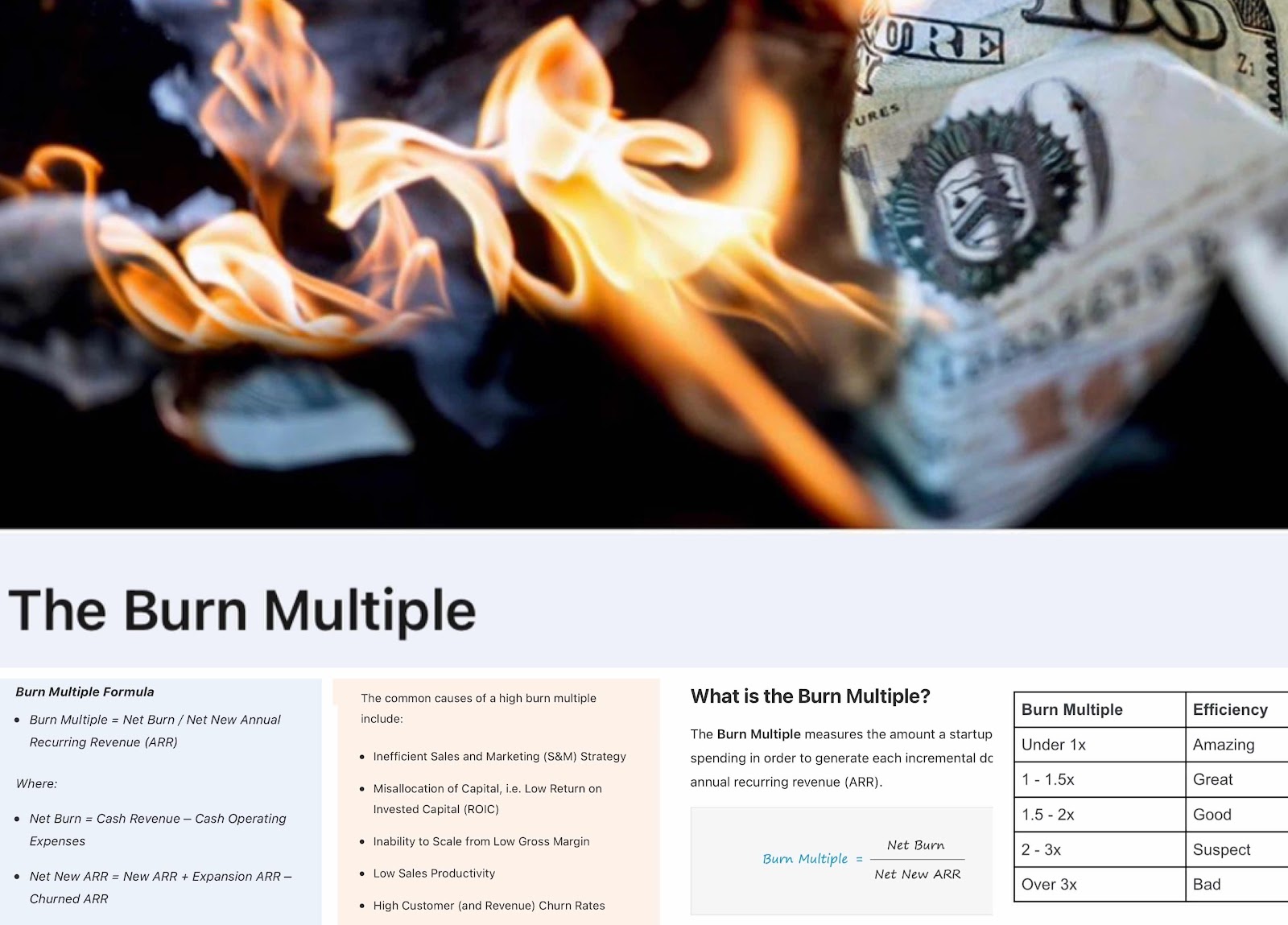
https://bsivc.blogspot.com/2023/03/david-sacks-burn-multiple.html


the Burn Multiple - the inverted Bessemer ratio shared by David Sacks 


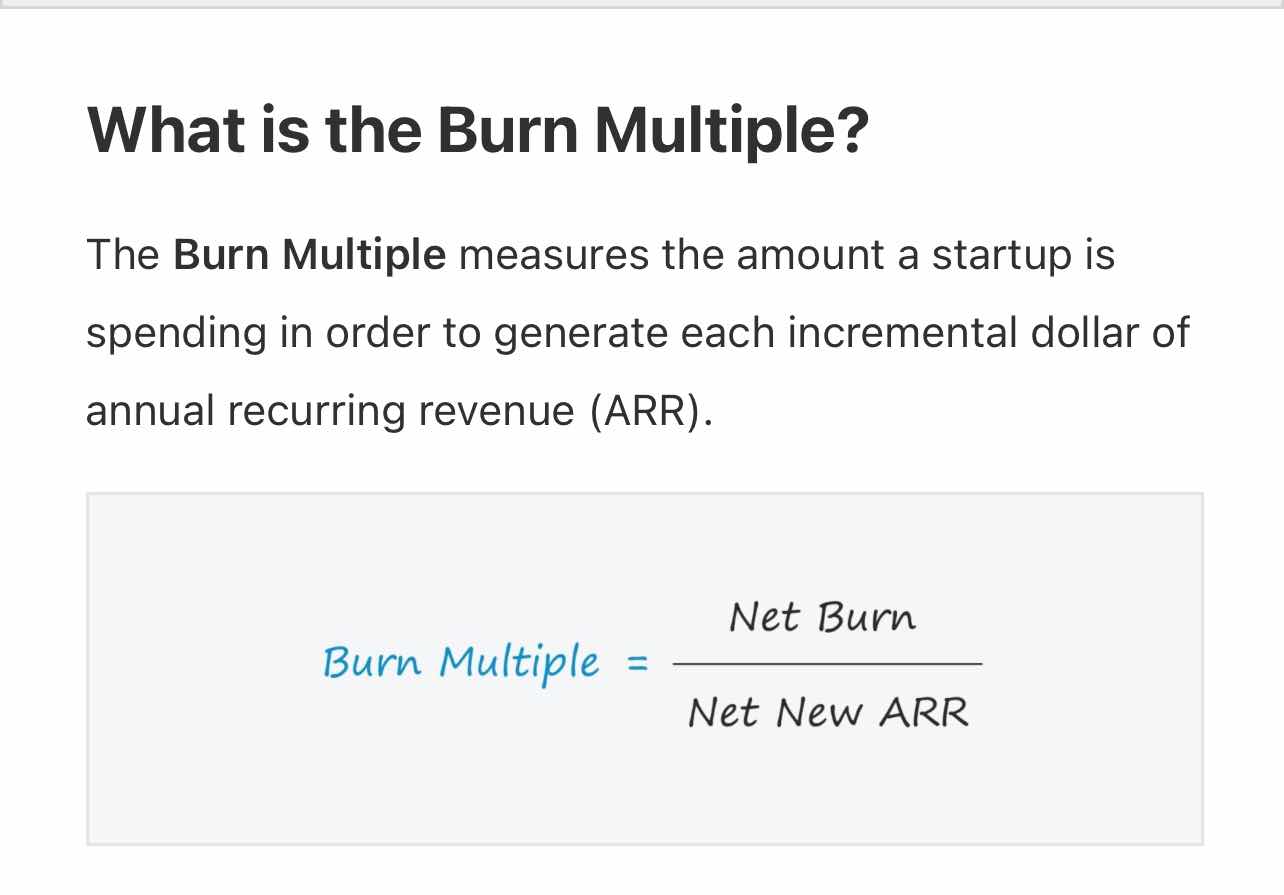
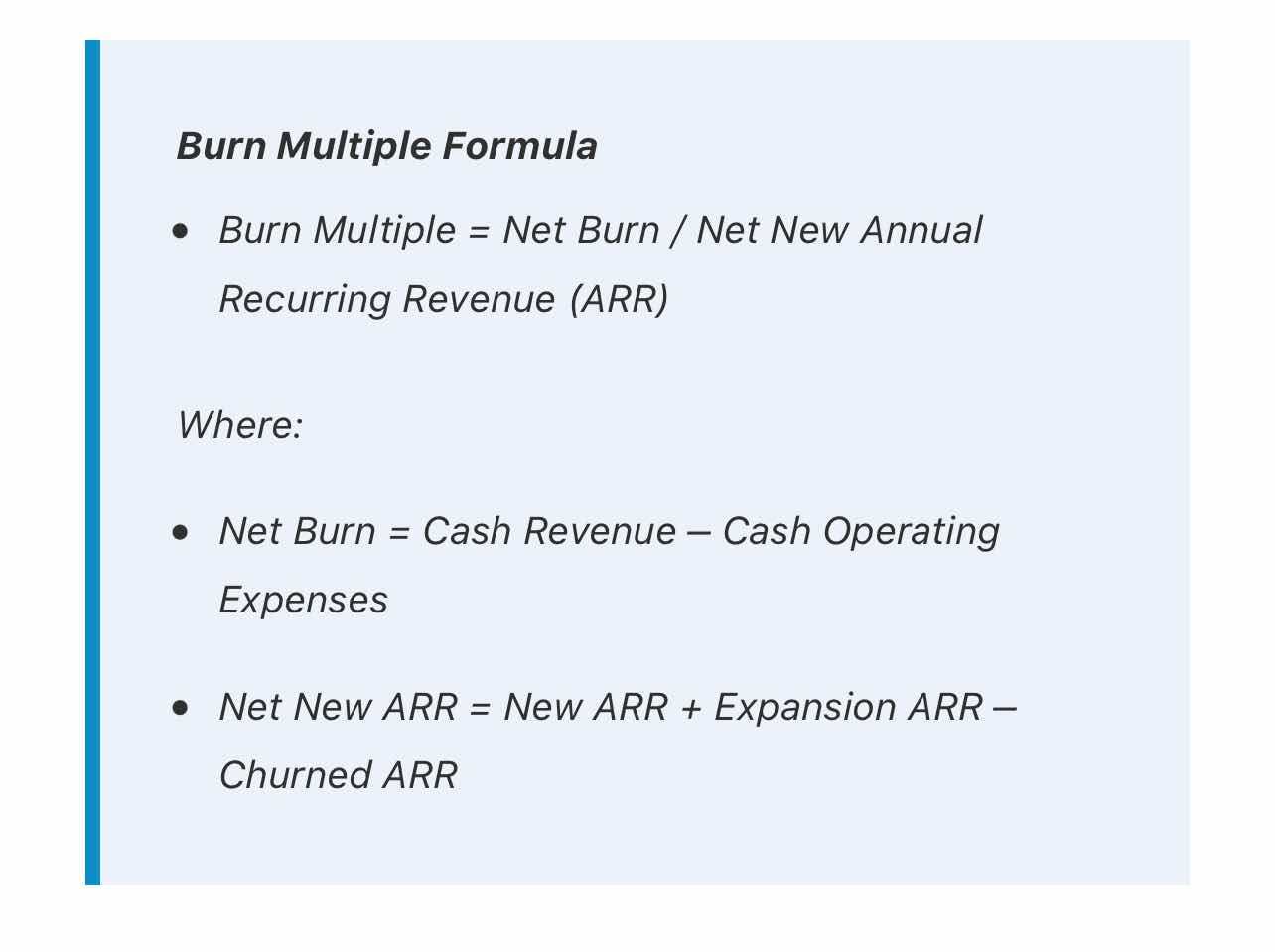
Burn Multiple = Net Burn / Net New ARR

In other words, how much is the startup burning in order to generate each incremental dollar of ARR?

The higher the Burn Multiple, the more the startup is burning to achieve each unit of growth. 

The lower the Burn Multiple, the more efficient the growth is.

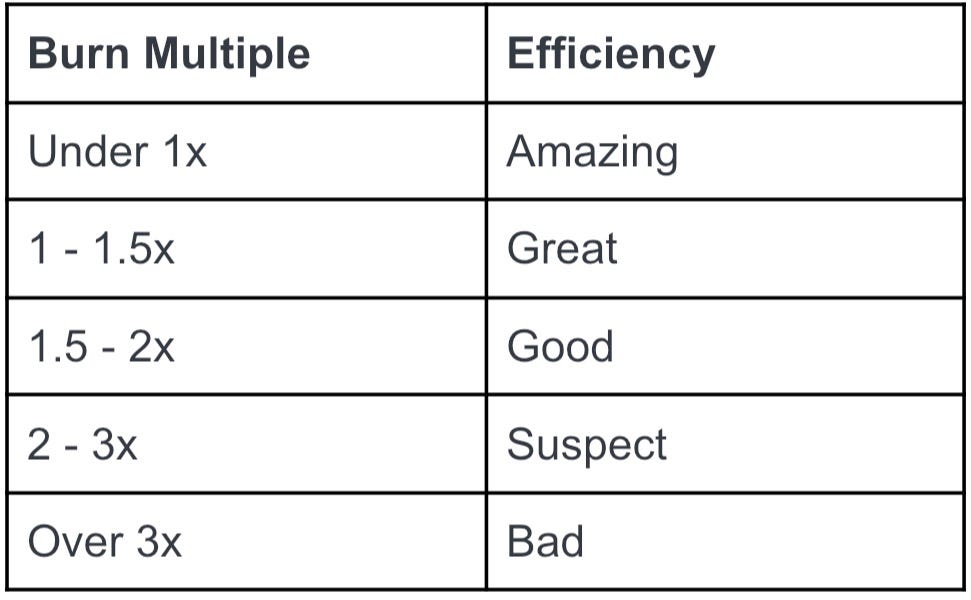
For venture-stage startups, these are reasonably good rules of thumb


So when raising Seed to Series-A and beyond, consider the following:

👍🏼18 months runway is ok, 24 months is better 
👍🏼cap salaries and remunerate via ESOPs that can reduce burn 
👍🏼if new markets are exceeding a burn multiple of 3-4, reconsider for now
👍🏼managed growth is ok, cash is king
👍🏼mark to market regularly 

This is not the environment you want to be raising in twice in the same 18 months. Money is going to get tighter as interest rates continue to rise to curb inflation. It’s going to be hard to attract dry powder as venture returns become less attractive with other capital allocation assets. 

Learn about the concept of burn multiples in austere times (see attached article). Great opportunities will still be funded but we are no longer in a ‘blitz-scale’ era; your growth and market strategies need to reflect that. 

A good investor will help navigate these waters. We don’t expect founders to understand all the underlying macro economic issues, but it is our role to help you chart a sustainable path forward. 

Don’t be afraid to ask questions, test assumptions or reach out as it’s the best way for us to get through this together. 

#startup #capitalmarkets  #tech #investment #venturecapital #venture


David Sacks - the burn multiple


David Sacks of PayPal, Twitter and All in game talks about a burn multiple

Two simple ways to measure capital efficiency are the Hype Ratio and Bessemer’s Efficiency Score:
  1. Hype Ratio = Capital Raised (or Burned) / ARR
  2. Efficiency Score = Net New ARR / Net Burn

David  think Bessemer has the right idea but prefers to flip the numerator and denominator, so the ratio is an annualized version of the Hype Ratio. 

He  calls this the Burn Multiple:
Burn Multiple = Net Burn / Net New ARR


  • A gross margin problem — If the company spends too much on COGS in order to deliver the product or service, its burn will increase rapidly as it scales. If there’s not operating leverage in the business, the Burn Multiple will not improve with scale.
  • A sales efficiency problem — If CAC is prohibitive or sales productivity is diminishing, burn will increase relative to new ARR, causing the Burn Multiple to worsen even though growth continues.
  • A churn problem — Churn will net against the denominator of the Burn Multiple, causing the multiple to increase. A leaky bucket makes it hard to grow efficiently.
  • A growth challenge — If growth is stalling, the company may seek to compensate by spending more on marketing, give-aways, discounts, or promotions. That will be picked up in a higher Burn Multiple, as burn rises faster than new sales.
  • A founder leadership problem — If the founder lacks the skill or will to control burn, that will show through in the Burn Multiple.

Eventually, for a company to become profitable, burn must reach 0, which implies that the Burn Multiple should also approach 0 over time.