Showing posts with label ausindustry. Show all posts

Friday, October 03, 2014

Big Corporates - Innovate or Die!!

Innovation is becoming the buzzword - not only in the innovation hubs of startups - but also in the land of the big corporates

Indications that the Bureacratic Disease is setting in
  • Are you starting to defend your margins through pricing?
  • Is bureaucracy rife and issues re people trying to maintain their positions an, titles and jobs a problem?
  • Is it a mission to do something different?
  • can you relate to the drain phenomena?
  • Is the early vision of your Company exhausted?
A growing number of large brands are investing in non-core innovation for Growth. They must.
Disruption knocks. For some, disruption has all but destroyed the current status quo.

As my mentor Allen Pathmarajah says - when the rate of change on the outside is greater than the rate of change on the inside, the end is near.

there are 2 fundamental reasons why large corporates don't thrive in innovation
1. risk appetite is low and
2. fear of failing

Below are 8 examples of how organisations have started to infuse innovation into their culture
  1. Silicon Valley outposts, Nestle detting up a facility there
  2. Telstra supporting Muru-D
  3. Google supporting Fishburners
  4. On-Premise accelerators: Polleniser incubating Spreets
  5. Co-location with entrepreneurs, such as the RocketSpace model in San Francisco (soon             NYC and London)
  6. Continual learning - The Innovation Masterclass and the 10X Coaching Club and its                   accredited Business Diploma
  7. Attending investor forums
  8. Create a space where its ok for risky behaviour and the ability to push the edge with the             comfort that its ok to fail 
Many organisations need a good dose of new leadership to make innovation real and sticky.

Innovation is not a nice to have - its a necessity - and its good business.

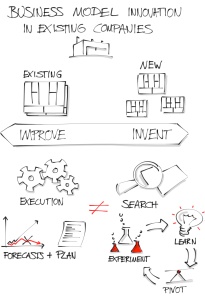
Steve Blank talks about innovative businesses needing to both improve and invent!


So - in summary
  • Continuous disruption will be the norm for corporations in the 21st century
  • Continuous innovation – in the form of new businesses-  will be the path for long term corporate survival
  • Current corporate organisational models are inadequate for the task
  • Look to set up an Innovation Mastermind Group

The video below ( emphasizes that companies will need to have an organization that can do two things at the same time:  executing and improving existing models and inventing  – new and disruptive – business models.


When I speak to a founder of a start-up - it really gets my juices flowing 

They don't talk about building a lifestyle business (which represents 90% of all SME's). My Dad was a pharmacist, and his why was to earn enough money to live well, feed and educate his family and enjoy a day at the races to get is adrenalin pumping…..

Founders of Startups talk about

  • How they are going to change the world by doing something important
  • They are disrupting
  • They are making a massive difference
  • They are going to take over the universe
  • They are excited and they are on a mission

DO you think there should be a position for an Chief Innovation Officer? 
Can this position be outsourced? 
Would you like to learn more about innovation? 


  • -->

Sunday, August 17, 2014

The difference between a startup and a small business


An article inspired by smart company - (which is in my Spark collection on #keynected ) http://keynect.me/2j

Download keynected - it's like a flipboard on steroids! 

“Startups have two important defining characteristics: Potential for high growth and disruptive innovation. Small businesses, on the other hand, lack those defining characteristics.”

– Alan Noble, head of engineering Google

“A startup isn't a business yet. It's a guess that if you build X product that Y customer will value it. When that changes from a guess to a reality, you're a business. For a new business, they already know the product is valued by customers, it's just a question of whether they can find enough of them and deliver it efficiently.”

 Mick Liubinskas, entrepreneur in residence Muru-D

“A startup is a temporary organisation that is still discovering its purpose and intends to grow very large when it finds it. A small business knows what it is and will probably stay comfortably small forever.

“For example, YouTube was a dating site in its days as a startup but discovered it needed to be a video-sharing product. When it knew this, and understood how to make money, it ceased to be a startup and began scaling. In contrast, a web development agency has a well-understood business model that can immediately be executed. But it is unlikely to be a massive business.”

– Phil Morle, CEO Pollenizer

“Startups are high-growth, high-risk ventures that set out to find a scalable business model in a large market. They almost always have a strong technology component in order to facilitate the ambitions of rapid growth. At the very beginning of a startup, it is usually unclear who the customer is and how they will obtain value from the product.

“Over time, startups have the capacity to make economic and cultural contributions that are disproportionate to their modest beginnings.”

– Scott Handsaker, co-founder Startup Victoria

Saturday, August 03, 2013

Is the 206 billion deficit the core issue in our Australian elections?

My politics are "agnostic" - I think the political system and policies of Labor and Liberal are both good.... however I am not cool with lies and deceit!

The Australian's article this morning ht a chord with me


"THE era of Kevin, interrupted by the Julia interlude, has been a roller-coaster ride. Having promised fiscal conservatism, the excuse of the global financial crisis unleashed a period of rapid growth in government spending, successive budget deficits and mounting public debt under Kevin Rudd's guidance.

Now, with Rudd's return, Labor has launched a charm offensive that seeks to whitewash the past: it is as if aliens from Mars, fortunately departed, had been in charge. But the damage of that era cannot be wiped out so easily.
Will the electorate forget Rudd's past as he seems to have done?"

... so here it goes!!

Before Australia can continue to go forward economically, we need to identify what the problem is before we can fix it...

What is that problem?

Is it Bad fiscal management?

"The Commonwealth's balance sheet has shifted from $44.8bn in net assets when Rudd took office to $161.6bn in net debt this year..... a $206b turnaround!

a shift from a budget cash surplus, averaging 0.9 per cent of gross domestic product during the Howard years to a cash deficit that exceeded 4 per cent of GDP in 2010. "

This in itself might not be a bad thing.....has the money been used for good purpose. It is interesting to provide a score of 1 - 10 on the following questions (KPI's)
  • Has that debt resulted in an increased asset base for our country, that will lead us to sustainable growth for the future?
  • Stave off the negative effects of a worldwide GFC
  • Are the people happier, better off, worse off?
  • Has our infrastructure improved?
  • Roads, trains, bridges, education, healthcare, security, leisure time, etc?
  • Sustained benefit for the community - such as healthcare, edcation , security
  • If they spent to facilitate commercial enterprise and SMEs
    • export, 
    • r and d, 
    • innovation,
    •  infrastructure, 
    • workplace education, 
    • leadership programmes, 
If the blowout was to support something that is beneficial for the shareholders (the people) that generates revenue and sustained benefit instead of trying to kill business, they would have lots of revenue and could spend what they have.
But they seem to  just keep going back for another piece of the beheaded Golden Goose and seem to spend it on unsustainable 

 Joe Hockey's comment  "We don't have a Revenue problem, we have a spending problem." should be finished by .... "on things that are not sustainable or beneficial to the public!"

The past decade from mining has resulted in a massive revenue windfall
Increase demand of resources to china and India and massive increase in the price of steele ($30 to $130 per tonne).
What are the things we can do to make this revenue sustainable?

What did we do with this revenue? 
Did we spend it on infrastructure that would increase productivity?
 Or
Did we blow it all on tax cuts and subsidies to inefficient private services, wasteful programmes (batts, school rorts) ,public bureaucracy (increased politician wages), badly managed programmes (blowout of NBN)

What if we took  the wasteful spending out of the picture... Imagine it was never spent...however, continue to support stimulus in a sustained way.....where do you figure the budget would have been today?
Surplus or Deficit

2. Is it Bad Leadership - 
The government needs to be responsible governors and leaders

Living within your means shouldnt just apply to consumers and business... It should apply to government!

Spending capital and debt is a good thing, which can create wealth for individuals, corporates and countries.
however
The debt has to be good debt!
Debt that is used for sustained growth and benefit for the future of the country.

But they just keep going back for another slice of the beheaded Golden Goose !!

It's ok to spend from capital or debt, as long as their is a reason or a plan that this spend will ensure growth and sustained surplus where more money will come in than go out!

Core values
If management
  • stuff up
  • lie
  • don't perform
they need to be held accountable and  fired..... I have never seen a CEO that has been fired for incompetency bad management and bad leadership be returned by the board!

It seems ok to the Electorate (the shareholders) for our leaders to lie and cheat and backstab.... Just because "that's what politicians do"

This is an inditement to ourselves, the people!!  The shareholders should call a meeting to replace the board  and the returned CEO!

HERE'S THE THING!!!

Shit happens, budgets blow out, business turns around, ventures fail.... That's OK, and can be rocks that seem to be in the way, that can act as stepping stones later on! (thanks Paul :))

But if the core values and ethos is where lies and deceit and mismanagement is OK, the end of prosperity is near .....

And that is what the real issue is!

The credibility of this government is questionable. They do not have the moral authority to remain in government, nor can we vote them in based on competent leadership and governance....

Whether it was a Liberal or a Labor government.... My comment above would be the same!

THE OPPORTUNITY
Australia has the opportunity to be the shining light to the world.
We have it all
Resources, Beauty, Peace, Multiculturism, Racial and Religious tolerance,, Good people, Free press, Great Climate, Good Education, Innovative People, Strong International Relationships and a strong Moral Compass

(Just remember Kevin, we were all immigrants, many of us refugees)

Let’s use these assets to build an awesome nation with a sustainable future for ourselves, our children and our future generations...,

Let’s leave our kids an amazing legacy....

We need great leadership based on core values of truth not lies!


Monday, October 15, 2012

Do You want to maximise your export grants?


FEDERAL GRANTS ON HOLD

It has recently come to light that the Federal Government has placed a 'temporary pause' on new grants. It has been confirmed that the Commercialisation Australia program and the Clean Technology Investment Fund, among others, have been affected by the pause.

Swan... we are putting a pause on $2b worth of government grants.
We need a surplus!
While the programs are still open for application, no new grants are being written for the duration of the pause which has been described as a 'normal part of the budget process'. At this stage all background work such as preparation of guidelines and the assessment of applications is continuing as normal, but uncertainity remains regarding how long the pause will last and what will happen to the grants programs following the conclusion of the pause.

EXPORT MARKET DEVELOPMENT GRANT

EMDG is the financial initiative of Australian Government aiming to help and aid current and aspiring exporters.

Do you want to maximise your export grants?
Global and domestic economies are facing turbulent times. Europe’s sovereign debt crisis, the struggling US economy, Australian’s two speed economy and wavering business sentiment are just some of the challenges facing business today.

Australian businesses have historically demonstrated their resilience and resourcefulness during tough times. Initiatives such as EMDG are important tools in bolstering the current account and foster strong, sustainable growth.

The Export Market Development Grant:

• Provides a 50% rebate on eligible overseas marketing costs above $10,000 (minimum spend $20,000).

• Acts to encourage Australian exporters to seek out and develop overseas markets. These markets include goods and specified services and industrial property rights which are substantially of Australian origin.

• Has a maximum grant payable of $150,000 per annum for a maximum of 7 years.

We at BSI believe that there is no better time than now for exporters to plan their activities and to establish or increase their overseas market share.

If you wish to know more please contact us and we will be happy to arrange a meeting for an obligation free initial eligibility assessment.

BSI INNOVATION
Suite 1, Level 3
55 Holt Street
Surry Hills NSW 2010
P: 02 9212 5505

Sunday, September 30, 2012

Steve Blank: How to launch a succesful startup!

The professor who popularized the "lean" movement describes his Lean Launchpad course.

Steve Blank is a Silicon Valley-based retired serial entrepreneur, founding and/or part of 8 startup companies in California’s Silicon Valley. A prolific educator, thought leader and writer on Customer Development for Startups, Blank teaches, refines, writes and blogs on “Customer Development,” a rigorous methodology he developed to bring the “scientific method” to the typically chaotic, seemingly disorganized startup process.

"The Startup Owner’s Manual" was Blank's second book and is a step-by-step guide to building a successful startup, offering practical advice for any startup founder, entrepreneur, investor or educator.
His Customer Development methodology launched the lean startup movement. It is rooted on startups "getting out of the building," talking to customers and using that feedback to develop and refine their product.
I think I saw my guru Gerry Engel in the video! 


Sunday, August 12, 2012

Check Out August Spark

Would love your comments and feedback on how this can be improved.... what articles you want... have you got an article to write... This will be going to 235,000 people!!


Saturday, April 28, 2012

6 things to include in an Investor Presentation

OK, you have listened to Wayne from 10X Sydney and you have had an investor saying "tell me more" - and you want him to invest in your business.... these are the 6 things you need to articulate in a simple, clear presentation.... A powerpoint slide show works well.
  1. The problem and your solution.  What pain are you going to solve? Have you got the "pain killer". This is your hooks, and needs to be covered in the first paragraph. You have articulated this in your 30 Second Pitch.... State your value proposition, and what specifically you are offering to whom. Skip the acronyms, history of the company, and the disruptive technology behind your solution.
  2. Market size and growth opportunity. Is your Opportunity SCALABLE? Investors are looking for a large and growing market. Spend a few sentences providing the basic market segmentation, size, growth and dynamics – how many people or companies, how many dollars, how fast the growth, and what is driving the segment. Skip the comment that you are conservatively estimating your penetration at 1%.
  3. Your competitive advantage. What is your X FACTOR ... how do you make it 10X? Identify your sustainable competitive advantage, like unique benefits, cost savings, or industry ties. Don’t kill your credibility by saying you have no competition. At minimum, you compete with the way things get done currently. Most likely, the investor has already seen multiple plans with similar solutions.
  4. Business model. Who is your customer, what is the price, and how much does it cost you to build one? Do you now have real customers, are just starting development. Outline your sales and marketing strategy (direct marketing, sales channel, viral marketing, and lead generation (what is mobiffiliate?). Identify key quantities, such as customers, licenses, units, and margin.
  5. Your team. Remember that investors back people, more than ideas. Why is your team uniquely qualified to win, and what have they done before? Have you got the attributes of a good leader? Explain why the background of each team member fits, by naming roles and names of relevant companies. Include outside advisors if they have relevant experience.
  6. Financial projections and funding. You need to show your summary revenue and expense projections for three to five years. Investors need to know the amount of funding you are asking for now, and what they get. The request should generally be the minimum amount of cash you need to reach the next major milestone in your plan.The plan needs to be realistic, and you ned to know these numbers like the back of your hand.
Your first page and first paragraph (maybe a picture of your brand) is key. Less is more here, so include the grabber, show your passion and commitment.

Have a feedback form asking them to fill it in.... you are after a follow up meeting, where they are interested in doing due diligence..... That’s your metric to see if you have their attention. It is unlikely that you will have an investor invest after this session.

Friday, April 13, 2012

10 mistakes investors make in Africa, and how to avoid them


Abel Myburgh, Africa Desk Coordinator for BDO

Thu, 12 Apr 2012 11:59


Every year, African governments and big companies issue lucrative international tenders for major projects. Abel Myburgh, Africa Desk Coordinator for auditing firm BDO, offers advice on what companies should consider before and after winning that coveted tender.


Lack of knowledge and planning


Many investors regard the African continent as a single business regime and ignore the fact that there are over 55 countries, which include the surrounding islands. Each nation has its own rules and regulations. Some regions have tried to introduce uniform regulations but on the ground, the applications are different. We have experienced instances where companies tender and win contracts in Africa, only to realise that conducting business is difficult than they expected. We recommend that you start planning early - before the tender documents are filed. There are issues that can influence pricing, deliverability of the terms of the contract, and extracting profits from the specific country.

Lack of knowledge of the business culture in the host country

It is not unusual to find total disrespect for local culture. To avoid this, an in-depth study of the business norms and culture of the specific country should be undertaken. A lot of problems and misunderstandings can be avoided if a new entrant understands the perceptions and actions of their partners in Africa. The language barrier also forms part of this problem - it is important to acknowledge that English is not always the only or the main business language.

Unrealistic expectations

This is one of the most common mistakes made by new investors, and it can have a major impact on operations. The World Bank’s ‘ Doing Business’ guide can be used as an indicator, but country-specific information on regulations and business environment must be obtained in order to be informed on the exact procedures to follow.

Type of business entity to set up

Many companies may be under the impression that they can just begin operating in a country. However, the reality is that in most countries it is mandatory to register an entity. Another important consideration is the duration of the operation as some countries apply Permanent Establishment (PE) regime, which can result to a company paying tax locally on its worldwide profits.

Minimum share capital

Companies need to take into account any statutory minimum share capital requirements, which can vary from US$500 to US$1 000 000.

Local participation

In many countries, it is mandatory to introduce local shareholders and directors to a newly established company. A company then has to source indigenous shareholders, and the risks are numerous here. Proper planning is crucial in order to find reputable local shareholders or to opt for a different entity, for instance, a company branch.

Foreign exchange regulations

BDO has found that a number of companies stumble over this specific hurdle in that they cannot repatriate all of their profits and investments during or after the project has come to an end.

Direct and indirect taxation

Taxation is one of the biggest cost factors that companies have to take into account when operating in Africa. Many African countries have some of the highest tax rates in the world and in some cases, very aggressive tax authorities. Therefore, companies must do their homework when it comes to indirect taxes particularly import duties.

Taxation of employees

This is often a major area of concern, which tendering companies must plan for. Foreign employees’ presence in a country beyond 183 days will most likely trigger residency tax issues.

Work permits

It is important for a company to understand the latest requirements and regulations concerning foreign workers. BDO has encountered occasions where foreign employees have unknowingly operated in a country illegally due to obtaining incorrect visas.
What foreign investors look for in potential partners in AfricaFor African companies looking for foreign equity partners or financing, there are six key points to remember: western investors value time, honesty, direct communication, competition, planning and action - and they look for entrepreneurs who can execute ideas.

According to US-based investment consulting firm, RENEW LLC, this checklist will provide African companies with invaluable advice on how to deal with foreign investors.

Sunday, September 20, 2009

Australian Government support for export businesses

By Export Finance and Insurance Corporation (EFIC)

Any first foray into exports can seem daunting. One must set about preparing an export business plan, developing a marketing strategy, organising logistics and securing finance. While government support can be a key to export success, navigating through the myriad of government programs can be a challenge on its own.

The Australian Government’s three key export agencies, AusIndustry, Austrade and Export Finance and Insurance Corporation (EFIC) , offer valuable support, whether a business is new to the export game, building on early successes or an established global player.

AusIndustry, the Australian Government’s agency for supporting business innovation, can help on the export journey.

BSI assists companies identify which programmes are best for them and assists in maximising these grants.

If a company is in the early stages of growth, or a separate company has been set up to commercialise research, you could be eligible for financial assistance and business advice under AusIndustry’s Commercialising Emerging Technologies (COMET) program.

Another AusIndustry scheme, Tradex, can provide up-front exemption from customs duty and GST on eligible imported goods that are intended for export.

Austrade, the Australian Government’s trade and investment promotion agency, has programs designed to assist in developing the skills and knowledge to find and maximise export opportunities.

An Austrade Export Adviser can help determine the best way to obtain market research, link the company up with international partners, provide on-the-ground support when it is time to visit potential buyers and help develop a risk management plan.

Once an overseas market has been identified, an effective export marketing strategy is essential. Austrade can advise a business on how best to market its product or service internationally.

Austrade’s Export Market Development Grants (EMDG) scheme encourages the growth of export markets by reimbursing up to 50% of expenses incurred on eligible export promotion or marketing activities above a threshold amount.

It’s also a good idea to talk to a bank at an early stage about the finance to support export plans. If the bank can’t provide all the necessary support, contact EFIC. As the Australian Government’s export credit agency, EFIC provides finance and insurance solutions to help Australian exporters overcome the financial barriers when growing their businesses overseas.

EFIC helps successful businesses to win, finance and protect export trade or overseas investments. Working directly with exporters or with their banks, EFIC provides loans, guarantees, bonds and insurance products which can be tailored to the needs of both large and small exporters.
16/09/2009 12:00 AM

for more information join the bsi network

New RandD Tax Credit Scheme

Friday 18 September 2009

Changes to the R&D Tax Credit scheme will come into effect in the 2010-11 income year. The scheme will replace the R&D Tax Concession with a tax credit system. Key changes include:

*
a 45 per cent refundable tax credit (the equivalent to a 150 per cent tax deduction) will be provided to small businesses with a turnover of less than $20 million per annum
*
a 40 per cent non-refundable tax credit (the equivalent of a 133 per cent tax deduction) will be provided to businesses with a turnover of $20 million or more per annum.

To find out more about the changes, visit the AusIndustry website. There are also business consultation sessions being held around Australia in the next few weeks. For more information and to register, visit the R&D Tax Credit Consultation page.


This information is brought to you by www.business.gov.au

call BSI on 02 92125505 to see how this may effect you

Thursday, July 23, 2009

Interview with Rob Judd of BSI Innovations on R&D

Ivan Kaye interviews R&D Tax COncession specialist Rob Judd from BSI Innovations on the R&D Tax Concession and R&D Tax Offsets. for more information see BSI R&D