Thursday, May 08, 2014

Appboy Raises $7.6M Series A To Bring Marketing Automation Tools To Mobile Apps


Posted  by  


Appboy, a company that helps mobile app marketers better retain users and keep them engaged, is today announcing $7.6 million in Series A funding. The round was led by Icon Venture Partners, and saw participation from new investors IDG Ventures, and Mike Lazerow, founder of Buddy Media. Existing seed investors, including Blumberg Capital, Accelerator Ventures, Bullpen Capital and T5 Capital, also participated.
The company has raised a total of $7.6 million. However, in addition to the $5.1 million in Series A funding, Appboy previously raised $2.5 million via convertible note seed financings, which have now converted.
While a number of companies from the earlier days of the mobile app ecosystem have focused on helping app developers acquire new users, Appboy is about taking the next step. It helps companies keep their users by offering a suite of tools that enable companies to better understand their user demographics, so they can engage them in a timely fashion through in-app messages, push notifications and even email.
“It’s not an acquisition game anymore. I really believe 2014 will be about user engagement, retention – those kind of numbers – rather than how many downloads you had,” says Appboy co-founder and CEO Mark Ghermezian.
Once integrated into an app, Appboy’s platform immediately begins creating a rich profile on all the app’s users. Ghermezian explains that it’s not really an analytics platform, despite some similarities, but a mobile user management platform.
“If you want all the different, crazy charts, we’re not that,” he says. “But if you want to understand your users down to a per-user level, and manage all your communication with them…that’s what we are.”
The company has already found traction with some well-known app publishers on the App Store, including textPlus, Pic Stitch, GSN (Game Show Network), Urban Outfitters, and a variety of digital magazines through a channel partnership with Mag+.
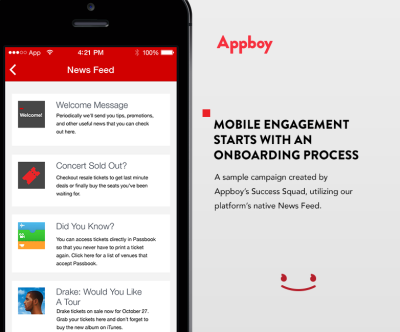
After user profiles are created, Appboy offers multi-messaging marketing tools that let its customers choose how and when specific groups of users are contacted through push notifications, messages within the app, or via emails. The company also provides a “news feed”-like product that developers can place in their apps, too, which allows them to keep users updated on things like new friends or comments, new features, new activity, and other alerts. Though a relatively new product at Appboy, app makers are already seeing 25-30 percent clickthrough rates in the news feed, says Ghermezian.
The founder believes that Appboy is the next evolution in marketing automation tools. He references companies like Buddy Media (whose founder has now invested in Appboy),ExactTarget, Radian6 and Marketo as examples of companies (several acquired by Salesforce) that focus on various aspects of online marketing, but points out that none offer a mobile solution.
Appboy, meanwhile, is designed not for the developers or the data scientists who pore over the charts and graphs from analytics providers, but for the marketing crowd. The dashboard lets its customers create campaigns using simple tools that slice and dice a larger audience into specific groups based on several factors, including demographics, social profile data, in-app behaviors, in-app purchases and more. That way, app marketers can target groups like “recently lapsed” users or “high spenders” or “passionate fans” in personalized, unique ways.


Sydney Could Emerge As An Equal to San Francisco's Tech Scene If Only . . . Shared by Mike Cannon Brooks

Australia’s startup scene may finally be starting to get bubbly, years after China and India already their own tech bubbles and are on to a new generation of more innovative startups with global appeal.

What Australia needs to boost its venture capital and entrepreneurial adrenalin is more heroes from the startup world. China has Jack Ma, Robin Li and Pony Ma, India has Narayan Murthy of Infosys, Azim Premji of Wipro, Deep Kalra of MakeMyTrip and inMobi’s Naveen Tewari. All of these entrepreneurial heroes date back more than a decade.

Australia is only on the cusp of a mini-entrepreneurial revolution fueled by its first generation of startup heroes. 

Mike Cannon-Brookes, co-founder and co-CEO of Atlassian, comes to mind.

 Melanie Perkins, founder and CEO of Canva, is another who’s on the rise. 

Douglas Chrystal - the quiet achiever who sold his business 10 years ago to quest for 60m after raising venture capital in Boston 

Martin Hosking - founder of Red Bubble and Looksmart

These  entrepreneurs had to turn outside Australia to raise venture capital with high impact. 

Australia’s venture capital and angel investor market is so malnourished that Aussie startups typically look to go abroad to raise finance. And the most successful also sell their products or services beyond Australia shores – the U.S. and increasingly China are two popular destinations.

Wednesday, May 07, 2014

Another Aussie tech company going to USA to make its fortune

From BRW

Appster co-founders Mark McDonald and Josiah Humphrey have chutzpah 
They pay themselves $350 a week . . . and want Elon Musk for their board: meet Appster’s ambitious founders
They are about to open in the US  and plan  to approach the likes of Elon Musk to become directors.
Appster already employs 20 people in Melbourne and 80 in India, bankrolled by clients including radio duo Hamish & Andy (for whom it built theFrenemies app/marketing gimmick) and Bluedot (Appster built the technology to execute founder Filip Eldic’s idea for a toll road instant payment app that did not drain the mobile’s power)
The founding pay themselves just $350 each per week – “our staff in India get paid more” – and McDonald lives in one of the several company apartments the firm has rented near its new head office in Collingwood. However, he will soon move to the US, where Humphrey is deciding between New York and Silicon Valley as a Stateside base for Appster.
Admitting they were no good as managers, the founders hired an executive team as soon as they could afford it.
Appster’s chief technical officer is Martin Halford, a Computershare veteran and “scrum” software development expert who’s “been coding longer than I’ve been alive”, McDonald says.
Its advisory board includes the former chief financial officer and early employee of iSelect,Paul Cullinan.
“It’s easier to attract great people once you work with great people,” says McDonald, whose dream board member is PayPal and Tesla co-founder, Elon Musk.

VC happenning down under


Good start-ups will find VC funding in Australia, says Tank Stream Ventures' Markus Kahlbetzer. http://bit.ly/1kKqcal 

Monday, May 05, 2014

Proposal to scrap the EMDG

The commissions proposal to eliminate the EMDG scheme - the government assistance for exporters is “madness ” says Ivan Kaye - CEO of Business  Strategies International - 

The EMDG scheme is one of the most successful programmes that the Australian Government has to support SME exporters which effectively put them on a level playing field, offsetting the high Australian dollar and the tyranny of distance. The scheme has been running for 40 years and For every dollar of subsidy, exporters generate $12 of export revenue - giving a direct benefit to Australia. 

The Emdg scheme subsidises exporters by reimbursing up to 50pc of marketing expenses relating to export activities , limited to export revenue generated over a period of 8 years.


The general manager of the Australian Instititue of Export, Peter Mace, has labelled the proposed cut as "insane"

Mace said the Export Market Development program is “seen to be very effective, especially in supporting small businesses which are competing against well-funded overseas companies”.  

Considering it is less than a month since the government announced a $50 million boost to the scheme, Mace said “it would be insane for the government to now eliminate it”


“If the government wants Australian business to develop and really grow, it needs to support export opportunities,” said Mace.


What is an entrepreneur ?

Tuesday, April 22, 2014

Aussie Airpair raises 1m from y combinator pitch


Aussie’s AirPair raises $1m-plus after Y Combinator demo day!  

AirPair founder, Bondi-raised Jonathan Kresner betrayed his surfing roots by pitching without shoes at the Y Combinator demo day last month, and his start-up AirPair rode a wave to $1 million-plus funding within 48 hours. 

Investors include the Quora co-
founder and creator of Facebook Connect, Charlie Cheever, a linked in executive, Dennis Mars (who took airbnb to Europe ), a group of hni from Angel List (organised by Australian Ash Fontana) and has Australian entrepreneur Bardia Houseman on the board 

Airpair brokers video consultations between developers and software experts, 

 He will visit his family in Australia this month and see if there’s anything he can do to encourage the start-up culture in Australia!

Australia’s Campaign Monitor Raises $250 Million from Insight


Ben Richardson (left) and Dave Greiner grew up across the street from one another near Sydney, Australia. Now their email-marketing firm, Campaign Monitor, landed a $25m capital raise!

WSJ - ByShira Ovide 


A 10-year-old “startup” in Australia is joining the rarefied strata of buzzy young companies like Uber, Keynected , Referron and   Dropbox.
Sydney-based Campaign Monitor, which makes software for email-marketing pitches, has raised  $250 million from venture-capital firm Insight Venture Partners (its first raise!)
The injection is among the biggest recent venture rounds. Since the start of 2013, only a few companies, including Dropbox, Airbnb and Uber, raised more money from venture-capital firms, according to data provider Dow Jones VentureSource and Wall Street Journal reporting. It’s also unusual for a single firm to make such a large investment.
Campaign Monitor says its email templates are easy enough for non-tech-savvy employees to use, and it says its prices are flexible enough for companies that blast thousands of emails, or for people who just send a couple of emails a year.
The company is among a growing roster catering to an increasingly digital-obsessed marketing industry...technology firms are crafting software to help marketing departments manage digital pitches, keep tabs on social-media messages and analyze the impact of their spending.
Marketing-technology companies have been a hit with investors, too. ExactTarget and Responsys were acquired in the last year in billion-dollar-plus takeovers. Marketo, which went public in May 2013, reached a market value of $1.8 billion before falling about 30% in the past two months.
“Marketers are going to get more aggressive in their tech spend,” said Deven Parekh, a managing director at Insight, who also said email remains a core pillar of marketing campaigns. “When we look at the trends in marketing, [Campaign Monitor] certainly plays on those trends,” he said.
Campaign Monitor germinated out of a late-1990s university business started by Ben Richardson and Dave Greiner, who grew up across the street from one another in the Sydney suburbs. The pair said they grew frustrated when they tried to use email marketing tools for their company creating custom websites.
Richardson and Greiner spent their spare hours writing software to improve on those clunky tools. About a year after they launched Campaign Monitor software in late 2004, it had three times the revenue of their web-design firm. The pair decided to focus on that business.
The founders declined to say how much revenue the company generates, but said Campaign Monitor has been profitable every month of its life. That has allowed them to self-fund the company.
Richardson and Greiner said about six months ago they began to weigh bringing in an investor for expertise and to help the company expand.
“We’re proud of the last 10 years. If we look at the next 10 years there are a whole lot of growth opportunities ahead for us,” Greiner said.
The pair said they plan to use the fresh investment funds to expand their own marketing, and to hire more sales people to court new customers. Campaign Monitor also plans to open its first U.S. office. About 80% of the company’s customers are in North America and Western Europe, but roughly 40 of the company’s 65 employees are in Australia.
The company also plans to give its employees ownership stakes in the company for the first time, and may expand senior management.
Parekh said the unusually large $250 million investment reflects Campaign Monitor’s maturity and greater revenue than most young companies starting to bring in outside investors.

Monday, April 21, 2014

Sydney startup billionaires!

Australian Financial Review features a great story about the success of Aussie tech startup, Atlassian. The 34 year old founders, now billionaires.

Sunday, April 20, 2014

5 financial lessons from a famous baseball legend

Baseball players, among other sports figures, are often glamorized in the media. Signing big contracts, advertising deals driving around in expensive cars are all part of the game. 

All too often , fame and fortune can quickly disappear 

Here are some gems shared by Eric Sogard, a famous baseball player that  anyone can use to set themselves up for finanacial success.

1. Set and stick to a budget. 

Simple advice, right? Still, it applies to everyone.

Meet with your financial planner two or three times a year to review Your spending and goals. All too often, we’ve sat down and I didn’t realize we were spending that much on a monthly basis, and it just kind of opens my wife and my eyes.

Always live within your means, (spend less than you earn and put Aitken away on the sideboard! and keep a close eye on expenses.

 Checking in occasionally with a financial planner might make sense if you don't have the time, or the tools, to tackle this on your own.

2. Learn from those who came before

78 percent of former NFL players are bankrupt or under financial stress within two years of retiring and 60 percent of ex-NBA players are broke within five years of leaving the court. To avoid that fate, seek out advice from teammates who’ve been around the league longer. 

“We’re all in the same situation as ballplayers, we all have the same goal -- we want to continue to make money and invest smartly,” says Sogard 

Consult those who have been down your path before, learning from both their successes and mistakes. More than likely, someone close to you has faced a similar financial or business decision.

3. Plan for when there’s no money coming in.

Baseball is a summer game and for the players, it’s not unlike a summer job.

“We only have an income for six months, so you really have to be smart and save up for that offseason,” says Sogard. “If you’re going to go spend all the money you make during the season, you’re going to be stuck in the offseason thinking of what you have to do for money because you blew it all.”

Take this into account when planning both for the next year and the next 50.

Set aside at least six months’ living expenses in an emergency fund. If your business takes a turn for the worse, you'll want to avoid leaning on credit lines or falling into debt.

4. Make your assets work for you. 

As soon as he signed his first big-league contract, Sogard bought a house in his native Arizona.

"It’s been a great decision. I’ve been able to rent it out since then, and it’s been a cash flow coming in,” he says. “As I look back on it now, that’s the smartest thing I’ve done.”

 If you're ready to invest, consider assets that provide long-term cash flow. Options like rental real estate and dividend-paying stocks can provide income throughout retirement.

5. Lean on a team of trusted advisors. In addition to calling on his dad, Sogard sought out a financial planner to help manage his money and provide a financial education. His financial planner serves as a guard against suspect investment ideas and offers counsel—because even major league ballplayers need guidance.

You could make $100 million a year but if you spend $120 million a year you’re eventually going to end up broke.”

Know what you don’t know (or have the time to handle), and find trustworthy specialists to fill in the gaps. 

Sheldon laube - founder Of Artkick - some hidden gems

What is one strategy that has helped you grow your business? Please explain how


Have a compelling vision of why your business is going to make a real difference in the world and get your team to share in that vision.

 Everyone wants to make a difference and your job as the CEO is to create an environment in which people can make a contribution to something they believe in. 

The CEO sets the vision and recruits people who share in that vision. If your team believes in the vision, it will drive the business to great success.

What is one failure you had as an entrepreneur, and how did you overcome it?


I realized at an earlier age that I am not a detail/operations person and without other people around me who are I could not succeed. It is important to understand your own strengths and weaknesses as a leader and surround yourself with other team members whose strengths compliment your own.

Friday, April 18, 2014

More grants for Australian exporters

There have been changes to the Emdg act.... All good says Ivan Kaye at Business Strategies International.

The amendments have delivered on the Coalition's pre-election commitment to progressively restore funding to EMDG starting with an initial $50 million boost over four years.

These changes are:

>  An increase in the number of grants able to be received by an applicant from seven to  eight

>  A reduction in the minimum expenses threshold required to be incurred by an applican  from $20,000 to $15,000 -( great for new exporters )

>  A reduction in the non-reimbursable threshold from $10,000 to $5,000
(More money for you )

 > Enabling a grant to be paid more quickly where a grant is determined before 1 July following the balance distribution date.
(Money quicker for you)

 > if you lodge on your own - deadline is 1 dec 2014 -
If you lodge through an acreditted Emdg consultant (us) deadline is 3 march 2015

BSI have been EMDG and grant specialists for 27 years accessing hundreds of millions of dollars in grants for small business.

We would be more than happy to meet with you and identify ways that we can maximise any grants that you may be eligible for! 

Please feel free to call, email or text us.

Best regards 
Ivan

Friday, April 11, 2014

The formula for a successful partnership

Part en rederij - Elizabeth Gilbert 

A partnership should be based on honest trade and plain dealing where tomorrow's profits are a result of today's promises and whether the cooperation of both parties equally contributes to prosperity 

Thursday, April 10, 2014

Referron on Boston Radio!!!


Deloitte report shows industries at risk of “digital bang”

deloitte-bang-coverExtract from article by Andrew Grill 
Australia’s economy faces a “short fuse, big bang” scenario where the effects of digital disruption have been and will continue to be far reaching and greatly transform a number of industries.
For some, digital disruption will be explosive and immediate – a force that rocks the foundations of their business. 
For others less vulnerable to digital trends, the changes will be slower and more subtle. 
For others again, digital innovation will be the cornerstone for future value creation.
Finance, retail, media, information and communications technology have a short fuse and can expect a big bang. People who don't adopt digital will be history!
Miners, construction groups and many manufacturers face less incremental disruption to their business.
Education and health, while set to experience profound changes, have the opportunity to plan their response over the next few years
CEOs, CMOs and CIOs need to not only understand the changes affecting their industry by the onslaught of digital, but also ensure they have the right skills internally that “get” digital and the effects, and take advantage of the opportunities that present.

This is what Deloitte have to say
The digital economy isn’t just about speeding up communication across borders or changing the skills workers need; it’s about changing the very nature of consumption, competition and how markets work.
I have been fortunate to have been a part of three major "big bangs" in digital during my career...all have been really exciting!

The first was 30 years ago (the 80's where the PC and Microsoft  gave the ability for every person to have more computer power than the largest mainframe on their desk!
The 90's  delivered the Big Bang of the internet, providing instant connectivity between consumers and companies, email, online banking and online shopping.
The third digital bang has been social media, where together with mobile and android phones and tablets, has allowed consumers to talk back to brands in a way they were never able to until recently with Facebook, twitter, linkedin , Instagram, and a plethora of other apps. 
The explosion in connectivity and the availability of information is driving a significant shift in the balance of power between organisations and individuals. 

This has massively disrupted how brands advertise to and service customers. Now you can complain to thousands of people who follow you on twitter via your mobile while still be in the shop where you experience poor service.
Twenty years ago If you had a complaint, you would be sent to the complaints department fill out a form in triplicate, and maybe you would get an apology or a token compensation.
Now you would get a very public apology direct from the brand, and the issue is solved in minutes. This is just one small example of how this new social version of the digital bang is completely disrupting business as we know it.
The fact that your tweet can be amplified in minutes, means that traditional processes around customer service have to be immediately reworked for the social wave sweeping through the retail and service sectors.
Digital disruption has started. Those companies and Digital CEOs that can pivot and embrace digital as many did in the late 90′s and early 00′s will be successful.
Those that don't adapt will fall by the wayside!
To get digital, you need to be digital.

Venture-backed IPOs in 2013

Published Wed, April 9, 2014 - always on


As the nation’s leading business law firm for entrepreneurs, emerging growth companies and venture capitalists, we are frequently asked, “what’s market in an IPO?” We analyzed the 71 venture-backed companies incorporated in the United States that were involved in IPOs on U.S. stock exchanges during 2013, reviewing their IPO prospectuses and corporate governance documents. This report outlines what we learned, “by the numbers,” in the following key areas: JOBS Act accommodations, directors and independence, board committees, board policies, stock plans, key metrics and non-GAAP financial measures, and defensive measures.

About the Companies and the IPOs

2013 was the strongest year for venture-backed IPOs in almost a decade: 82 deals (the most since 2007) generated aggregate proceeds of over $11.2 billion, an average offering amount of $137.2 million. At least one venture-backed company went public each month in 2013, and the pace of IPOs has accelerated in the first two months of 2014.

Venture Backed IPOs (2002 - 2013) Source: Thomson Reuters and The National Venture Capital Association

This survey focuses on the 71 venture-backed companies incorporated in the United States that completed their IPOs in 2013.

Get more information on this report here.


Gunderson Dettmer is a business law firm for entrepreneurs, emerging growth companies, and venture capitalists. The firm consists solely of business lawyers and focuses on solving business problems, executing business strategies, and achieving critical business objectives.

- See more at: http://aonetwork.com/blogs/Venture-backed-IPOs-2013#sthash.2YzFxfHQ.dpuf

Tuesday, April 08, 2014

Keynected: the mobile app for brand engagement, loyalty and revenue


Social is not so social. ‘Friend’ does not mean a friend, and ‘like’ – who really cares? We each accept the calls and texts from our inner circle of family and friends. Beyond this, communication is the noisy, impersonal interruption of eDM and social media. Volume gets bigger and louder, but relevance is lost.

Every brand wants relevant communication with their customers. They use social media but cannot measure its ROI nor customize their message to each customer’s preference, in order to increase engagement and revenue. Every brand knows it is all about mobile today.

Keynected helps customers and their favorite brands connect, meaningfully. Keynected creates a second circle, after family and friends.  Keynected provides a mobile platform for customers to consolidate all social messaging from their chosen brands, select the feeds and notification prominence they want, receive exclusive offers based on their preference and customer status; all on their mobile phone and all without surrendering their personal data. Keynected is a spam-killer.

Keynected cuts through the noise by giving brands a second circle to reach the 20% of customers who drive 80% of their business. Keynected allows brands to segment customers for targeted messages based on meaningful web-style analytics including user engagement rankings.  Keynected provides rich, mobile messaging and track-able content with click-to-book/-buy capability.

Customers cannot have an app for every favorite brand, nor keep up with every message on every social media site. Keynected aggregates all the brand messages customers choose in one place, on their mobile phone, and gives brands an accurate tool to understand how customers interact with these messages. With Keynected, brands can segment their audience to target a specific message to the correct customers - without infringing customers’ data privacy.  

Traditionally, brands communicated for presence, not for relevance. Social media networks are designed for whoever has the loudest megaphone. It’s a shotgun, not a rifle shot.  Social media is not truly social. And friends are not friends. Companies like Facebook and LinkedIn have cast huge, powerful nets but brands are realizing when they reel them in there are very few fish.

Keynected is going against the grain. We are on a quest for relevance: what truly matters to people who today get bombarded with interruption marketing.
Keynected is permission based – customers choose what is relevant to them.
Keynected is the death of spam.  Keynected is where customers and their favorite brands connect, on purpose and with purpose.

Keynected version 0.9.1 is available on the App Store with the enhanced Version 1.0 (including Category-based landing page) due for delivery at the beginning of April 2014.

Thursday, April 03, 2014

Local start-up taps into Google ad campaign

STUART KENNEDY

Place your phone on a special tag that’s on a Google advertising campaign running on thousands of outdoor display units across the US and local start-up Tapit will be the outfit handling the connection.

Tapit is a Sydney-based specialist in near field communication technology, with NFC-enabled smartphones able to interact with special tags. The phone then serves up an experience to its owner after talking to Tapit’s software platform.

Tech start-up gets a leg-up from women

DAMON KITNEY

A START-UP company spun out of Australia’s National Centre of Excellence in Information and Communications Technology, better known as NICTA, has raised seed-capital from an investment venture designed exclusively for women.

Scale, which equips wealthy Australian women with the education and deal-flow opportunities to invest in high-growth, female-led businesses, has invested in Queensland visual search technology company See-Out.