Wednesday, June 27, 2018

Crowdfunded Jayride provides investors an exit

VentureCrowd founder Steven Maarbani and Jayride CEO Rod Bishop believe crowd-sourced equity funding will become a ...
VentureCrowd founder Steven Maarbani and Jayride CEO Rod Bishop exit crowdfunded equity startup at a $37m valuation giving investors 107% return (Peter Braig).

The first crowd-sourced equity funding raise was priced at 24¢ per share and was one of three rounds the company raised in this manner, equating to about $700,000. 

Jayride listed earlier this year on the ASX at a 50c listing price raising $15m with “follow the seed”investing $8m 

Mr Bishop with the Jayride team at the company's Sydney headquarters.
Rod Bishop with the Jayride team at the company's Sydney headquarters.

Access to capital is a key part in the startup world - and crowd funding is a great source says Maarbani 

If funding is not found in Oz - they will go overseas .

The one that got away 

"ThreatMetrix is a case in point . Raising capital in the  USA and was sold for $US817 million and that growth story was lost to Australia," Mr Maarbani added.

So what is Jayride 

It is an airport travel comparison service covering  2000 ground transport operators and 500 airports and most recently it recorded 28 per cent quarter-on-quarter revenue growth to $633,000 for the third quarter.

A crowd funding investor 

Serial entrepreneur and Sydney Angel, Justin Butterworth, invested $50k into  Jayride's first crowdfunding round as one of a portfilio of  25 “high risk startups” including Instaclustr, taxi booking app Ingogo, photography start-up Snappr and property tech venture Snug.com. 

Mr Butterworth told AFRs Yolanda Redrup 

"Investing in early stage businesses is a high-risk activity and investing smaller parcels with a trusted platform with quality deal flow like VentureCrowd helps minimise the downside risk," 

"It also gives opportunity for diversification and, in my view, gives you a better chance of a reasonable return for this class of asset."

Justin  Butterworth founded home rentals business Rentahome, which was acquired by Fairfax Media for $29 million. 

Crowd funding and Venturecrowd

Since being founded  in 2014 , Venturecrowd has facilitated 45 deals (10 a year) raising about $25 million.

There are clearly a lot more backable deals out there - the question is how to find them, commercialise them and get them invested.

Crowd funding is a great way of funding - and will be part of the  "traditional capital stack" for start-ups when legislation is enacted later this year, enabling public companies to take part in public crowdfunding.

In the UK, 24 per cent of all venture capital invested done through either of the two leading crowd funding platforms, giving the mum and dad an opportunity to invest and have the same opportunities as Angel investors and venture capitalists.

Venture capital investment returns can be significantly higher than traditional asset classes but also present high risk. With risk diversification and access to information, this risk can be mitigated.

 If you get 10 per cent in superannuation you think your fund manager is a genius - here is an opportunity to invest in an asset class that can give you significant higher returns - albeit with higher risks - with the knowledge that you are supporting innovation and growth! 

The Australian Superannuation  is over $1 trillion - 1000 billion - 1pc invested in startups ($10b) would make Australia the world focal point of innovation .

Opportunities to watch 

An investment opportunity to watch in the future is Anwar Khalil’s “My Recruitment Plus” increasing its annuity by $100k quarter in quarter! - watch this space for more details! 


Sunday, June 24, 2018

HealthMatch raises $1.3m - the global platform for clinical trials


CEO Manuri Gunawardena, who took leave from medical school to pursue HealthMatch, is now planning international expansion.

http://www.afr.com/technology/healthmatch-raises-13m-as-it-seeks-to-become-the-global-platform-for-clinical-trials-20180615-h11fu4?et_cid=29132120&et_rid=1928623412&Channel=Email&EmailTypeCode=The%20Brief&LinkName=clinical%20trials%20of%20potential%20treatment&Email_name=The%20Brief-0618&Day_Sent=18062018

HealthMatch, an Australian start-up aiming to become the go-to platform linking sick patients with clinical trials of potential treatment, is targeting US expansion after a $1.3 million capital raising from Australian venture capital and US industry insiders.

The early stage start-up first rose to prominence late last year, when it won the inaugural Australian version of popular US pitching competition TechCrunch Startup Battlefield, and will now begin hiring more staff to capitalise on progress it has made in establishing its product.

The company has created an online platform which uses machine learning to sort through the thousands of clinical trials being run by contract research organisations (CROs) in Australia and matches relevant registered patients. Its co-founders Manuri Gunawardena and Arran Schlosberg needed funding to hire software engineers and some marketing and operations staff as the company starts to grow in earnest.

The Tempus Partners Team Andrew Larsen, Connie Lee, Conrad Yiu and Alister Coleman have led the HealthMatch funding round.

The funding round was led by Sydney-based venture capital fund Tempus Partners, which closed a $40 million fund to invest in local start-ups last year. The round also included backing from US-based investors including WhatsApp head of product Anton Borzov, and Google's director of intellectual property and litigation Catherine Lacavera.

​Managing partner of Affirmative Investment Management and former chairman and CEO of Goldman Sachs, Stephen Fitzgerald and Australia and New Zealand and angel investor David Kenney has also chipped in money. 

US interest  

Ms Gunawardena told The Australian Financial Reviewthat HealthMatch had received a lot of interest from the US following its TechCrunch success, and said she had spent time in both San Francisco and New York meeting with potential investors. 

The market for clinical trials is much larger in the US than Australia, and HealthMatch intends to aggressively target the market once it has established itself as the platform of choice for patients in Australia.

"We ended up trying to pick the investors that could actually contribute to the company with more than just money," Ms Gunawardena said.

"Anton from WhatsApp offered to help us with product design and how to really optimise the way that we present this to patients, whereas aside from her legal expertise at Google, Catherine also used to work in pharma in New York, so that will be really helpful."

While she said HealthMatch was confident in the technology side of the business and her own background in medicine meant they understood the clinical trial sector, she had favoured Tempus Partners as a lead investor due to its ability to also provide strategic advice about how to scale up her start-up's operations.  

Worthy purpose

Tempus Partners managing partner Alister Coleman previously co-founded software-as-a-service company ShippingEasy, which was sold to NASDAQ-listed Stamps.com for $80 million in 2016.

Mr Coleman said he believed HealthMatch could be a game-changer in the healthcare sector and had a worthwhile mission in helping many people live longer and healthier lives. 

"Access to new and improved treatments is critical for patients and has the potential to be life-changing for patients and their families globally," Mr Coleman said.

"Access to new and improved treatments is critical for better healthcare outcomes globally, and HealthMatch delivers this using software and AI at the core to facilitate faster clinical testing outcomes."

Ms Gunawardena said the year ahead would now be focused on increasing the number of clinical trials listed on the platform and, as a result, the number of patients matched with suitable trials.

Future plans

Then it will target a larger Series A funding round to fund a US office, which is likely to be in New York, close to the global headquarters of big pharmaceutical firms and the US venture capital funds likely to invest.

"Because we are automating this, we are planning to get almost all of the clinical trials that are available in Australia on to our platform, so it becomes the go to place for patients within Australia ... I think that is quite achievable for us," Ms Gunawardena said.

"We are definitely using Australia as a way to test out our product, see where the inefficiencies are, improve them and improve our machine learning, before continuing to build out into the States.

"We will continue operations in Australia, and always look to keep our R&D and engineers in Australia, but in a way it is a test bed before we move into a larger market."  

Wednesday, June 13, 2018

OpenLearning raises $8.5m Series A from Malaysian investors


 A Muru-D graduate, OpenLearning has raised $8.5 million in Series A funding bringing total investment raised to $13.7m.


OpenLearning was designed to allow for social learning, through “reflecting, sharing and discussing ideas”, with a broad goal of improving access to high-quality online learning for higher education.


This latest funding is led by Malaysian Prestariang Berhad, a technology training provider, and Paramount Corporation Berhad, an investment company focused on education and property development. Brimo says both have interests aligned with OpenLearning, and will facilitate expansion into Malaysia.


Malaysia was the first country in the world to launch a national massive open online courses (MOOC) program, using the OpenLearning platform, and has national targets for blended and online learning.


OpenLearning is is researching “things like artificial intelligence and how that can have an impact on education”. Says Brimo


Challenges have been many - including getting people from different countries working together but one .


With persistence and determination, the team  is confident of success! 

Sunday, June 10, 2018

Marijuana lights up in Canada

The Bob Pritchard Column

 
A lot has happened with the marijuana industry. Up until recently, it was a drug that was considered harmful. People lost their jobs or couldn’t even get a job because of the drug. It was life changing, but mostly because of the stigma behind it.
 
However, a lot has changed in the past two years. Some really big examples can be seen with government legislation and the medical industry. Canada’s public health agency, Health Canada, reported that the number of people in the nation who were registered to use medical marijuana reached 235,621 by the end of September 2017. That’s a 40% increase from just six months earlier.  That means 0.6% of the country’s population of almost 37 million were using marijuana for medical reasons.  Its not a lot, but it is rapidly growing.
 
 
In 1995, a year before California became the first U.S. state to legalize medical cannabis, a Gallup poll recorded that only 25% of Americans supported the idea of making weed legal.  This past October, Gallup showed over 66% were in favor of full legalization.
 
The U.S. Congress continues to make it exceptionally hard for legalization in America. It’s still illegal and has no recognized medical benefits.  The U.S. is missing out on a lucrative opportunity because of its stubbornness when it comes to legalizing cannabis.
 
However, Canada isn't wasting any time. It legalized medical marijuana in 2001 and has Health Canada oversee licensing and regulation with the substance.   Now it looks like Canada could be the first developed country in the world to approve recreational use of marijuana in August or September of this year.
 
Investors and companies have begun to see the incredible potential and opportunity associated with cannabis.  The Canadian developments have had four of the largest publicly traded firms surging — investors want in. The combined market value of the four largest publicly traded firms has reached more than $USD 780 million. Together, all marijuana companies on Canadian exchanges have a combined market value of about $USD 25 billion.
 
If and when full legalization happens in Canada, it’s going to bring a huge increase to the market’s capital potential.   There are going to be a lot of companies that want to be a part of this booming industry.
 
With the demand for marijuana steadily increasing, there are 20 major companies that began in the mining or oil and gas sectors and have now shifted towards Canada’s marijuana industry.  These companies realize it would be more profitable to be part of the marijuana industry rather than spend a lot of money on mining and not actually earn a profit from that particular resource.
 
Using mining companies as a way to publicly trade makes it easier and faster to list on the public exchange. Companies don’t have to undergo a full securities commission review or file a prospectus, which is what they would have to do for a traditional initial public offering.  Canadian exchanges demand that companies present a viable plan to sustain operations and also submit to a review.
 
The potential is obvious.
 
 
If the whole world smoked a joint at the same time, there would be world peace for at least two hours. Followed by a global food shortage
 

Wednesday, June 06, 2018

Where will Cryptos be in 2019?

The Bob Pritchard Column 

Cryptocurrency is worth around $500 billion and projected to be in the trillions by the end of 2018.  There are a few events taking place that set crypto up for long-term growth and help highlight where the industry will be by the end of the year.
 
One of the best ways to gauge the growth of the digital currency market is by looking at the exchanges and investment channels.  

After 2017, Bitcoin transitioned from being an investment for nerds to 90% of Americans knowing what Bitcoin is. Exchanges and investment channels are changing to meet the needs of these new retail investors.
 
 
At the start of 2017, investors had to go through crypto-to-crypto exchanges for many altcoins and this could pose security risks for the traditional retail investor. To address this issue, fiat-to-cryptocurrency wallets like Coinbase began to offer more tokens and there were more mainstream ways for investors to access crypto.
 
In the last year, over a hundred hedge funds have been launched for crypto.  The main exchanges and software wallets have upped their game. Soon Coinbase will offer more ERC20 tokens, tokens built on the Ethereum platform, on its platform. These include VeChain, OmiseGo, Golem, Storj, EOS, Tron, and Binance Coin. New tokens on Coinbase will attract more investors and encourage demand. It will also boost market liquidity. This indicates that the digital currency space is going to grow significantly.
 
But the question is: will big governments allow digital currencies to succeed?   The answer may surprise you. Many governments are running full tilt at blockchain.  In China, President Xi Jinping praised blockchain technology as a “breakthrough.” China is considering blockchain technology as one of its priorities alongside AI, the Internet of Things, artificial intelligence, and mobile communication. South Korea is using blockchain technology to track packages, and in neighboring Japan, massive gaming company Gumi launched a $30 million global blockchain investment fund.
 
In the United States, multiple government officials and states support blockchain technology. Former U.S. Treasury Secretary Larry Summer stated, “blockchain will change a great deal of financial practice and exchange.” Governments are opening up to blockchain technology,  but what about the cryptocurrencies blockchain supports?
 
To many governments, digital currencies are still high risk, posing a risk to retail investors because of volatility. he Securities and Exchange Commission in the US is holding initial coin offerings (or ICOs) to the same standards as other forms of venture capitalism. This will help protect investors, while still empowering small companies to take advantage of coin offerings, which have dozens of benefits.
 
Since the start of 2018, regulators are making crypto safer for the retail investor. Some cities, like Hong Kong, are embracing their own digital currencies.
 
So where will things be in 2019?
Based on increased adoption, more tools, and a general increase in interest, blockchain technology is gearing up to end 2018 strongly:
  • Security tokens will become more common as companies opt to use regulated initial coin offerings. Security tokens present a unique opportunity for investors and will allow them to participate in early-stage companies.
  • More tokens will come onto the fiat-to-crypto exchanges. We've come a long way since the early days of Bitcoin, and now digital assets are becoming mainstream use and adoption.
If you don’t have digital assets already, now is the time to start.

There is a school of thought that says Cryptos will come into its own when Qantum  computing  gets nailed - and that he says is imminent! 

Tuesday, June 05, 2018

Microsoft goes back to its roots and has agreed to buy Github for $7.5b!


Microsoft goes back to its roots and has agreed to  buy Github  for $7.5b! 

GitHub  lost $66 million over three quarters in 2016, with revenue of $98 million. In 2015 Github was purportedly worth $2b in 2015!

Bill Gates and Paul Allen founded Microsoft to give hobbyists a way to program a new micro-computer kit, the MITS Altair, and it now seems to be going back to its core! 

GitHub is a code repository and a social network of sorts for 27 million software developers, hosting on around 80 million repositories of code. Many corporations, including Microsoft and Alphabet Inc.’s Google, use it to store their corporate code and to collaborate and communicate with each other. 

Microsoft used to be obsessed with everything being on the Microsoft platform, being totally against open source. Open-source software allows developers to tinker with, improve upon and share code -- an approach that threatened Microsoft’s business model and the Windows Operating System.

Under the leadership of  CEO Satya Nadella, Microsoft have done an 180 degree turn. Microsoft is now supporting Linux, and has used open-source models on many of its products  - moving away from the Windows Operating System, finding the power of collaboration  and being able to connect with the broader developer community the natural way to do business 

The players at Github-  In August, GitHub announced that it was looking for a CEO to replace Chris Wanstrath, one of the company’s co-founders. At the time GitHub’s Chief Business Officer Julio Avalos joined the company’s board of directors and took over much of the day-to-day leadership of the company.


Friday, June 01, 2018

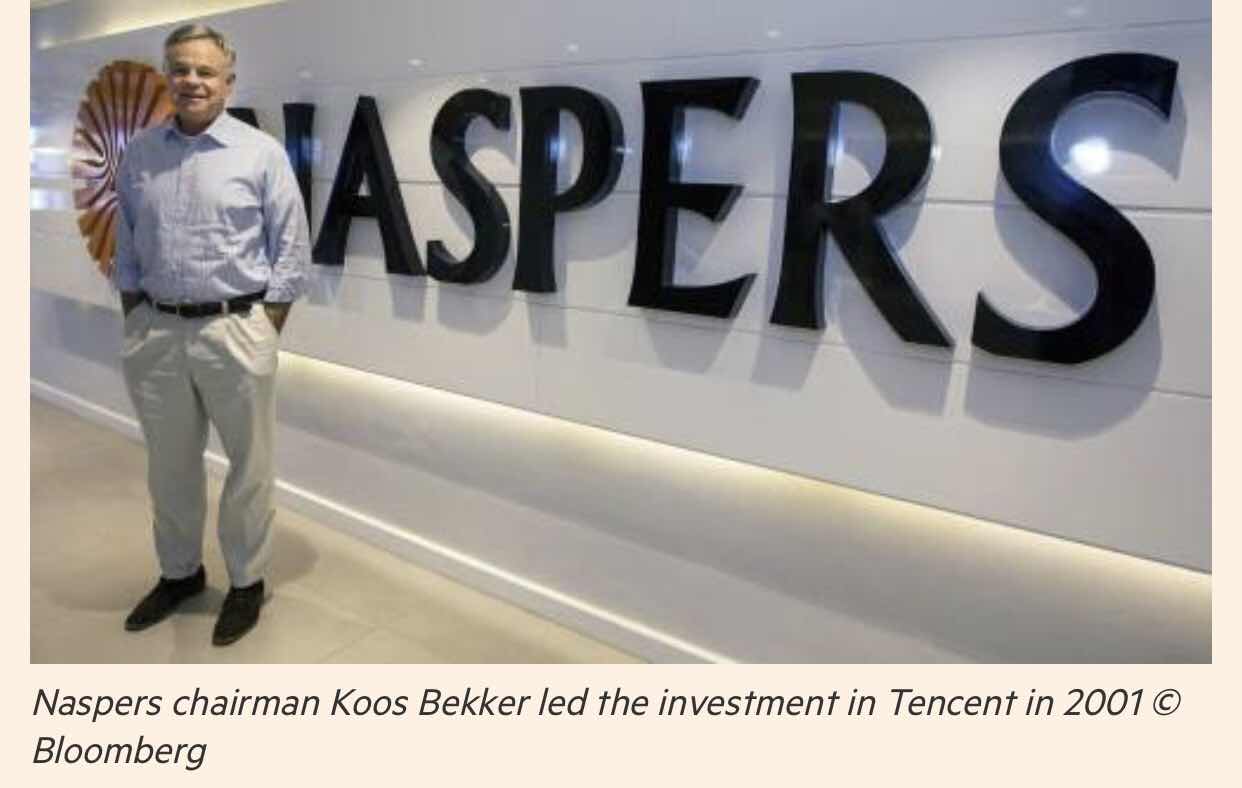
Tencent’s 60,000% Runup Leads to One of the Biggest VC Payoffs Ever


South African media company Naspers Ltd. is cashing in a sliver of one of the greatest venture-capital investments ever.

The Cape Town-based company is selling $10.6 billion of shares in Tencent Holdings Ltd., equal to 2 percent of the stock in the Chinese operator of the WeChat messaging service, it said in a statement Thursday. 

The stake Naspers bought for just $32 million in 2001 -- when Tencent was an obscure Web firm in a nation where few people used the Internet -- is now worth $175 billion.

Who would have thought? 


Thursday, May 31, 2018

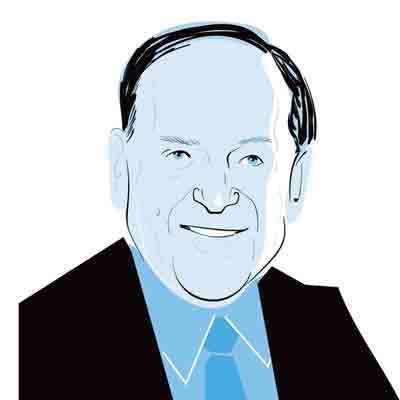
THESE FIVE BILLIONAIRES MADE THEIR FORTUNES AFTER 40

  • LATE BLOOMERS
    NOT EVERYONE IS A ZUCKERBERG. THESE FIVE BILLIONAIRES MADE THEIR FORTUNES AFTER 40.
    • SHELDON
      ADELSON, 84
      NET WORTH: $43.3 BIL
      The gambling kingpin didn’t get his start in casinos until 55, when he bought the Sands Hotel & Casino on the Las Vegas strip for $128 million. He was no stranger to Sin City, though: Earlier, he had organized and run a computer trade show there.
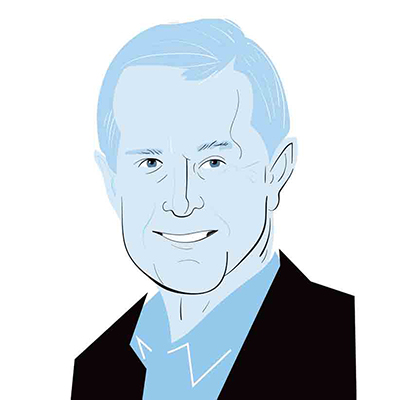
    • DAVID
      DUFFIELD, 77
      NET WORTH: $8.9 BIL
      The former IBM employee started two business software companies after turning 40. At 47 he started PeopleSoft, which he sold to larger rival Oracle nearly two decades later for $10.3 billion. Soon after the sale, he started Workday, the HR and financial management software company.
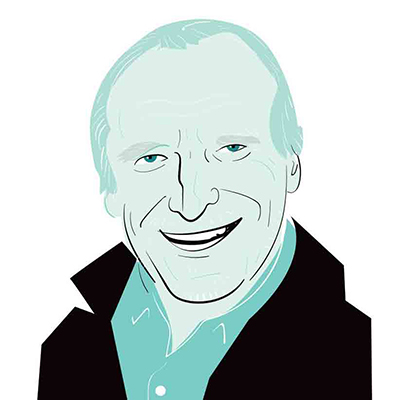
    • DIETRICH
      MATESCHITZ, 74
      NET WORTH: $24.7 BIL
      After marketing goods like shampoo and toothpaste as a corporate shill, he cofounded Red Bull at 42. The master salesman pitched the energy drink as fuel for accomplishing daring feats (famous tagline: “Red Bull gives you wings”) and emblazoned the brand on skydivers, motorcyclists and big-mountain skiers.
    • JAMES
      DYSON, 71
      NET WORTH: $5.5 BIL
      When his family’s refurbished hoover vacuum gave him grief (it seemed to just push the dirt around), Dyson set about creating a better vacuum. Fifteen years and 5,127 prototypes later, at age 46, he brought the world’s first bagless vacuum to market. Now he has more than 60 products—from hair driers to fans.
    • DAVID
      CHERITON, 67
      NET WORTH: $6 BIL
      In 1998, the 47-year-old Stanford professor wrote a $100,000 check to two Ph.D. students named Larry and Sergey who came to his house and pitched him on a company called Google. Cheriton also cofounded three technology companies after his 40th birthday that were sold or taken public.

Tuesday, May 29, 2018

Venture Capital in Australia: What does Anthony , Frank, Richard, GIna, Mike an...

Venture Capital in Australia: What does Anthony , Frank, Richard, GIna, Mike an...: The number one spot was recycling magnate Anthony Pratt ($12.6b) ,  with Meriton’s founder Harry Triguboff coming in a close second with a personal fortune of $11.45 billion. The Lowy’s who built  Westfield ($8.26B) , Glencore Mining’s, Ivan Glasenberg ($6.85B)  and Gina Rinehart’s Resources ($10.41B) made the top 10. Scott Farquhar and Mike Cannon-Brookes of Atlassian are up there as well with $5B each.

What does Anthony , Frank, Richard, GIna, Mike and Scott have in common? - They are all in the 2018 top 100 Rich List

The number one spot was recycling magnate Anthony Pratt ($12.6b) , with Meriton’s founder Harry Triguboff coming in a close second with a personal fortune of $11.45 billion.

The Lowy’s who built  Westfield ($8.26B) ,

Glencore Mining’s, Ivan Glasenberg ($6.85B)  and

Gina Rinehart’s Resources ($10.41B) made the top 10.

Scott Farquhar and Mike Cannon-Brookes of Atlassian are up there as well with $5B each.

There are 12 technology Richlisters and Ruslan Kogan aged 35, who grew up in a Housing Commission Home in Melbourne,  is back on the list after a 3 year break.


There have been interesting characters that have coloured the pages of the Rich List
Kerry Packer was a regular contender with the West’s 80’s entrepreneurs such as Alan Bond (of America’s Cup fame) and Robert Holmes a Court who  built and lost their fortunes.

The Rich List includes immigrants.  men and women, young and old, self-made millionaires, , and those born with a silver spoon in their mouths; both the  educated and uneducated.

Becoming rich can be a reality for anyone in Australia.

So, looking at the lists these are 8 gems that we can learn from them 


1. PROPERTY IS STILL THE NUMBER ONE SOURCE OF WEALTH


2. TIME AND LEVERAGE COMPOUNDS WEALTH 

They understand the power of compounding
Time and regular investing  grows their asset base.

The rich concentrate on building their balance sheets even more than they do on their profit and loss accounts, usually leveraging with other people’s money (which is why property is such a good thing)

The average age of this year’s Rich List is Stan Perron aged 95, is the oldest member of the list coming in at #15 and is showing no signs of slowing down.
ANYONE CAN DO IT

3. FOCUS ON YOUR KNITTING 

One core trait that successful entrepreneurs share is the ability to take a good idea and repeat it over and over again.
You become an expert by doing one thing one hundred times, rather than doing one hundred things once.

4. TEAM

Surround yourself with a good team because if you are the smartest person in the room you are in trouble.

5. VISION - PLAN - ACTION 

Have a vision , formulate a plan - write it down  and take action .

IN SUMMARY 

Invest your money and time into wealth-producing assets and a Vision you believe in. Have strong Values, a long-term Plan, and never lose sight of where you want to end up.

One of my mentors from Durban , John Moshal, said he likens himself to a farmer with a plough -  With rough and arid land in front, with the farmer ploughing the land , so that those following have the opportunity to farm on fertile ground!

Wednesday, May 16, 2018

100 Years Of America’s top 10 Companies


Who  do you think the 10 top companies will be in 100 years?

Will they be the same companies? 

What industries? 
  • 3D
  • AI
  • VR
  • Energy /food/water 
  • Hybrid of banking , communication and tech
  • ??
  • ??

What do you think the value will be ?
  • 1920 - $5-10b 
  • 1980 - $50b - 100b
  • 2020 - $500b - 1tril
  • 2050  - ??
  • 3000  - ??

Tuesday, May 08, 2018

Business as usual for SMEs looking to invest in r and d and claim the r&d tax incentive


  • So what is this R and D incentive 


it is basically a cash rebate to incentivise you for developing innovative products and services. 


It provides a rebate of between 13.5% to 41.5%

So if you spend $100,000 on developing a new product or service or innovating,
you could get back between $13,500 and $43,500 depending on your Companys' profitability.
(limited to $4m per year) 


  • Are you Eligible 

If you are 


  • an Australian Company
  • Undertake R&D Activities in Australia 
  • Spend Over $20k 

YOU COULD BE ELIGIBLE 

ps ... if you are 3 years old and your turnover is greated than $1.5m there are a whole host of other grants you can claim 


  • SME's don't claim for a whole host of reasons

INCLUDING

  • They dont have adequate systems to record R&D activities
  • They do not know what R&D actually is (the legislation is very murky and difficult to interpret - even by the experts 
  • They don't know what they don't know 

Some research indicates that at least 50% of SMES undertake R&D activities and could potentially claim this incentive - but only 1% do!


  • The Risk

Funds from the budget have been allocated to crackdown on non-compliance and rorting , so you need to ensure you have your ts crossed and is dotted 

Budget 2018 Changes 


  • Changes to percentages to be claimed with companies whose turnover is greater than 20m - giving more to those who spend more on r and d as a percentage of revenue .
  • Caps on spend 
  • Those that claim - names and amounts will be published 
  • Bigger budget to be spent on compliance - so ensure you have your claim verified and auditable! 

Let me know if you want a referral to the best r and d consultants in the country!