Saturday, August 31, 2019

Warren Buffett - Advice for Entrepreneurs - THE BEST IS YET TO COME


THE BEST IS YET TO COME

Warren Bufffet shares 2 examples of people he met during his career - that highlights the importance of CUSTOMER SERVICE and the Importance of having great people in your TEAM

Rose Bumpkin - an immigrant - that could not speak english and spent the first 20 years of her life working to educate her children and save enough money to bring her siblings to USA, built a furniture store with a $2500 loan and no further equity to a turnover of $!.5b
and
Jack Taylor - who started his business with $25k and built Enterprise

It starts with a Dream, a Determination to succeed and a total focus on the customer.

The gems 

1. Its all about the customer

2. You need to have an amazing team that is looked after, is passionate and understands the value of customer service - you cannot do it alone

1. Its all about the customer

  • you need a genuine desire to delight the customer 
  • to wow the customer
  • you want that customer to succeed 
What goes through the customers mind? Its where they had the great experience that they will remember and refer

If the customer  has a good or bad experience in the store or transaction online - They will remember how they were treated. The Customer Experience is key (CX) or User experience in the App World (UX)

If you have an experience where the personnel was rude and not great - you are not going to want to go back.
Delight your customers

Your Team 

Delight them through other people - your team.
Look after your team.... you need to multiply yourself through other people.

Your key is to surround yourself with people better than you are - starting with your spouse, teachers, friends, employees, mentors

Look for the people that are examples for you, learn from them

Associate with people that will take you on a better path - and you will grow from strength to strength

FIND THE RIGHT TEAM AND LOOK AFTER THEM 

These Gems, together with a dream and a determination to succeed took Rose Bumpkin into a $1.5b turnover business with a  total capital $2500 and Jack Taylor who built Enterprise with very little equity invested into a conglomerate bigger than Hertz, Avis and Budget together. 


Monday, August 26, 2019

Monday, August 05, 2019

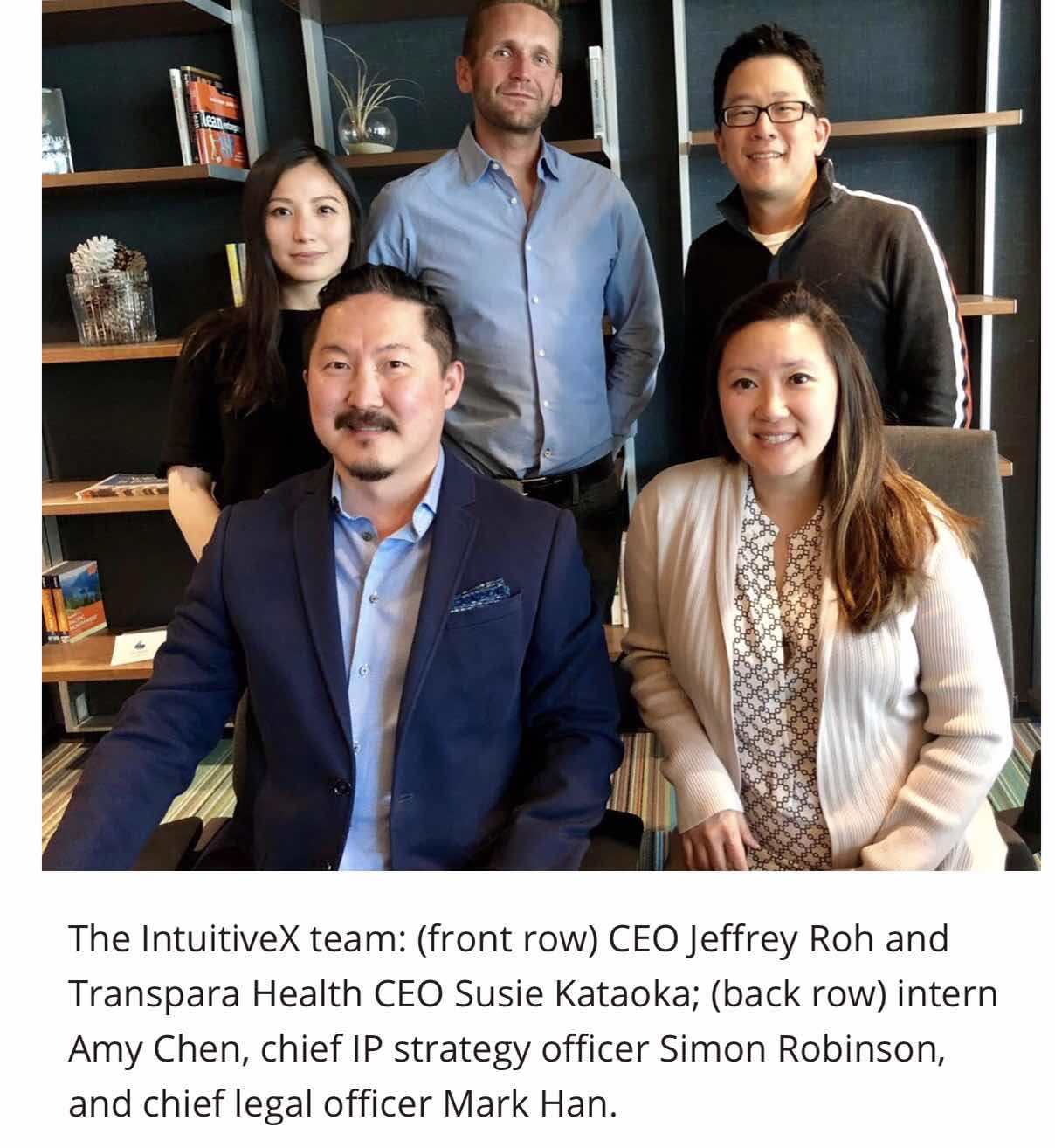
IntuitiveX backs Life Science, Biotech and Medical Device Startups


Seattle based Life Science Incubator, IntuitiveX, is passionate about helping startups take their ideas from concept to commercialization, 

The Pain

“It takes grit, vision and an innate resilience to brave the ideation process and build a roadmap to commercialization. Due to current systems unique to the life sciences, the process is incredibly complex, costly and time-intensive. This creates a huge barrier to entry into an industry that is not only ripe for innovation but also impacts lives around the world.”

The Painkiller 

To overcome the monumental barrier, accelerate innovation, and impact lives around the world, IntuitiveX was born.

EXPONENTIAL INNOVATION. We are a driving force behind medical innovation, serving as an incubator for ideas and a catalyst for change.

Spinal Surgeon, Dr Jeffrey Roh co-founded IntuitiveX with Mark Hahn and Simon Robinson in 2016, and now  has a portfolio of a dozen startups, which includes digital health, medical device and biotech companies.  

IntuitiveX is a hybrid of accelerator programs like TechStars and Y Combinator as well as “startup studios” such as Pioneer Square Labs. 

The incubator uses a crowdfunding model from a network of investors who pool resources through a holding company rather than a traditional investment fund.

The ideal investee is an entrepreneur  with technical knowledge who needs business and financing support. In exchange for equity, the incubator provides both funding and expertise.

The incubator places a high emphasis on securing intellectual property protection early on and commits to supporting startups for a longer period of time.

Portfolio Company - Transpara Health

One of it’s portfolio investments is Transpara Health (coinvestors being Will Little and Wilson Fong, of Prota Ventures) , giving price transparency for patients. 

The site recently launched with information from around 250 providers. Increasingly, providers are offering direct pricing for services at rates that are lower than what a patient might pay to their insurance for the same service.

For more about IntuitivX - https://www.intuitive-x.com/ 


Sunday, July 21, 2019

Emotional Intelligence is fundamental to maintaining our relevance in the AI revolution


We have had some major systemic shifts or revolutions in the last 100 years 

The industrial revolution changed the world by overthrowing the agrarian society

The internet and mobile phone revolution which made us a truly global community and has democratised opportunity 

Today, we are at the beginning of an AI revolution that will take us places that we did not thought possibleArtificial intelligence is becoming faster, more efficient, cost-effective, and systemized. 

Whatever it is you know, AI can and will learn it and use so quickly you will become irrelevant! 

  • How can you survive and thrive in the AI revolution? 
  • What can you do to take advantage and stay relevant ? 

You will need a completely new focus. 

The focus will need to be about the development of human capital - building relationships. 

Connecting, Collaborating, Contributing Consistently and building Communities 


Knowledge and skills is no longer power - machines can do that -  It’s the human interaction that will have greater value. 


The power is 

  • emotional intelligence, (EQ ) 
  • conversational intelligence and the ability to communicate effectively and persuasively , (CQ) 
  • relational intelligence and the ability to navigate human dynamics. (RQ )
And 
  • Likeability intelligence (LQ) 


It’s the power of vulnerability that will set us apart from AI.


No matter how sophisticated A.I. becomes, it can never show real human vulnerability. It is in our vulnerability that we get to know each other beyond anything the “data” can reveal. 

Harvard Business Review (HBR) explains, “Those that want to stay relevant in their professions will need to focus on skills and capabilities that artificial intelligence has trouble replicating — understanding, motivating, and interacting with human beings.”

It is in genuine vulnerability that we reveal ourselves not only to each other but often to ourselves. 

This is how we truly connect human to human, heart to heart, mind to mind.

So where can we find a springboard to vulnerability?

In a word— learning. 

Organisations need to recognise the value of people on their balance sheets 

When we look at the balance sheet  of a company - what is missing in the numbers is it’s people . 

It cost us 1.5 to 2 times the annual salary of an individual to replace them. The training of that individual at an emotional intelligence level can be a stellar  investment that will pay off for their entire career with your organization. 

The revolution is upon us and we can no longer ask our people to do what we are not willing to do. 

Training and continuous learning of the soft skills is key 

In the age of AI, EQ must be incorporated into professional development efforts. Allocate time for EQ learning initiatives. 

Compelling scientific evidence has already emerged citing a positive relationship between EQ and job performance. I reckon this relationship will only be fortified in the upcoming years. 

“What are you doing to actively increase your emotional intelligence, your ability to connect, collaborate and contribute with your peers and those around you? 

Call the team at BSI Learning may be able to guide you on your EQ journey .


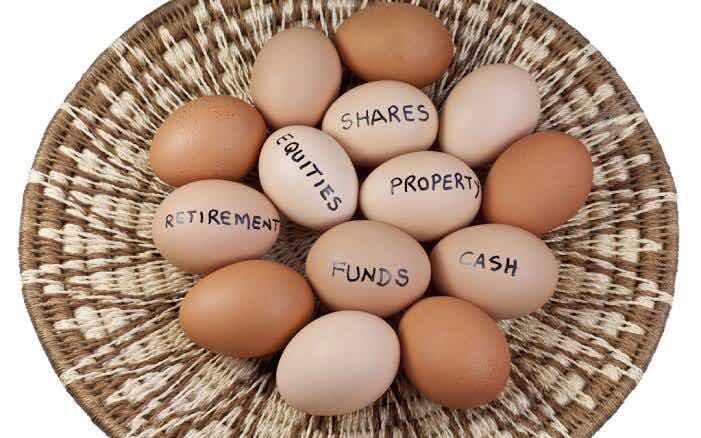
So where can you invest in the next 13 months and get a min 6% return?


SMSFs are looking for Yield  - and they are not getting it with bank deposit returns - sub 2% .

Returns in The ASX baskets of shares has done really well in the year to 30 June 2019 .

Investors expect a 6.1 per cent total return from Australian shares over 12 months, but will struggle to meet it (but not by much) according to my friend Recep Parker of Investment Trends . (Ps He is seriously smart)

It is expected that a diversified portfolio of quality Australian shares can yield 6 per cent this year after franking, with The Plato Australian Shares Income Fund targeting a 9 per cent gross return, including franking.

But beware - This is no time for complacency. 

According to Morningstar, after strong gains this year, Australian shares are 20 per cent overvalued (on a market-weighted basis for the S&P/ASX 200 index),

Living off capital and not doing the risk thing taking riskier bets on yield may be a stellar strategy this year - 

says Peter Bolton, a former investment adviser and editor of yeildreport.com.au, which tracks yield across asset classes.

So where do you invest your savings  that is in your super, mattress or Banks to give you an adequate yield?

These are some ideas 💡 of where you can get 6% yields in an article by Tony Featherstone in the AFR today https://www.afr.com/personal-finance/budgeting/how-to-get-a-6pc-yield-without-losing-your-shirt-20190717-p5281i

Unlisted Australian Government Bond Funds

The Mercer Australian Sovereign Wealth Bond has starred with a total return of 11.5 per cent over 12 months. The Jamieson Coote Active Bond fund had a 10.4 per cent in that period and the Vanguard Australian Government Bond Index Fund returned 9.98 per cent.

These are outstanding returns given the risk profile of government bonds but are unlikely to be repeated in the next 12 months without a slew of further domestic rate cuts.

Listed Australian Government Bonds 

The Russell Australian Government Bond ETF returned 12.01 per cent over 12 months to June 2019, ASX data shows. The iShares Treasury ETF returned 10.59 per cent and the SPDR S&P/ASX Australian Government Bond Fund 10.52 per cent.

Corporate fixed-interest funds

They are investment in bonds - debt issued by corporates 

This form of corporate debt has a greater risk of default but typically has higher returns.

In investment-grade bonds, the Vanguard Australian Corporate Fixed Interest Fund has a gross return of 8.08 per cent over one year to June 2019. It invests in bonds issued by Australia’s major banks, offshore banks, property trusts and other lending institutions.

Neuberger Berman’s NB Global Corporate Income Trust is part of a new breed of listed funds in Australia that offer exposure to global high-yield corporate bonds – a $US2.7 trillion market.

Listed on the ASX in 2018, the trust holds a portfolio of sub-investment-grade bonds from up to 350 companies, including Netflix, Dell, Hertz and Virgin Media. The goal: a 5.25 per cent annual return (after fees) paid monthly, with low volatility.

Smart beta equity ETFs 

The iShares S&P/ASX Dividend Opportunities ETF had a trailing yield of 7.14 per cent at the end of June 2019, ASX data show. It provides exposure to a basket of 50 high-yielding stocks.

The UBS IQ Morningstar Australian Dividend Yield ETF aims to replicate the price and yield performance of Morningstar’s model income portfolio, consisting of 25 stocks. Its trailing yield is about 4.9 per cent and one-year total return (including capital growth) is 11.6 per cent.

One of the first yield-focused ETFs, the Russell High Dividend Australian Shares ETF, had a trailing yield of 8.5 per cent in June 2019 and total return of 11.7 per cent. 

And then their are hybrid funds 

This is where the funds find the acquisition of the LiC with debt and equity 

I’ve invested in GEAR that invests in the top 50 - leverages it by 30-50pc - dividends pay interest and growth gives a return .

Peer-to-peer (P2P) funds

Enables your money to invest in an individual loan or pool of loans, potentially earning a higher return compared to fixed interest, albeit with higher risk.

They promote net returns about 6.5 per cent over 12 to 15 months.

Investors in property-based P2P funds must be comfortable with potential default risks if borrowers cannot repay their loan and property prices falls.

Investors who believe property values are stabilising and the risk of loan defaults is easing because of rate cuts, might find extra appeal in P2P platforms in mortgage securities. 

They suit experienced, risk-tolerant investors who understand the risks of property lending.

Lending to Business  or others that you know 

There is a business called Credi - the people’s bank - that enables you to be the bank to people that you or your trusted adviser knows - with all the relevant securities in place.

Another business - Thincats - invest in small business - and promote 10-15% returns - where they do the analysis and risk profile - and “crowd source the lending.

Investing in Business and Venture Capital 

This can give exponential returns - but is not for the faint hearted . It might be worth putting a small percentage of your portfolio into high risk stocks or shares - on the chance that maybe it can become a google, Apple, Microsoft, 10cent, canva , amazon or atlassian  .

You will also be playing a part in the Innovation Space!


Global Stocks 

Look to invest in global stocks - China, Asia, USA and Europe 


And then there is Direct  Property - Commercial and Residential 

Residential Property has taken a hammering this year - however long term - with the ability to borrow money at low interest rates - it’s enabled many Australians to build wealth over the years. 

Based on the stability and attractiveness of the Australian lifestyle - it looks like demand for property in Australia is likely to rise - however there are risks that you need to look out for and strategies to follow to maximise the likelihood for growth.

With negative gearing available - it is a stellar way to build your assets and wealth with the help of your taxes 

Commercial property - will give higher returns - because there are higher risks 

How to invest 

These investments are all readily accessible via Wraps and online. 

If you want to know how to invest your savings and super - and minimise your risk - based on your risk profile - speak to your financial planner - www.arktotalwealth.com.au

Www.arktotalwealth.com.au

Monday, July 01, 2019

me&u gets support of Australian superstars


Steven Premutico sells Dimmi’s and launches me&u with the help of Australia’s tech superstars 


The Idea 

Steven Premutico (pictured) is back with another piece of hospitality-tech sure to make waves in the industry.

When Steven Premutico sold Dimmi’s he spent thirty days walking the famed Camino San Tiago in Spain, where he came up with the idea to create me&u.


The Investors 

The new startup has received investment from some of Australia’s best known Tech Players - many of whom had a precious success with Dimmi’s - including Cliff Rosenberg (a current non-executive director  at Afterpay, and formerly at Dimmi and managing director (MD) at LinkedIn APAC), Will Easton (MD Facebook Australia, ex  Dimmi), Jason Pellegrino (ex MD Google Aus, Domain CEO), Mike Abbott (co-founder Uber Australia), Tim Reed (CEO MYOB), Neil Perry, and John Szangolies (founder of Urban Purveyor Group).

The pain me&u solves 


"It's clear Aussies love to eat in restaurants, but the way we order and pay is terribly clunky and antiquated whether that be trying to catch the waiter's attention to order, waiting for the bill at the end of the night or the awkwardness of splitting the bill. It simply shouldn't take five minutes to pay a bill! We will fix that."


What me&u does 


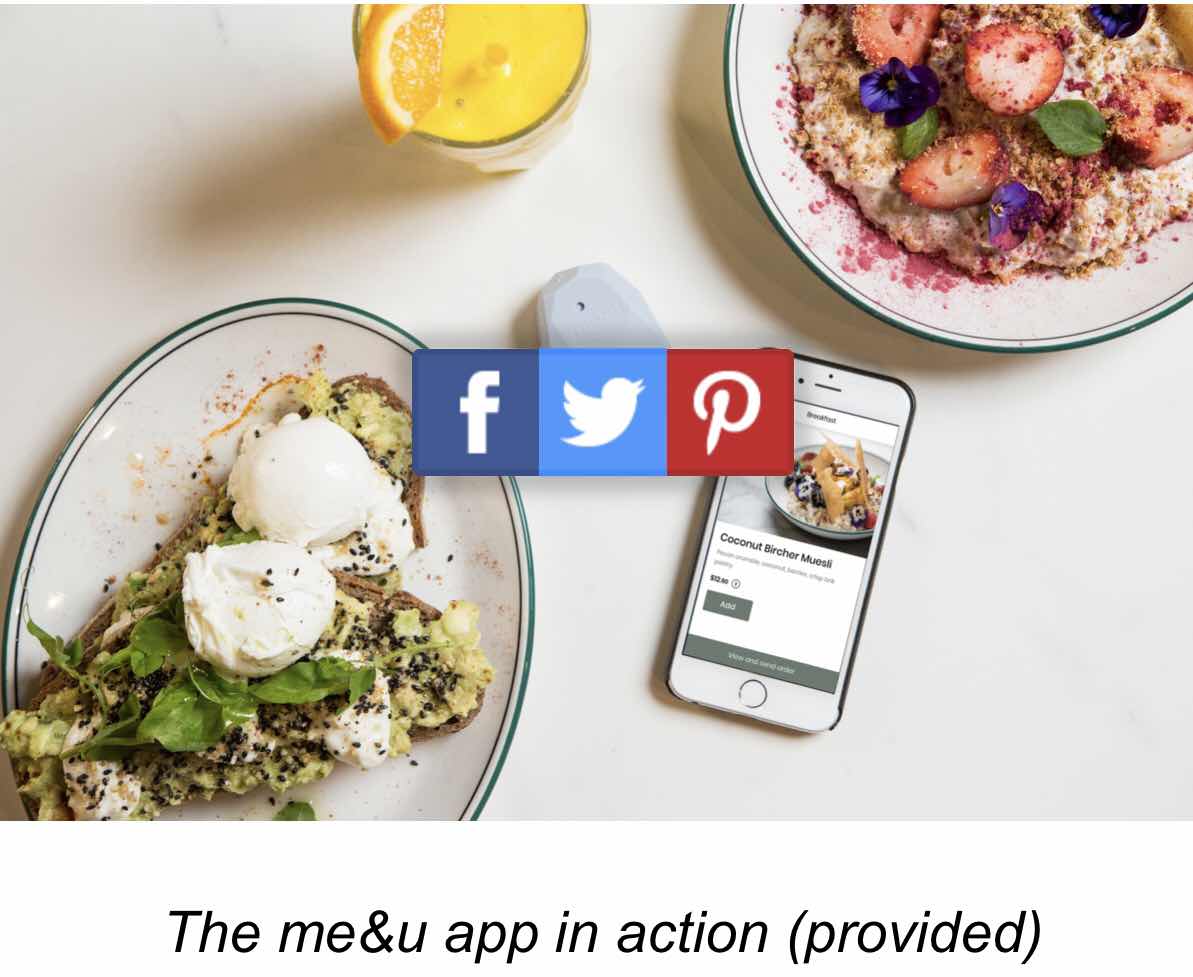
Customers simply need to tap their phone onto an NFC (near field communications) beacon provided by the restaurant which sends a menu instantly to the me&u app, allowing customers to place an order right away.

The app also allows for those with allergies and dietary requirements to filter out inappropriate choices.

At the end of the meal customers can pay via the app and even split the bill, removing the need for awkward conversations and piles of miscounted cash.

Premutico says the new app will be disruptive in hospitality by combining the beauty of Instagram with the convenience of Uber.

In addition to improving the ordering and payment process in restaurants, Premutico says me&u will give floor staff more time to improve customer service and allow them to focus on what matters.

The app will improve efficiency and enable waiters to provide a more effective customer service to patrons 

"Waiters run around tirelessly all night, service lessens, the customer experience drops, and upselling doesn't happen. We want to free up the waiters, improve the customer experience and improve industry profitability.”

"At Dimmi we disrupted the way we book our favourite restaurants. Now we will disrupt the way we order and pay," says Premutico.


The customers and industry me&u helps 

At launch over 500 restaurants have already signed up to use me&u, including Rockpool Dinging Group, Boathouse Group, Chat Thai, Watsons Bay Hotel, Sonoma and Pablo.

"For the hospitality industry to survive and thrive - it has to evolve and use the technology available to provide a more effective customer experience. “  says Premutico.

So what are the insights from this blog  that you can adopt in your business? 

Sunday, June 30, 2019

Should public investors have easy access to invest in startups?


A great Insight from Niki  Skevak from Blackbird Ventures 

Afterpay, Xero and Pushpay all went public super early at super silly valuations and created awesome business worth billions of dollars each

In 2016, Afterpay went public on a $500k annualised revenue run rate and raised $25M on a $165M post-money valuation. It's now a $7B company 3 years later with a $214M annualised revenue run rate.

 (oops $6b now) 

Maybe make it easy for startups in Australia to list on the asx and enable public investors to get in at a stage that’s often reserved for VC/private capital markets? 

They can have a strategy to invest in startups where 1 in 10 will work! 


Monday, June 24, 2019

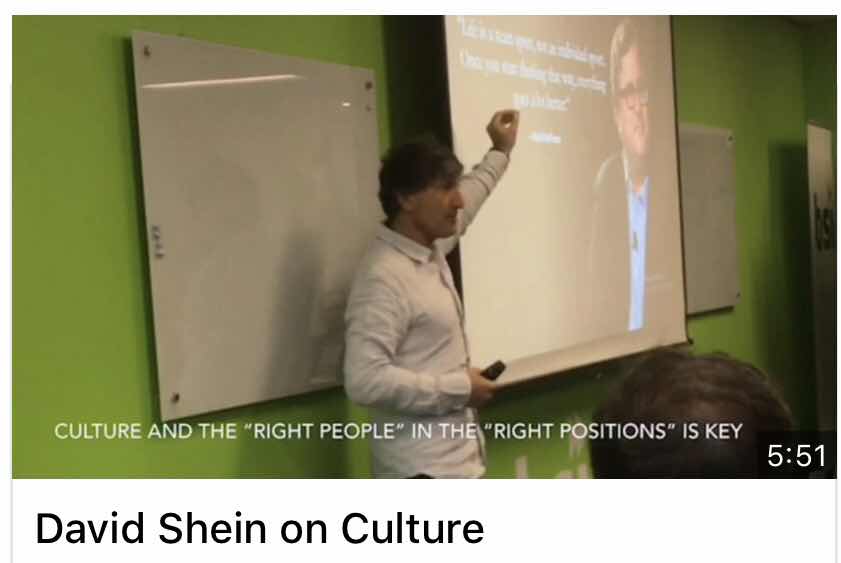
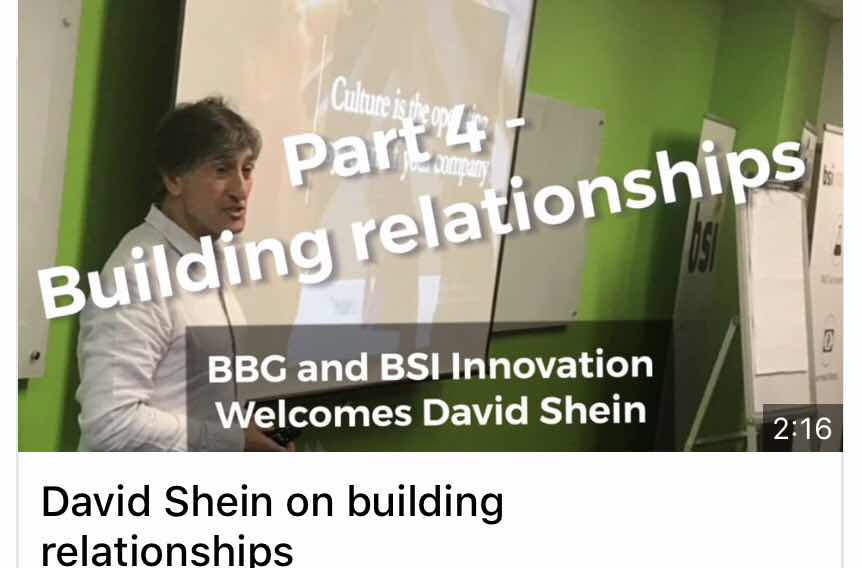
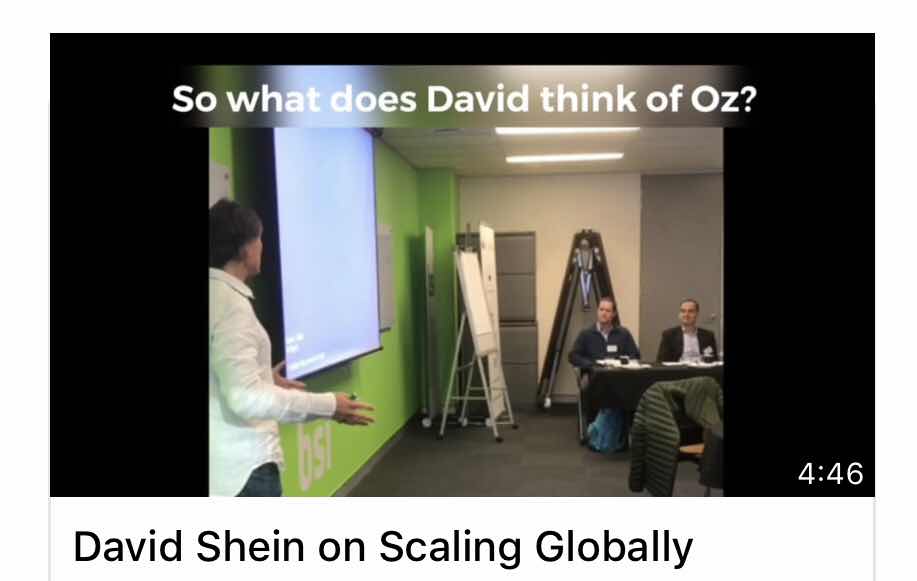
David Shein Shares his recipe of turning a startup into a business he sold in 2001 for over $600m

We were grateful to have David Shein share his story, some of his learnings and strategies  with us at the BBG BSI Innovation Forum last week.

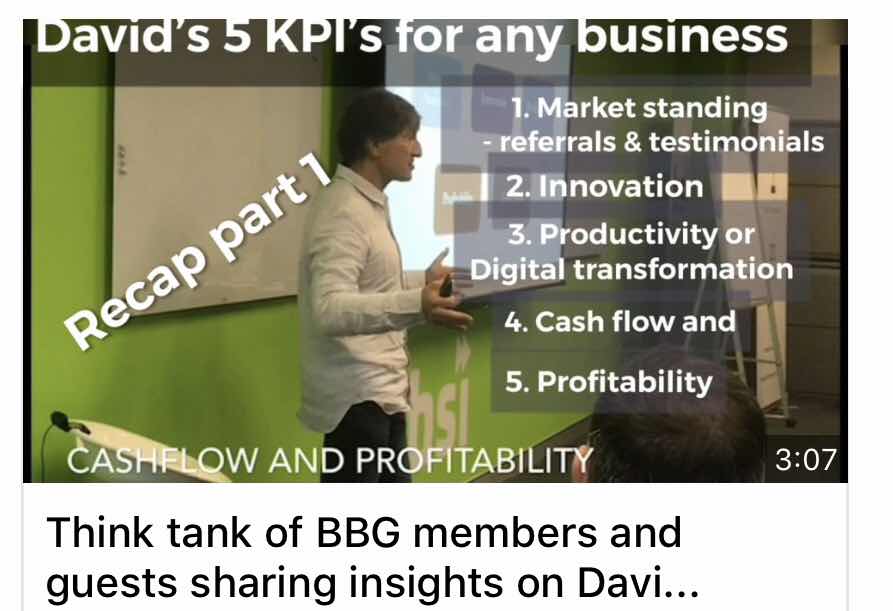
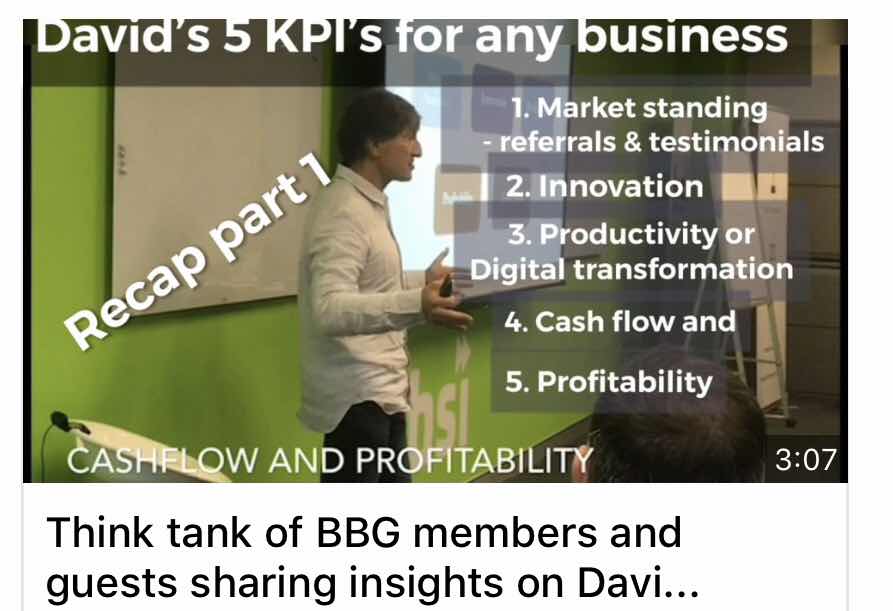
David shared his vision, KPIs and thoughts and strategies  on customer service, culture, building relationships and scaling globally.

This was followed by a robust Thinktank of  “3 Pods of 6” and a sharing of insights and learnings on how these learnings and strategies can be implemented into our own businesses and organisations! 

1987 - 1991 - Comtech  founded - grew from startup to 85 employees - winning NABs ethnic awards. (His speech then would be the same as his speech now)

1991  to 2001 - grew from  85 to 1400  employees - and $1b in revenue - making a tradesale to Di Data - for +$500m (in height of boom - a year before crash!!

2001 to 2002 - wallowing

2002 - now - investing in startups and innovators with passion, purpose and peraerverence (in no particular order)

Here  is a taste of the start of a sensational BBG Forum

Enjoy!!

(Let me know if you want to see the rest!) 


Part 1 


Think Tank part 2 and 3 


ICANsee cannabis Ocular Therapy -


The medical cannabis market will reach at least $19B in the next 26 months making it an attractive and important sector.  

Combating inflammation and pain are among the most impactful applications of medical cannabis.

A medical market primarily driven by inflammation and pain is the ocular therapeutics  market of eye drops. iCAN believes that the medicinal use of cannabinoids in eyes drops is inevitable and the time to stake a claim in that market is now. 

iCAN is pleased to announce that iCANsee is offering an investment opportunity in their seed round right now.

iCANsee are first movers in the cannabis ocular therapy market, with clinical applications and for both over-the-counter and prescription markets utilizing nanotechnology-based delivery system, developed here in Israel, and iCANsee was awarded a Government  grant from the Israel Innovation Authority for the R&D.

If you’d like to find out more about iCANsee, please download the brief here:

 you’d like to find out more about iCANsee, please download the brief here:

Want to know more?

Send us an email, along with a signed copy of our standard NDA, and we will get back to you as soon as possible.

CLICK HERE TO DOWNLOAD! For more info 

Want to know more?

Send Saul Kaye an email  incubate@israel-cannabis.com (no relation :) , and no vested interests 

along with a signed copy of their standard NDA, and he will get back to you as soon as possible.


Thursday, June 20, 2019

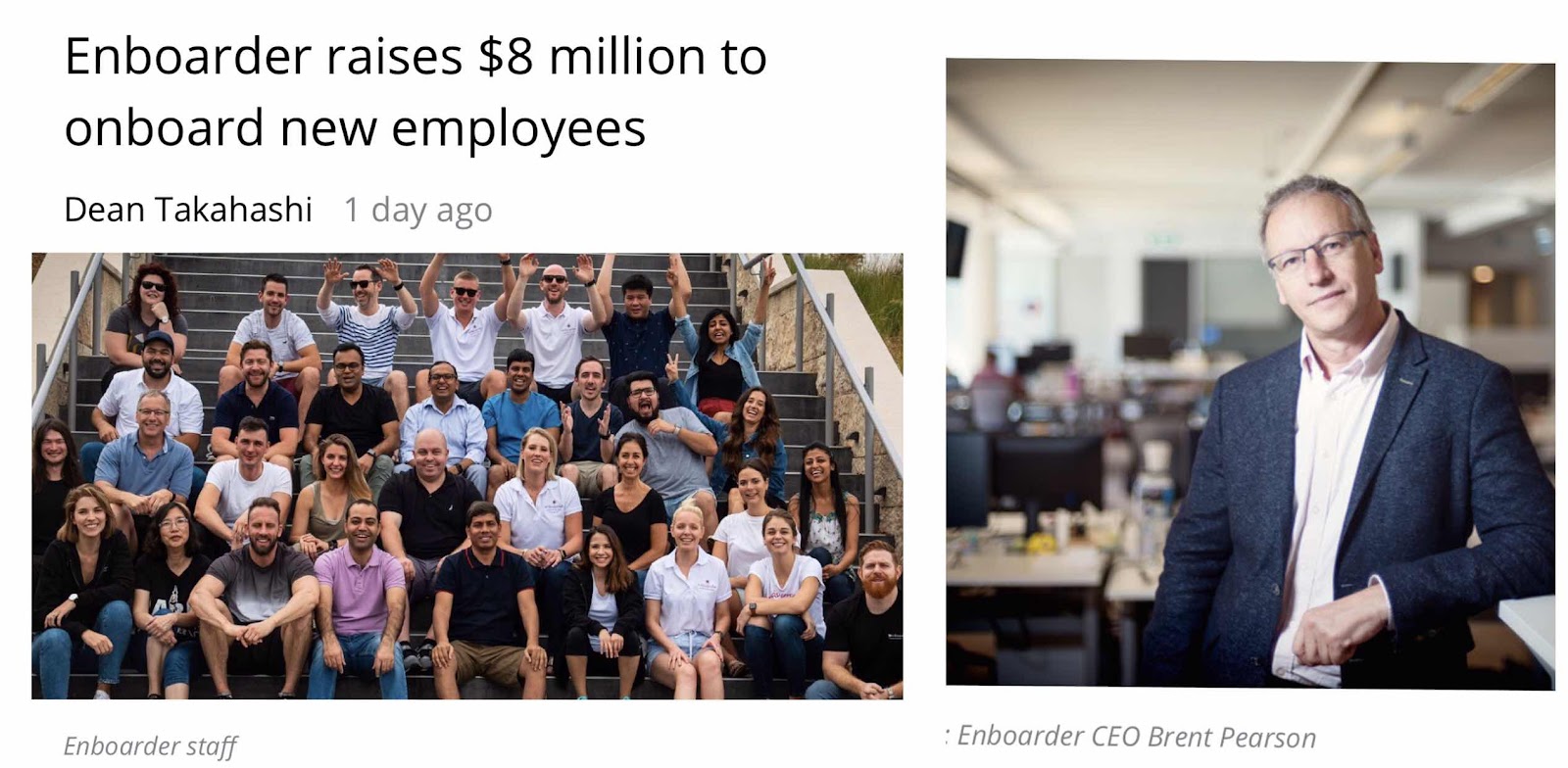
Enboarder raises $12m


Enboarder has to date raised $12m from VCs who love the founder and team.

What Enboarder Does 

Enboarders onboarding software relieves HR of operational processes, delivers personalized experiences and drives human connection well before new hires begin their roles.

It delivers intelligent nudges and personalized communications for managers and employees alike.

Enboarders customers

Global companies — including McDonald’s, Hugo Boss, EA Games, Eventbrite, Gap, Verizon, Wyndham and, most recently, Compass, the 10,000-employee real estate brokerage firm - have used its service to deliver onboarding experiences aimed at boosting employee happiness, productivity, and retention.

Who has invested 

Enboarder today announced it has raised $8 million to give employers better ways to bring new employees onboard.

Greycroft, which participated in Enboarder’s previous funding round of $4 million, is the lead investor in the new round, which brings the company’s total funding to $12 million. New investors Next Coast Ventures and Stage 2 Capital also participated in the round.

Laurence Schwartz at “our Innovation fund LP” supported by Jerry Stesel , Geoff Levy and Dave Shein was a 2016 investor 

So what is  Enboarder’s Unique Selling Proposition?

Enboarder CEO and founder Brent Pearson in a statement. “We’re living in an experience era, and yet we welcome new hires with a process. Employees have all the power today and place a premium on experience.  We provide that experience for the Organisation.” 

“Companies that do not adopt solutions to power an exceptional employee experience will lose the war for talent,” said Greycroft principal Will Szczerbiak. 

“Customers absolutely love it, the team is terrific and has executed flawlessly since we joined the seed in 2018, and we feel strongly that Enboarder will become the category leader of this emerging part of the HR tech stack.”

“We work hard each and every day to partner with exceptional founders and to add material value to help them realise their dreams and take on the world, and we are super proud to  announce our 2016 Investee Enboarder’s US Series A round, raising approx $12 million from US VCs Greycroft, Next Coast Ventures and Stage 2 Capital.” Laurence Schwartz at “our Innovation fund LP” supported by Jerry Stesel , Geoff Levy and Dave Shein

The Next Stage 

Austin-based Enboarder is planning to double its 40-person team in the next 12 months, with the new investment also helping build out the company’s sales, marketing, customer success, and product functions.

Wednesday, June 19, 2019

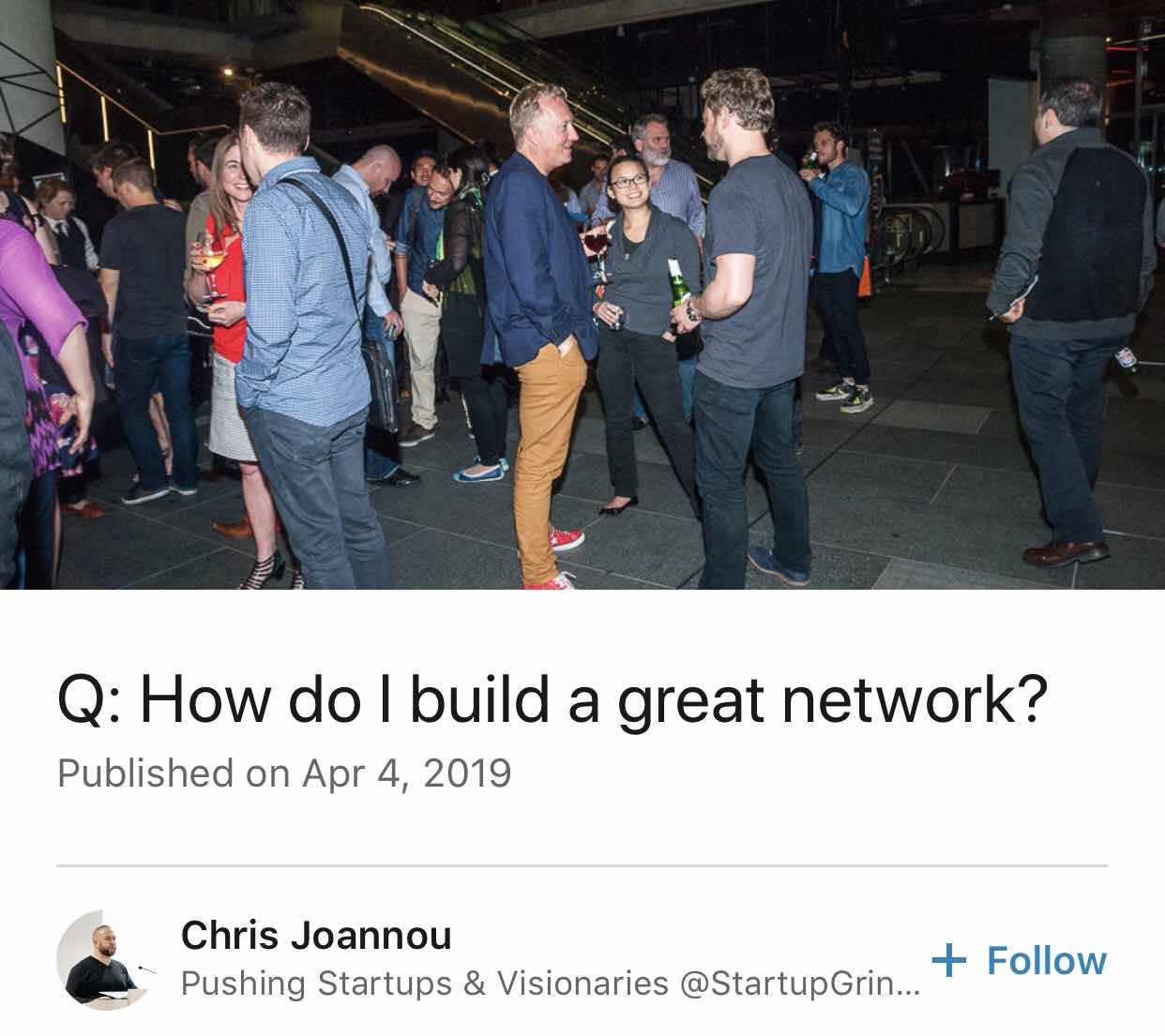
How Do the Gurus Build Great Networks?


This article has really resonated! Thanks to Noirin Mosley from Race Party for pointing this out 


A: You go out of your way to provide exceptional value for other people.

It really is that simple.

The only thing I would add, is to continue to work hard at both; delivering value and protecting that relationship.

So let me unpack that a little.

Delivering Value

How do you deliver exceptional value for someone? It starts with your first encounter. Do you try and jam a business card in someones hand? Maybe pitch them your product or service straight away? or do you act like a normal human being and just ask how they are going and what brings them here? Basically, listen.

At a networking event, It may seem counter-intuitive to what we think about business networking, but I assure you this is how you build meaningful relationships over time, and that may mean leaving out 'what you do' altogether. I have personally found that 9/10 if you don't mention it straight away the intrigue will get the best of them anyway and the ask will be natural! Perfectly set up for you to shine!:)

Your job is to see how you can help, or to quickly understand how you could add value. Could you help this person? Do you know someone that could help this person? That is it - no pre-tense. If the opportunity does arise, you develop a relationship based on giving value first, and ideally it will lead to all the other steps if you think it could lead to business (a meeting, proposal, etc etc). But it may just lead to you making an introduction for them, great - this is also super powerful. I assure you, they will remember that and remember you, and in time do their best to repay the favour. They will introduce people to you and your network will grow.

If they turn into a customer, always deliver the value you promised, and if you cannot, which from time to time also happens (despite best efforts), it is your responsibility to make up the difference. It should not stop with we tried our best. It should continue with we managed to increase sales by x% and I know we promised y%. What we plan to do is A, B, C, to make up the difference at our own expense. This signals two things, you care and that you will bend over backwards to deliver the results you promised regardless of circumstance.

Protecting the Relationship


Relationships are fragile, particularly those in business, so protect the relationships you create by thinking about the other person, it is not hard to ask yourself whether what you are offering or the intro you are suggesting is aligned with their brand or objectives. If it is not, you have your answer.

I love the VC style 'double opt-in'. As you start to deal with high-powered people or whenever you are in doubt as to whether the connection is truly beneficial to the other person. Email them first with the proposed introduction. Ie. I met this person, they have a great product or proposition would you mind if I connected you both? Your connection will appreciate you putting their interests first.

So that is it for today. Deliver value, keep delivering value, and protect the relationship.

Feel free to follow Chris Joannou if you like the post, and say hello to him if you need any help with your  product or growth.

Tuesday, June 11, 2019

Prospa ends it’s first day listed at a $750m valuation


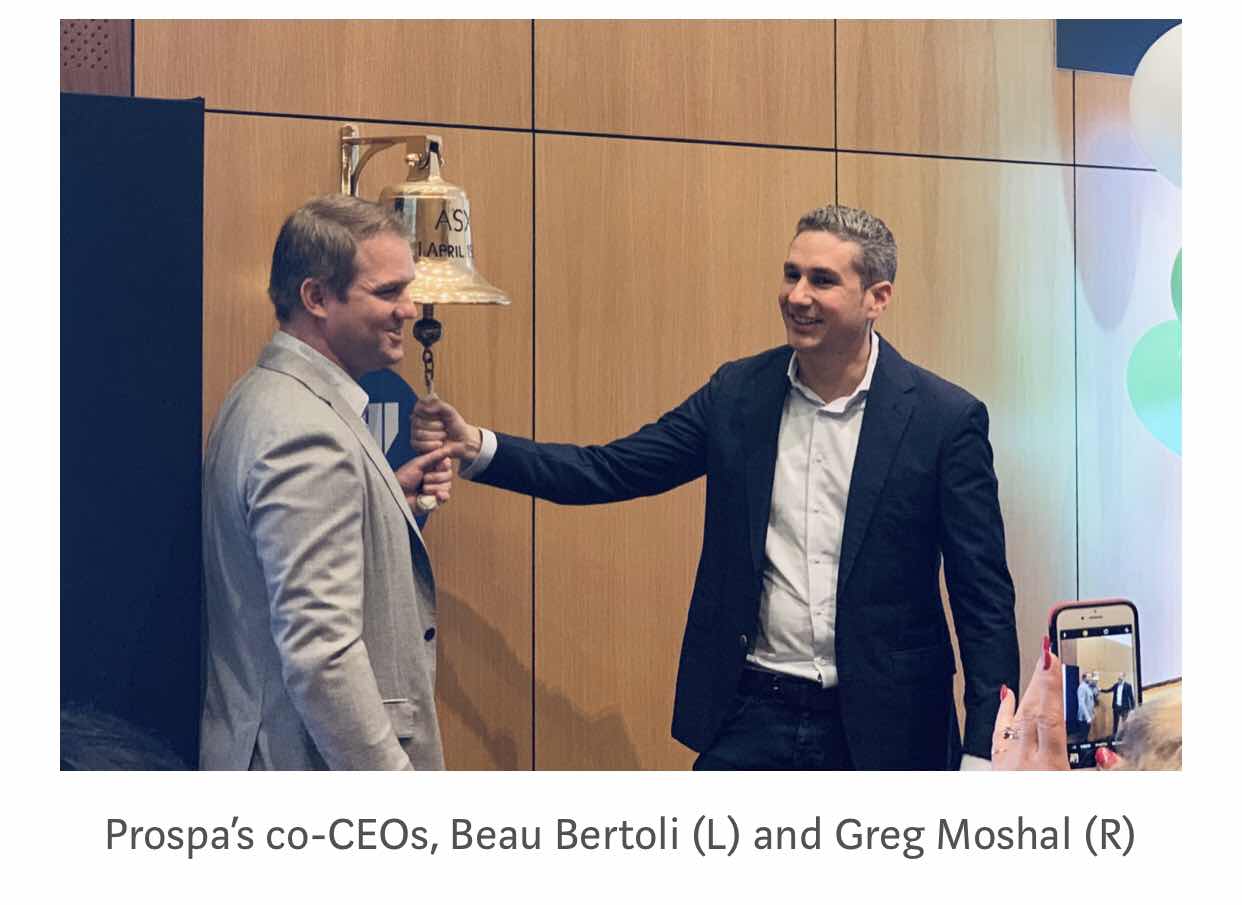
Greg and Beau’s Prospa listed on the ASX closing the day ending up at a valuation of $750m.

It was just the other day that I was on the bus with Greg, who was on the way to work at his start up, where he was developing algorithms to work out the risk of lending money to SMEs .

Prospa  was being backed by their investors  when they had a  team of 30 writing around $26m of loans per year. 

Their mission - to help small business grow by making it easy for them to access money.

7 years later Prospa is now largest online lender to small businesses, lending circa $1b pa (circa. 5pc of the SMe market - employing over 200 people.

The business has a great culture with awesome people who seem to love what they do, and they do it well, and are proud to do it as a team with their core values being teamwork, speed, customer obsession, simplicity and boldness. 

Prospa raised $110 million from investors ahead of the IPO, valuing the company at $610 million. It listed at $3.78 and closed at $4.46, valuing the company at $720m

Airtree Ventures invested circa $30m in the various rounds and today , together with the other shareholders including AustralianSuper and Entree Capital , is their payday! 

This is a big day for Venture Capital in Australia !


Sunday, June 02, 2019

Venture Capital in Australia - finding its straps

Since 2013 , 796 deals in Australian Venture Capital - equating to $4.5b of investment.

Justin Liberman and Paul Bassat’s Square Peg we’re involved in some of the biggest deals in 2018 - 
Deputy’s $111m raise and Airwallex $108m raise 

Some standout success stories in Oz -
Canva
Atlassian 
Afterpay
Zipmoney


Some of my favourites 
  • Referron and BBG 
  • my Recruitment Plus 
  • Solvexia
  • Credi 
  • Redbubble 
  • Retriever

Who are yours? 

AFR - Friday 31 May


8 billionaires have come from the cloud

Inspired by “Meet the billionaires of the new cloud boom - Jordan Novet” | @jordannovet -  - CNBC.com


Robyns’ walking towards the cloud 

The Ozzie Tech  Princes - The co-CEOs of Atlassian are each worth about $8 billion, more than Salesforce's Marc Benioff. These dudes have been joine by Dropbox's Drew Houston, Zoom CEO Eric Yuanto, Toby Lutke from Spotify and Chad Richison from Paycom in Oklahoma,  

The growth in cloud software has created  a number of billionaires writes Jordan Novet of CNBC and this trend is rising.

20 years ago, it was Salesforce leading the charge with its CRM and the cloud software market and Marc Benioff its standout billionaire evangelist. 

Since then, scores of tech companies that make their money selling subscription services have grown quickly, gone public and made at least 8 of their founders billionaires, and these numbers are trending up! 

SAAS is now the way we work - it’s become ubiquitous.

Recurring revenue from collaboration and communication tools (such as REFERRON - watch this space!!) , to accounting software (XERO and MYOB ) to Recruitment  software (My Recruitment Plus ) to security and software for the medical industry, SAAS software is taking over enterprise and legacy systems. 

This is how they do it.... small teams get hooked on their products and then watch them spread more broadly throughout the organization, leading to bigger monthly payments.

Microsoft’s Azure is competing with Amazon’s AWS offering, providing cloud infrastructure so other companies can offload their critical infrastructure.

So, here are the big 8 from the cloud

Scott Farquhar and Mike Cannon-Brookes, Atlassian
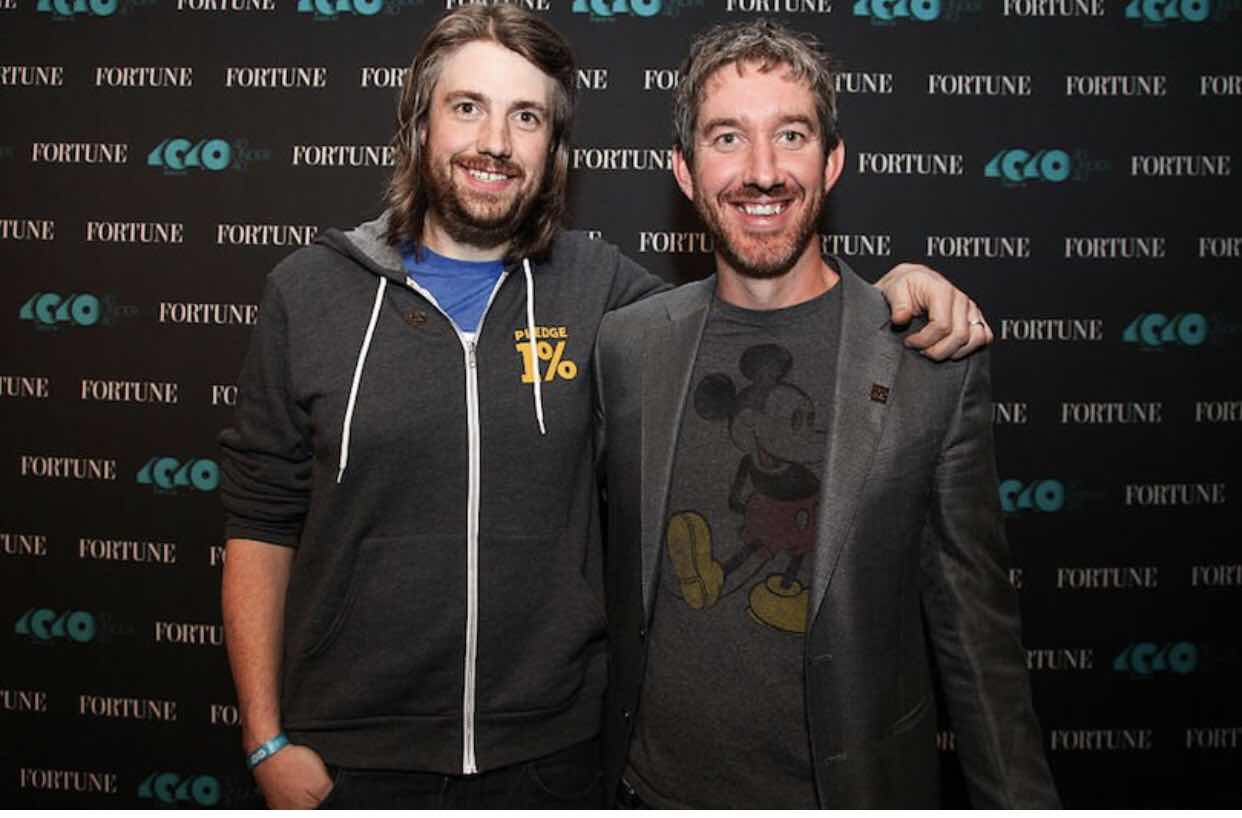

They each own about 63 million shares of Atlassian, which sells software for collaboration, project tracking and code storage. Their holdings were worth almost $8 billion each at market close on Friday, topping Benioff's net worth of about $6.6 billion. Farquhar and Cannon-Brookes were recently crowned by the New York Times as Australia's first tech billionaires.

The pair first met at the University of New South Wales in 1998, started Atlassian in 2002 with $10,000 and took it public in the U.S. in 2015. Along the way, they opened a large office in San Francisco, home to several top executives. 

Atlassian's revenue rose 38% from the prior year, and the share is up 41% in 2019, giving the company a market value of over $30 billion.

Farquhar has said that he and Cannon-Brookes want to provide education for 10 million children over the next decade, focusing on the developing world.

Eric Yuan, Zoom
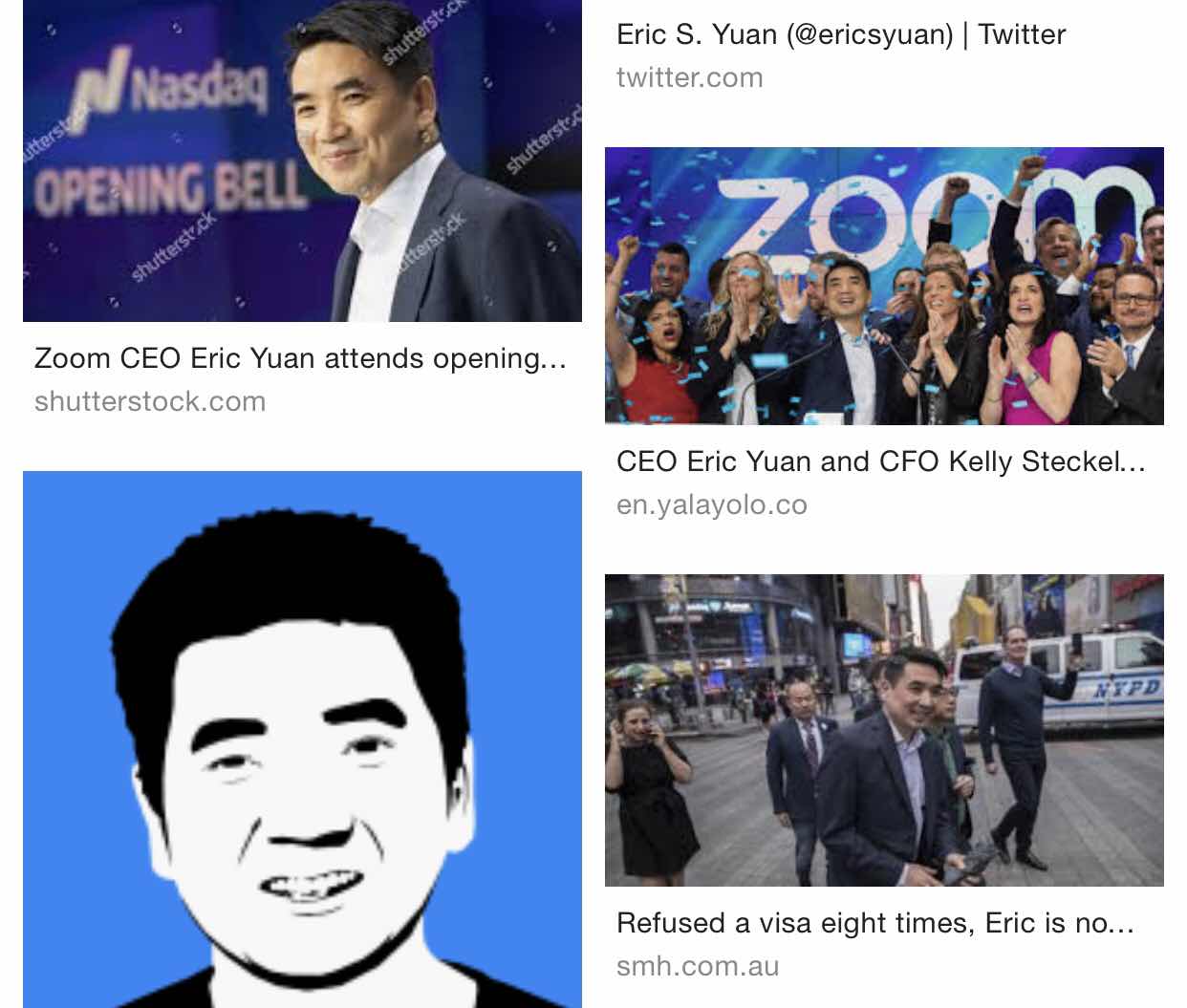

Eric Yuan, founder and chief executive officer of Zoom Video Communications IPO, on the Nasdaq on April 18, 2019. The stock has more than doubled from its IPO price, valuing the company — which is profitable — at over $20 billion.

Eric Yuan - A Chinese programmer who emigrated to Silicon Valley during the dot-com boom, holds close to 47 million shares in Zoom for a stake worth over $3.7 billion.

Before starting Zoom in 2011, Yuan helped build the WebEx video conferencing technology and then joined Cisco through an acquisition. Now Zoom competes with WebEx, and Yuan is more likely to meet with customers over Zoom than in person.

Zoom has a great freemium product, that makes business feel comfortable to upgrade into a paid SAAS


Tobi Lütke, Shopify
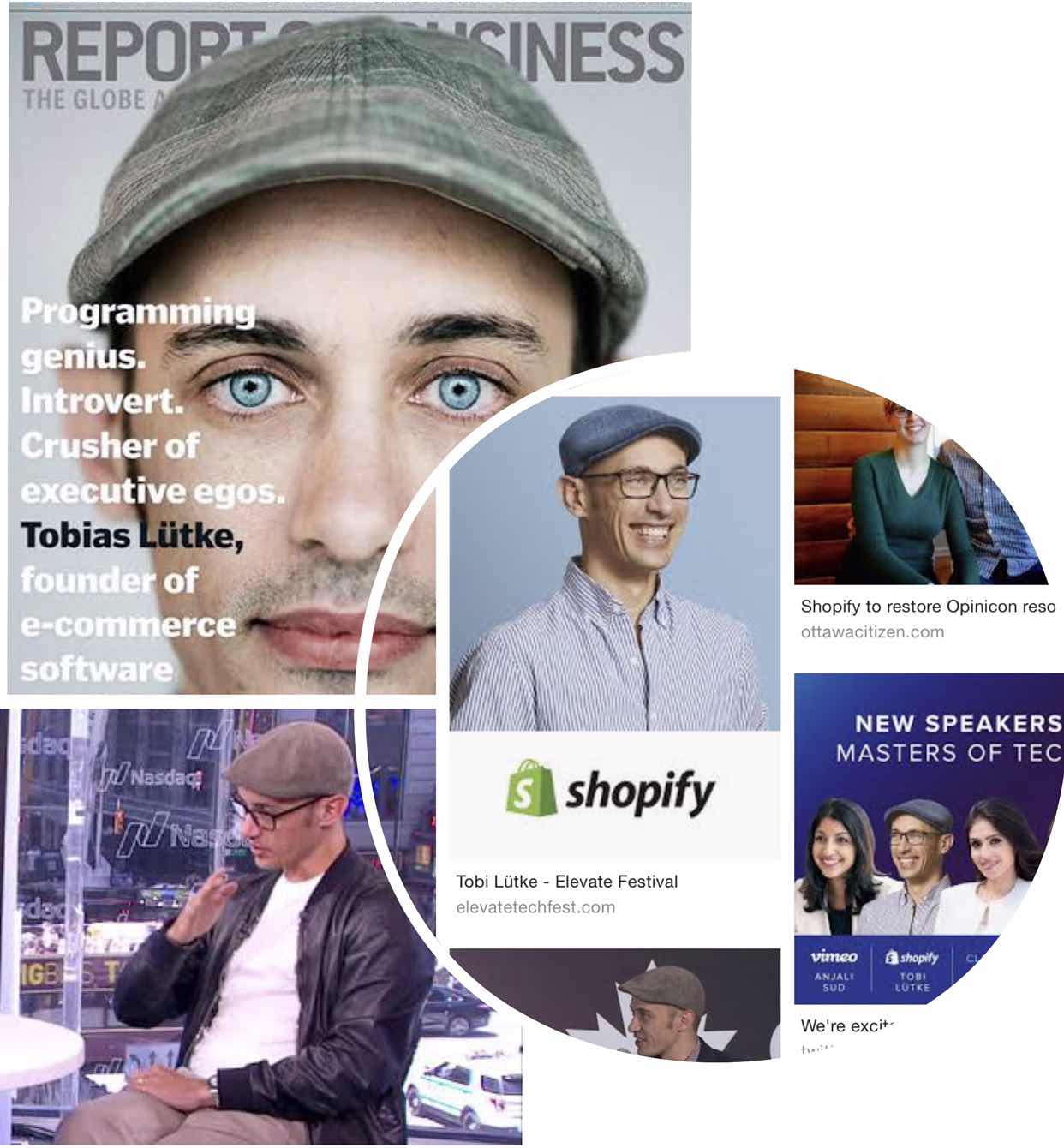

Shopify is based  in the Canadian capital city of Ottawa. 

In 2004, Lütke's task was to write code to sell snowboards online. The store, Snowdevil, opened for business, but Lütke and the team figured it would be a better idea to use what they learned to help the rest of the retail world sell their stuff online.

Shopify went public in 2015. Shares have since climbed more than 1,500%. In the most recent quarter Shopify's revenue nearly doubled, and the company says its software is now used by 800,000 businesses in about 175 countries.

Lütke controls almost 8 million shares worth close to $2.2 billion.

In November, someone on Twitter predicted that Amazon would acquire Shopify in 2019. In response Lütke wrote that he would prefer to buy Amazon in 2029.


Drew Houston, Dropbox


Drew Houston, chief executive officer and co-founder of Dropbox Inc, was  inspired to develop a service for storing files online after realizing he left a USB stick with critical information on it at home. 

Dropbox has racked up half a billion registered users of its cloud syncing and sharing service, and it's become popular with both consumers and business users.

Founded in 2007, Dropbox experienced such a rapid growth spurt in its early years that by 2011 venture investors were already valuing the company at $4 billion. That number hit $10 billion three years later. But the company has had to grow into that valuation and is still struggling to get there.

Dropbox went public in March 2018, with a market cap of $9.3 billion at Friday's close. 

Houston's 94 million shares are worth $2.1 billion.

"We're a little biased, but we think we have one of the most talented teams ever assembled, and we grow stronger every year," he and co-founder Arash Ferdowsi wrote in a letter published just before shares started trading. Ferdowsi didn't quite make the list yet!  — his stake is currently worth less than $850 million.

Peter Gassner, Veeva
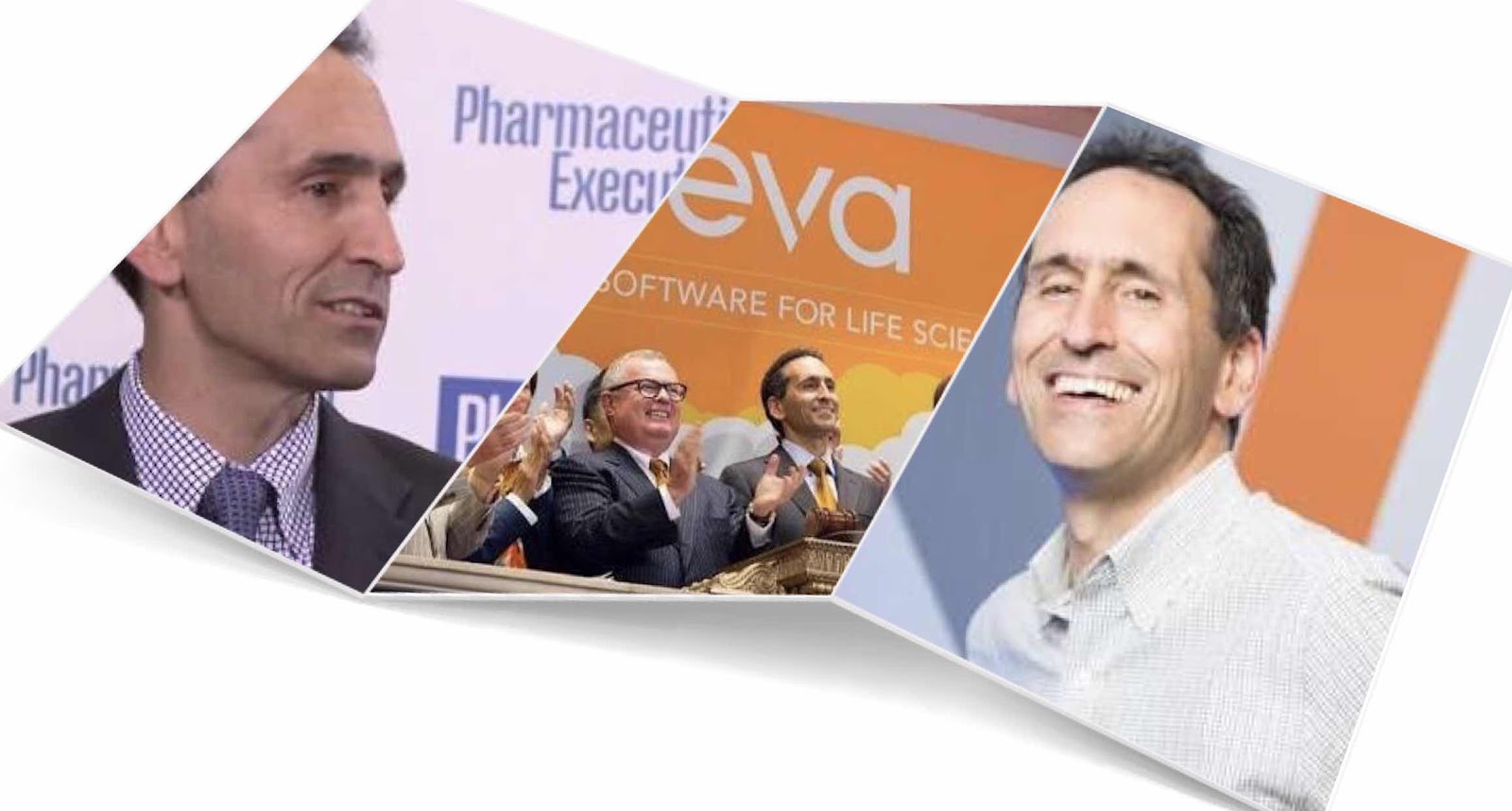

Gassner, co-founded Veeva Systems in 2007, is a veteran of IBM and Salesforce. Veeva focussed on a specific vertical - life sciences and pharma, but has since expanded its offering to a comprehensive suite of tools to the health-care industry.

Veeva was profitable at the time of its IPO in 2013, and its SharePrice  has gone  from $20 to $154.29.

Gassner, who also sits on Zoom's board, holds 13 million Veeva shares, worth just over $2 billion.


Jay Chaudhry, Zscaler



Jay Chaudhry, CEO of Zscaler grew up in a Himalayan village. Today, people in 185 countries use technology from Zscaler, whose cloud-based software helps companies provide secure access to cloud applications.

It's the fifth company he's started and funded.

"My success so far has mainly been because I have very little attachment for money," he told Bloomberg in an interview earlier this year.

Nevertheless, Zscaler has jumped 356% since its IPO in March 2018, giving it a market cap of over $9 billion. 

The 26.8 million shares Chaudhry owns are worth more than $1.8 billion.

Chad Richison, Paycom


Richison founded Paycom in 1998, and runs the cloud-based human capital management software company from Oklahoma City, near where he was born. With more than 2,000 people on staff in Oklahoma, Paycom is one of the largest employers in the state. The company competes with ADP, where Richison previously worked.

Paycom went public in 2014 at $15 a share.

 It closed Thursday at $212.10. Richison's 8 million Paycom shares have a value of about $1.7 billion.


Friday, May 31, 2019

Insight from Paul Bassat - founder of seek

Friday Gem

If you consistently do 3 things you are 90% on the way to having a fantastic career:

1 Do what you say you are going to do

2 Put yourself in the shoes of your customer/boss/partner/colleague & understand what success looks like for them

3 Act with integrity 

The rest is detail


TIE
Trustworthy 
Integrity
Empathy 

Atlassian founders Mike Cannon-Brookes and Scott Farquhar lead tech storming of Rich List

COLIN KRUGER, SMH

https://www.businessinsider.com.au/atlassian-founders-mike-cannon-brookes-and-scott-farquhar-lead-tech-storming-of-rich-list-2019-2019-5/amp


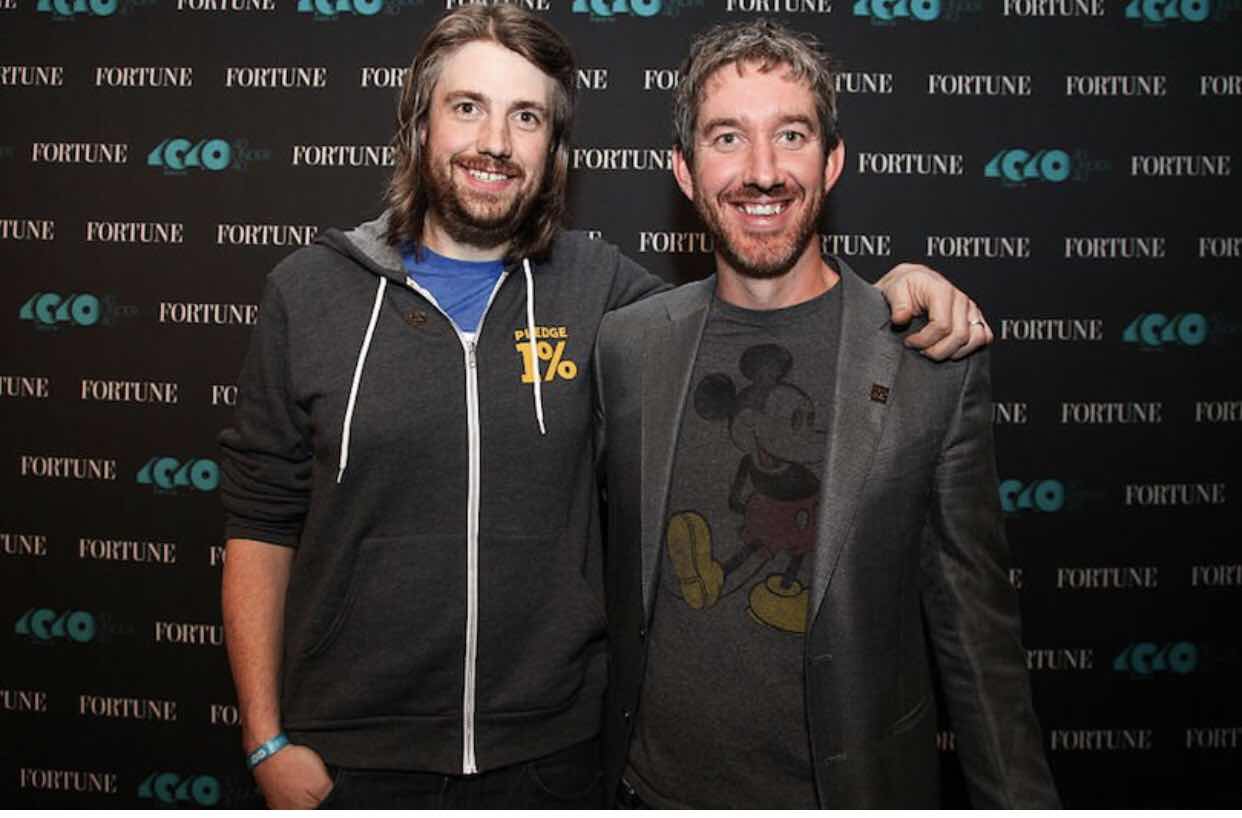
Atlassian co-founders and co-CEOs Mike Cannon-Brookes (L) and Scott Farquhar (R). Photo: Kelly Sullivan/ Getty Images for Fortune.

“Whenever the rich lists come out it’s the worst time of the year,” Atlassian co-founder Mike Cannon-Brookes told Good Weekend magazine last year.

“There’s no upside, only downside. Unless you want to kind of show off in a weird way. But then buy a freakin’ billboard, right?”

So the Atlassian co-founder probably won’t mind that the latest edition of the Australian Financial Review Rich List for 2019 significantly underestimates both his wealth and ranking.

While property is still the path to riches for most of those who made the cut again this year, our tech entrepreneurs have made their presence felt in record numbers. A record 14 tech entrepreneurs made the Rich List this year – and are scaling the heights of the rich list with unseemly haste.

The spiralling stock prices of companies like Atlassian, Afterpay and Wisetech have made it hard for the official tabulators of affluence to keep up.

The biggest leap on the Rich List came from Cannon-Brookes and his Atlassian Scott Farquhar. They nearly doubled their wealth from last year with Farquhar, fifth, pipping Cannon-Brookes, sixth, with a personal wealth of $9.75 billion and $9.63 billion respectively.

Most of their wealth derives from a combined 56 per cent stake in Atlassian, but the Rich List was measured from a 3 month average of the Atlassian share price taken from the first week of April. The stock has soared more than 48 per cent this year and the founder’s stakes in the company alone would currently be worth around $12 billion each.

It means that their actual rank may be as high as two and three on the list, respectively, which was still topped by Anthony Pratt, the head of the Pratt family’s packaging empire Visy, with a $15.6 billion fortune.

If Atlassian’s share price continues to rise at this rate even our cardboard king won’t be safe from the princes of Australia’s tech sector when the next list is unveiled.


And they are not the only ones making such spectacular gains.

Wistetech founder Richard White literally doubled his wealth to $3.31 billion and rose into the top 20 on the list. Afterpay’s astounding success also saw its co-founders make the Rich List this year and at a lower ranking than what the current share price would suggest.

Privately owned Canva flew entirely under the radar for this year’s Rich List as the company’s net valuation soared from $1.3 billion in January last year to $3.6 billion this month after a fresh round of funding from investors.

Based on the way the private rounds of funding usually work, the three founders Melanie Perkins, Cliff Obrecht and Cameron Adams should have a collective net worth comfortably approaching rich list territory, observers believe.

But wealth itself does not seem to be the a big talking point for these new tech stars.

Mr Cannon-Brookes, who declined to comment on Friday, has described his fortune as a merely scoreboard and not something he and Farquhar focus on.

“People never talk about jobs created, or products created, or the impact those products have had on the rest of the world, or any of that sort of thing,” he said last year.

Ms Perkins, the visionary behind Canva and her co-founder Mr Obrecht try and keep things simple. There is no harbour front mansion or glamorous holidays for the couple.

“Cliff and I still travel backpacking. The last couple of years we went horse trekking in Mongolia, staying in yurts in a tree house in Laos,” she said in a recent interview with this newspaper. “It has been really important to get out and see the world. We still love staying in pretty basic accommodation”.

This article was first published by The Sydney Morning Herald. Read the original here.

Thursday, May 23, 2019

Morals of the Zoom Video Communications entrepreneurial fable:

From the famous Susan Guo of Silicon Vslley’s Greylock Partners sharing  8 insights from Zoom 


1/ no market is “done” — even when the alternatives are many, free, have hardware sunk cost, and/or deeply embedded into an enterprise suite ELA


2/ “much, much better” is a sufficient displacement product strategy (VS novel features)


3/ software products can make people more productive — this is inspiring. I can do work more efficiently and happily, because of Zoom


4/ Customer centric culture has to come from somewhere. Here it clearly comes from Eric S. Yuan. Literally every time I see him/hear a story of him, the conversation inevitably ends with “customer happiness” as the guiding principle


5/ Free to users doesn’t preclude a company selling software at enterprise deal sizes


6/ Zoom’s “unit of user value” is 2 —> Infinity (internal & external, huge addressable user base), making it uniquely well suited to bottoms up, viral, WOM adoption


7/ People want good people to win. There are a lot of cynics in Silicon Valley today, but you will be hard pressed to find people who have met Eric and don’t support team Zoom


8/ Congrats to entire Zoom team on this milestone and what I expect will be just the first leg of an extraordinary, enduring company journey — and to my better half Pat Grady for being part of it

Friday, April 19, 2019

Sunday, April 14, 2019

3 things needed to scale a business

Great Insite by Michael Derin 
1. A leadership team
2. An ability to pivot
3. Ability to outsource


It is estimated that 70% of startups struggle with scaling. Getting a product to market and then gaining some initial interest and excitement is hard work, but it really is just the beginning. Once you have a working business and the wheels are churning then you need to be able to scale that business in order to maintain the future of the business.

Here are our top three areas we feel that many CEO’s miss and need to be doing in order to scale successfully.

1. Redefine your CEO role - your company can't rely only on you

While your company may need a CEO, and you may need something to do, you want to design the company to ensure that you aren’t integral. You want to build a leadership team that can function and make decisions without you. This can also help the business be more agile as it removes multiple layers of approval and red tape. If you are controlling everything and need to sign off and approve everything it can significantly delay your progress and speed.

You will find that by empowering your team to make decisions and be agile they will take more responsibility and you will build a strong culture of performance and accountability.

2. Pivot quickly

You might have launched with a great product that is selling well and have a clear direction that you feel you are heading in. However, changes in technology, environment and the market can mean that you need to change direction quickly.

You may see a new opportunity that wasn’t originally in your plan, but could be even more successful that your current direction. In this case you need to be able to pivot and change direction quickly. Agility in business can prevent you from stubbornly continuing down a path just because that is what you planned. You need to be open to change, and being able to do it quickly.

3. Outsource

There are some functions in your business that aren’t critical to the product and customer experience but are important for long term success of your business. We often find that as businesses grow they have a growing need for HR, legal and financial support. These are often lumped into a pile of stuff that you will ‘get to’, but often they aren’t dealt with as quickly as they could and should be.

Outsourcing these areas can ensure that you are getting expert support for the business whilst you personally focus on more critical areas.